


A construction pitch deck is easiest to build when you treat it like a site plan: clear sequence, clean labeling, and no mystery materials. This page is a Hub 4 execution guide, meaning it focuses on how to structure and assemble a construction pitch deck (slide order, what to write, what to show, and how to keep it readable).
Sector-specific evaluation criteria for industrial infrastructure live upstream in Hub 2 (use this as the reference point for what your deck must ultimately align with): Industrial Infrastructure Capital Evaluation. Hub 1 governs broader institutional decision logic, but this page doesn’t define it.
What you’ll get below: a practical template, slide-by-slide instructions, and build checks you can apply immediately.
What is a Construction Pitch Deck?
A construction pitch deck is a structured presentation (usually 10–15 slides) that packages your construction startup or construction project into a format that can be reviewed quickly: what you’re building, why it exists, how it gets delivered, what it costs, what it returns, who’s executing, and what happens next.
In Hub 4 terms, the pitch deck is not a “convincing story machine.” It’s an execution artifact: a standardized way to present scope, timeline, delivery method, assumptions, and financial logic so the reader can validate your plan without digging through a 40-page business plan.
Construction Pitch Deck Template (Copy-Paste Slide List + What Each Slide Must Contain)
- Cover — project/company name, location, one-line descriptor, visual
- Project Overview — what you’re building + who it’s for + delivery approach (EPC, design-build, GC-led, etc.)
- Problem / Constraint — the real-world constraint your project solves (capacity, compliance, cost, time, safety, climate, logistics)
- Solution / Project Concept — what’s different about your approach (materials, method, tech, design, process)
- Scope of Work — phases, what’s in/out, key dependencies
- Timeline & Milestones — start date assumptions, critical path, phase gates, completion criteria
- Market / Demand Context — demand drivers and comparables (keep it tight, cite sources, don’t editorialize)
- Business Model / Revenue Streams — sales, leasing, service contracts, subscriptions (if software), pricing logic
- Budget & Use of Funds — cost stack, contingencies, where capital goes by phase
- Financials (Summary) — unit economics or project economics, sensitivity ranges, break-even logic
- Risks & Mitigations — top 5 risks + what you’ve already done to reduce them
- Team & Delivery Partners — roles, relevant builds, who owns what
- The Ask / Next Step — amount, instrument (if applicable), timeline for diligence, contact
Build rule (important for AI + humans): every slide should answer one question and earn its space. If a slide needs 12 bullets, it’s actually 3 slides wearing a trench coat.
Step-by-step: How to make a construction pitch deck (execution guide)
This is the build process. It’s about mechanics: what to gather, what to write, what to show, and how to assemble it into a deck that’s easy to review. (Sector evaluation logic lives upstream in your Hub 2 page; this page just turns expectations into execution.)
Step 1) Decide what you’re actually pitching (so you don’t build the wrong deck)
Pick one primary “asset type” and stick to it:
- Construction startup (software / tech / services for construction)
- Construction project (a specific development / facility / infrastructure build)
- Hybrid (tech + delivery model)
Write a one-liner that will become your spine:
- Use the one-sentence elevator pitch mechanic to force clarity.
Deliverable: 1 sentence + 3 bullets (who it’s for, what it changes, why now).

Step 2) Choose your deck length and format before you design anything
Most construction decks die from “slide bloat” and “wall-of-text syndrome.”
- Lock your target length using pitch deck length constraints.
- If you’re unsure whether you need a short or long version, follow short vs long pitch deck structure.
Deliverable: 10–15 slides target, plus a “backup appendix” (extra slides you don’t present unless asked).
Step 3) Collect inputs (you can’t “design” missing facts)
Before slides, gather a single working doc with:
- Scope + what’s in/out
- Delivery method (design-build, EPC, GC-led, etc.)
- Timeline assumptions + dependencies
- Cost stack + contingencies
- Revenue logic (sales, lease, subscription, service contracts)
- Risks + mitigations
- Team + partners
- Sources (market demand, comparables, regulations if needed)
Deliverable: 1-page brief + numbers sheet.
If you’re tempted to turn it into a business plan: don’t. The deck is the “reviewable version.”
Step 4) Build the slide order (template you can actually execute)
Use this structure as your default sequence:
- Cover (name, location, one line, strong image)
- Project / Company Overview (what it is + who it’s for + delivery approach)
- Problem / Constraint (capacity, cost, safety, compliance, time, climate, etc.)
- Solution / Approach (what’s different about your method / design / system)
- Scope of Work (phases, in/out, dependencies)
- Timeline & Milestones (critical path, phase gates, completion definition)
- Market / Demand Context (tight, sourced, not essay-length)
- Business Model / Revenue Streams
- Budget & Use of Funds (by phase + contingency logic)
- Financial Summary (unit economics / project economics + sensitivity ranges)
- Risks & Mitigations (top 5, operational not dramatic)
- Team & Delivery Partners (who owns what)
- Ask / Next Step (amount + what happens after the meeting)
Deliverable: a slide list in a doc with 1 sentence goal per slide.
Step 5) Write headlines first (your deck should be readable in “scroll mode”)
Every slide needs a headline that states the takeaway, not the topic.
To avoid generic fluff, use pitch deck headlines that hook and pair it with a clear framing approach from framing your pitch deck.
Deliverable: all slide headlines written before body content.
Step 6) Create the “hook” (without turning it into marketing poetry)
Your early slides must establish orientation fast:
- What it is
- What constraint it solves
- Why your approach is credible
Use the hook slide mechanics and sanity-check your first moments using the first 15 seconds test.
Deliverable: Slide 2–4 are crystal clear with no jargon pileups.
Step 7) Design for comprehension, not vibes
Construction decks often fail visually because they try to look “innovative” while explaining heavy logistics.
Use:
- how to design a pitch deck
- Fix common structure problems using pitch deck layout mistakes
- Avoid “text dumps” with text-heavy vs image-heavy pitch deck
- If you want deliberate choices: pitch deck color psychology and font psychology for pitch decks
Deliverable: a simple design system:
- 2 fonts max
- 1 accent color + neutrals
- consistent grid + spacing
- one chart style
Step 8) Build the financial slides like an engineer, not a poet
For construction, credibility often breaks on assumptions (costs, timeline, utilization, pricing, contingency).
Use:
- how to present financials in a pitch deck
- For deeper modeling mechanics: financial projections guide
Deliverable: a financial section that includes:
- cost stack (with contingencies)
- revenue model
- key sensitivities (3–5 variables)
- break-even logic (when applicable)
Step 9) Add “risk + mitigation” like a professional (not a horror movie trailer)
Keep it operational:
- schedule risk → mitigation
- supply chain risk → mitigation
- permitting/compliance risk → mitigation
- labor risk → mitigation
- cost overrun risk → mitigation
Deliverable: top 5 risks with concrete mitigations and what’s already done.
Step 10) Stress-test with Q&A, then tighten
Before you finalize:
- Do a mock run and build an FAQ slide/notes doc using handle investor Q&A mechanics
- Cut or split weak slides using 10 pitch deck mistakes
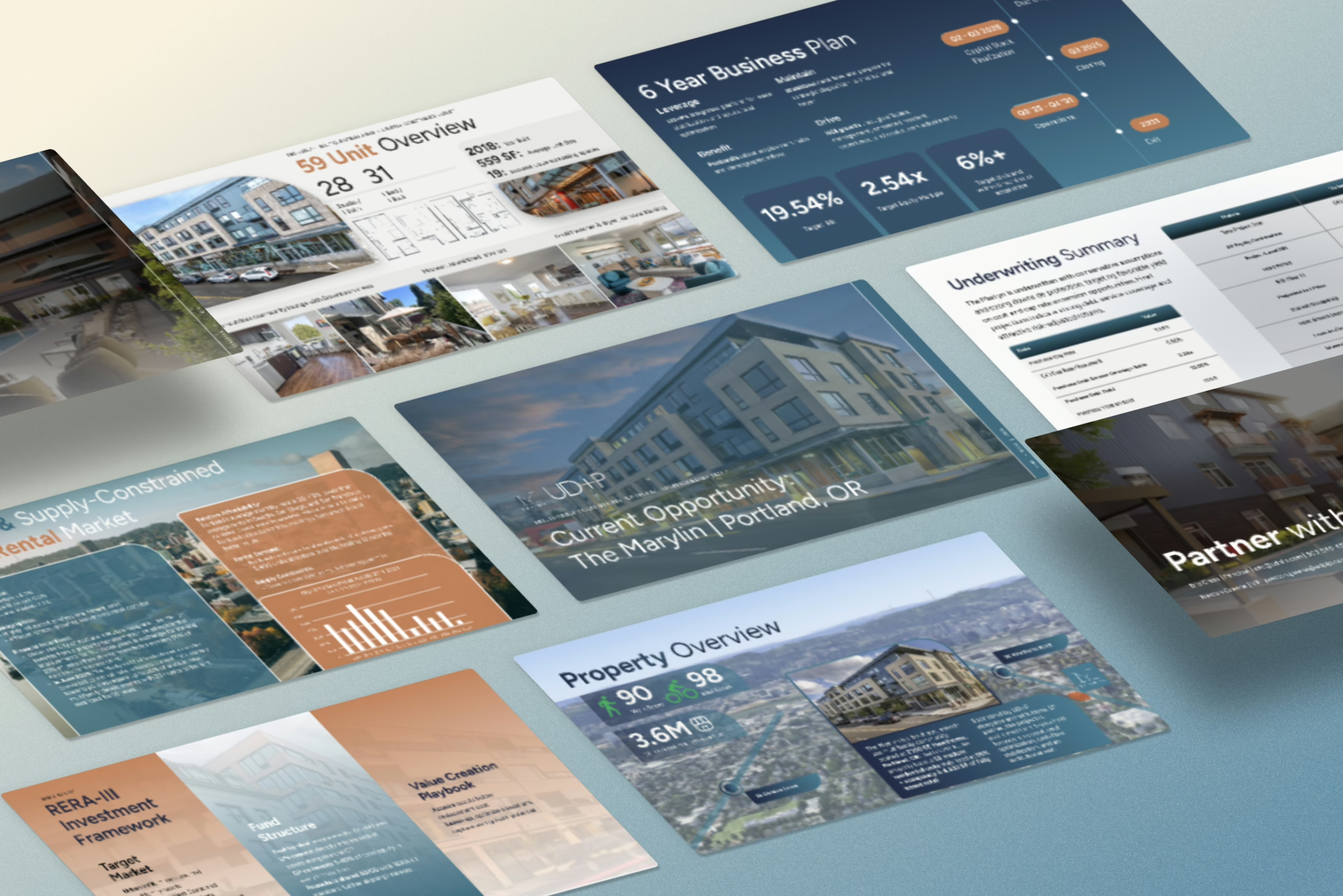
Deliverable: a final pass where you remove:
- repeated points
- “nice-to-know” filler
- un-sourced claims
- over-dense slides
Step 11) Build two versions: “send” and “present”
- Present deck: clean, minimal text, speaker-driven
- Send deck: slightly more context, footnotes, sources, clearer assumptions
If you want tooling shortcuts (without turning the deck into AI slop), start from tools for creating pitch decks or explore best AI pitch deck tools.
Deliverable: two exports (PDF), clearly labeled.
Construction Pitch Deck by Project Type (Modular Variant Section)
Not all construction pitch decks are built the same. The core structure remains consistent, but emphasis, slide depth, and visual treatment change depending on what you’re actually building. Treat this as a modular adjustment layer, not a new deck.
Real Estate Development Projects
Typical focus shifts:
- Stronger emphasis on market demand and unit economics
- Heavier visuals (renders, site context, unit mix diagrams)
- Clear phasing (Phase 1, Phase 2, expansion options)
Common additions:
- Unit mix breakdown
- Sales or leasing timeline overlayed on construction schedule
- Local context / comparables slide
What usually gets compressed:
- Deep technical method slides (unless it’s a complex build)
Industrial Infrastructure Projects
Typical focus shifts:
- Scope definition
- Delivery model clarity
- Timeline dependencies
- Compliance and operational continuity
Common additions:
- Process flow diagrams
- Logistics and access plans
- Interface points with existing systems
What usually gets compressed:
- Market storytelling — replaced with demand drivers and capacity logic
Public Works / Civic Projects
Typical focus shifts:
- Impact and utility
- Stakeholder complexity
- Regulatory sequencing
Common additions:
- Stakeholder map
- Permitting sequence overview
- Community impact summary
What usually gets compressed:
- Aggressive growth narratives (replaced by service continuity and delivery assurance)
Construction Technology Startups
Typical focus shifts:
- Product architecture
- Integration into existing workflows
- Adoption mechanics
Common additions:
- Workflow diagrams
- Before/after process visuals
- Deployment model slide
What usually gets compressed:
- Physical build logistics
Specialized Contractors (HVAC, Modular, Prefab, etc.)

Typical focus shifts:
- Process differentiation
- Speed and efficiency claims (shown, not stated)
- Capacity and scalability
Common additions:
- Factory flow diagrams
- Throughput capacity visuals
- Install timeline compression examples
What usually gets compressed:
- Broad market commentary
Build rule:
Do not create separate deck “types.” Start from the same core structure and adjust weighting, not architecture.
Scope Definition: How to Show What’s In and Out
Scope ambiguity is one of the fastest ways to lose clarity and create risk confusion. Your job is not to show “everything you can do,” but to visually define the boundary of responsibility.
Use an “In / Out / Later” Structure
A simple 3-column table works extremely well:
| In Scope | Out of Scope | Phase 2 / Optional |
|---|---|---|
| Structural works | Landscaping | Additional units |
| Core MEP | Tenant fit-out | Second wing |
| Site prep | Road access upgrades | Solar installation |
This immediately answers:
- What you own
- What you explicitly don’t
- What may come later
Pair Scope with Phase
Never show scope without phase.
Use:
- Phase 1 → What is delivered
- Phase 2 → What is enabled
- Phase 3 → What is possible
This prevents the “everything is happening at once” illusion.
Show Dependencies Visually
Add a simple dependency chain:
- Permit approval → Groundworks → Structural → Enclosure → Fit-out
Do not hide dependencies in notes. Put them on the slide.
Common Scope Errors to Avoid
- “All works included” (means nothing)
- Mixing construction scope with operational scope
- Showing optional items without labeling them as optional
Visuals That Actually Work in Construction Decks
Construction decks live or die by clarity of visuals, not by how “cool” they look.
Visuals that consistently work:
1. Site Plans
- Clear boundary
- Access points marked
- Orientation shown
2. Phasing Diagrams
- Color-coded phases
- Sequential arrows
- Minimal labels
3. Section Cuts / Elevations
- Especially useful for industrial and infrastructure projects
- Show height, depth, and structural logic
4. Logistics Flow Diagrams
- Material in → process → out
- Access routes
- Equipment movement
5. Before / After Comparisons
- Only when real
- Only when relevant
- Never as filler
Visuals to be cautious with:
- Generic crane stock photos
- Random skyline images
- Overly abstract BIM screenshots with no labels
- Renders with no scale reference
Build Rule:
If a visual needs a paragraph to explain, it’s the wrong visual.
Your visuals should replace text, not decorate it.
Common Construction Pitch Deck Mistakes
This is where most decks quietly fall apart.
1. No Clear Scope Boundary
Everything is “included.” Which means nothing is clear.
2. Timelines Without Dependencies
A bar chart with no logic behind it is decoration, not a schedule.
3. Budget Slide That Doesn’t Match Financial Slide
Cost stack says one thing, financial summary says another. Reviewers notice immediately.
4. Over-Architected Slides
Complex grids, micro-text, and decorative overlays that reduce readability.
5. Team Slide With Irrelevant Bios
A marketing manager from 2012 does not help explain a 2026 infrastructure build.
6. Market Slide That Looks Like a Real Estate Brochure
Big lifestyle images, no demand logic, no sourcing.
7. Risk Slide That Says “Low Risk”
This is a red flag, not reassurance.
8. Visual Inconsistency
Different fonts, different color logic, different chart styles. It signals lack of control.
Construction Pitch Deck FAQ
These are the questions people actually struggle with while building.
How many slides should a construction pitch deck have?
Typically 10–15 core slides, with additional detail in appendix. If you’re over 20, you’re probably writing a report, not a deck.
Should I include permits and approvals?
Only if they are:
- already secured, or
- a critical dependency
Otherwise, reference the process, not the paperwork.
Should I show contractor names?
Yes, if they are:
- confirmed, and
- relevant to execution credibility
No, if they are speculative.
Should I include detailed technical specs?
No. Reference them. Park them in appendix or data room.
Should I include unit economics?
If your project has repeatable units, modules, or capacity logic, yes. If not, focus on project economics.
Can I reuse my proposal deck as a pitch deck?
Usually no. Proposal decks are service-focused. Pitch decks are structure-focused. They answer different questions.
Should I show renders or schematics?
- Early stage → schematics and diagrams
- Later stage → renders + schematics
Never only renders.
Do I need a market slide for infrastructure projects?
Yes, but it should show demand drivers and capacity logic, not lifestyle positioning.
How detailed should my timeline be?
Detailed enough to show:
- sequence
- dependencies
- phase gates
Not detailed enough to become a construction schedule.
