


Mining decks don’t fail because the rock is bad. They fail because the pitch deck presentation forces reviewers to “figure it out.” This guide is a practical, execution-first walkthrough for building a mining business pitch deck that’s easy to scan, hard to misread, and structured slide-by-slide so your story survives first-pass review.
You’ll get a clear slide order, what to include in each section, and how to present technical + commercial info without turning your deck into a geological novel. If you want the upstream lens this execution is designed to satisfy, reference the industrial / infrastructure evaluation context once, then come back here to build.
What is a mining pitch deck?
A mining pitch deck is a short, structured pitch deck that summarizes your project so stakeholders can evaluate it quickly: what you’re mining, where, how the operation works, what it costs, what it returns, and what risks are controlled. Think of it as a decision-friendly snapshot — not a data room — where each slide exists to clarify one claim (resource, plan, economics, ESG, team, or timeline) in a format that can be checked fast.
Step-by-step guide: how to build a mining pitch deck
This is a practical build guide for creating a mining pitch deck from scratch. It focuses on structure, slide order, content depth, and formatting decisions so that the pitch deck presentation is readable, coherent, and technically legible. It does not explain capital decision logic or investor psychology. It explains how to construct the deck so it can be reviewed without friction.
Step 1: Decide the purpose and length of the pitch deck before designing anything
Before opening PowerPoint, Google Slides, Figma, or any other tool, you need to define what this pitch deck is supposed to do. Mining pitch decks often fail because they are built without a clear review context, resulting in decks that are too dense for first review and too shallow for serious discussion.
At a practical level, you are usually choosing between:
- a short introductory pitch deck (10–12 slides),
- a core narrative pitch deck (12–15 slides),
- or a core pitch deck with a technical appendix.
Deck length should be a function of stage, not ambition. If you are unsure how length shifts by stage, this breakdown on pitch deck length explains how structure and density change depending on context.
Once the length is defined, do not change it halfway through. All structural decisions depend on this.
Step 2: Write the single sentence that defines the project
Every mining pitch deck needs a single, plain-language sentence that describes what the project actually is. Not the vision, not the upside, and not the strategic narrative, but the factual identity of the project.
This sentence should include:
- the commodity,
- the location,
- the stage of development,
- and the commercial intent.
This is the same discipline described in the one sentence elevator pitch framework, but applied internally as a structural filter, not as marketing copy.
Every slide in your pitch deck should support, clarify, or evidence this sentence. If a slide does not, it is usually noise.
Step 3: Define the core claims the pitch deck must support
A mining pitch deck is not a document. It is a sequence of claims with supporting evidence. Before building slides, write down the five to seven core claims your deck must make.
In most mining pitch decks, these claims usually relate to:
- the asset being real and defined,
- the development plan being executable,
- the economics being coherent,
- the market path existing,
- ESG and permitting being managed,
- the team being capable,
- and risks being understood.
These claims will later become your slide headlines. This discipline sits inside proper pitch deck framing and prevents the narrative from drifting once content is added.
Step 4: Assemble the evidence before building slides
Before you design anything, collect the materials that will support your claims. This usually includes:
- a location map and concession boundary,
- a resource or grade summary table,
- a high-level development timeline,
- an economics snapshot (CAPEX, OPEX, unit economics),
- a risk and mitigation table,
- a permitting and ESG status summary,
- and team execution proof.
If you find yourself writing paragraphs to explain a chart, the chart is wrong. If you cannot summarise something visually, it likely belongs in the appendix. This discipline is part of the art of simplification and is especially important in technically dense mining decks.
Step 5: Build the pitch deck slide structure in a fixed order
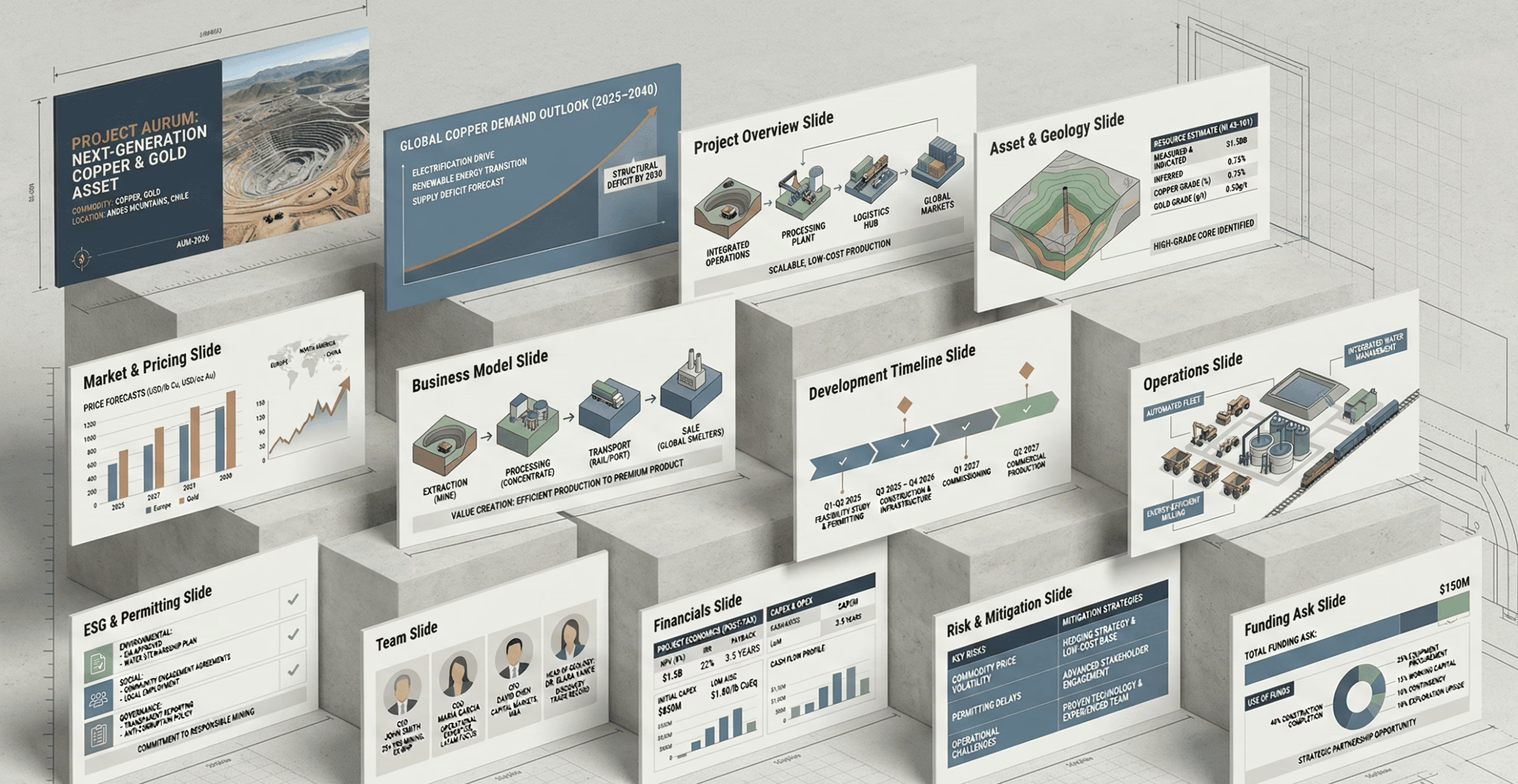
Once the purpose, claims, and evidence are clear, you can build the pitch deck slide structure. This is a standard, execution-safe order for a mining pitch deckSlide 1 – Title and project snapshot
Include the project name, commodity, location, and stage. One visual is enough. The goal is orientation, not impact.
If you want to refine how this opening slide works structurally, this breakdown of the hook slide explains how first impressions are formed in decks.

Slide 2 – Opportunity and demand context
Explain why this project exists in the first place. This is not a market essay. Two or three bullets and one data point are enough.
If this slide feels vague, it is usually because the problem–solution slide structure is not clear.
Slide 3 – Project overview
Describe what you are actually building. Mine type, development approach, and what “operational” means in this context. Avoid technical depth here.
This is a positioning slide, not an engineering slide.
Slide 4 – Asset and geology snapshot
One map, one table. The goal is to make the asset understandable in under thirty seconds. Avoid dumping drill logs or long technical descriptions.
This is where many technical founders make pitch deck mistakes by overloading detail.
Slide 5 – Market and pricing context
Show where demand comes from, who typically buys this material, and how pricing is generally referenced. Do not turn this into a commodity thesis.
If this slide becomes cluttered, review common TAM slide mistakes and simplify.
Slide 6 – Business model
Explain how money is made. Offtake logic, sales channels, pricing structure. This is not a revenue forecast, it is a structural explanation.
If this slide feels hand-wavy, it usually suffers from revenue mistakes in pitch decks.
Slide 7 – Development plan and timeline
Show the path from today to production. Milestones, phases, and key transitions. One timeline graphic is usually enough.
Avoid overly detailed Gantt charts. They reduce readability.
Slide 8 – Operations overview
Describe how the mine will actually run. Mining method, processing approach, logistics, key inputs such as power and water.
This is not a process engineering diagram. It is an operational overview.
Slide 9 – ESG and permitting status
State what is required, what is done, and what is pending. Keep it factual and procedural.
Avoid marketing language. This is an execution status slide.
Slide 10 – Team and partners
Show who is responsible for delivery. Focus on relevant experience, similar projects, and operational credibility.
This is where many decks fall into biography mode. Avoid that. If needed, review how value proposition slides and team credibility intersect structurally.
Slide 11 – Financial projections
Summarise CAPEX, OPEX, unit economics, and base-case outputs. The goal is to show shape, not detail.
If you are unsure how to present this cleanly, this guide on how to present financials in a pitch deck walks through layout and hierarchy.
Slide 12 – Risks and mitigation
List the main risks and how they are handled. This should read like an operational control map, not a legal disclaimer.
This is one of the areas most affected by pitch deck mistakes by stage.
Slide 13 – Funding ask and next step
State what is being raised, what it is for, and what happens next. No drama, no urgency, no emotional language.
If this slide feels awkward, it is often because of persuasion in pitch decks leaking into what should be a procedural close.
Step 6: Control visual hierarchy before adding detail
Mining decks often fail visually because everything is treated as equally important. Before adding data, define what the eye should land on first, second, and third.
This is where visual design errors founders make in pitch decks and pitch deck layout mistakes become relevant. Clarity always beats density.
Step 7: Decide whether the deck is text-heavy or image-heavy
You need to choose deliberately whether your pitch deck is primarily visual, primarily textual, or balanced. This is not aesthetic. It is cognitive.
If you are unsure how to strike that balance, this breakdown of text-heavy vs image-heavy pitch decks is useful.
Step 8: Review the deck as a sequence, not as individual slides
Once all slides are in place, read the deck from start to finish without stopping. Look for:
- jumps in logic,
- unexplained terms,
- missing transitions,
- assumptions that are not introduced before being used.
Most issues here come from content mistakes in pitch decks rather than design problems.
Step 9: Trim, simplify, and remove before polishing
Before refining visuals, remove anything that:
- repeats information,
- adds narrative but no clarity,
- belongs in an appendix.
This is also where decks start to look templated if you are not careful. If that happens, review common deck mistakes that make your pitch look templated.
Step 10: Only then refine design and formatting
Once structure and content are stable, you can refine layout, spacing, alignment, and consistency. If you do this earlier, you will redesign the same slides multiple times.
This is the point where how to design a pitch deck becomes practically usefulHow to choose the right pitch deck template for a mining project
A mining pitch deck template should be selected based on structural capability, not visual trend. Mining projects require space for maps, tables, timelines, and technical summaries, and many generic startup templates collapse when asked to carry this type of content.
When evaluating a template, you should look for a consistent grid system that can support both text and data, flexible content blocks that allow resizing without breaking alignment, and enough white space to prevent dense information from becoming unreadable.
Templates designed for SaaS or consumer products often prioritise large imagery and short text blocks, which works poorly for mining. You will spend more time fighting the layout than building the deck.
If you need a practical overview of which platforms and templates handle technical density best, the guide on tools for creating pitch decks explains the trade-offs between control, flexibility, and usability in detail.
The goal is not to find a visually impressive template. The goal is to find one that does not obstruct clarity.
How to avoid visual design errors in technical pitch decks
Mining pitch decks often fail visually not because the design is weak, but because the hierarchy is wrong. When everything is given equal visual weight, the reader is forced to work too hard to understand what matters.
Common execution errors include inconsistent alignment between slides, overuse of decorative icons, and dense text blocks that compete with charts and visuals. These issues increase cognitive load and reduce comprehension, even when the underlying content is strong.
A technically credible deck is one where the eye is guided intentionally. The reader should always know where to look first, second, and third. This is not an aesthetic preference, it is a functional requirement.
A detailed breakdown of visual design errors founders make in pitch decks and common pitch deck layout mistakes provides concrete examples of where these problems typically appear.
How to structure slides so they are readable by non-technical reviewers
Not everyone reviewing a mining pitch deck will have a geology, engineering, or mining operations background. That does not mean simplifying the project, but it does mean structuring slides so that technical content can be followed without specialist knowledge.
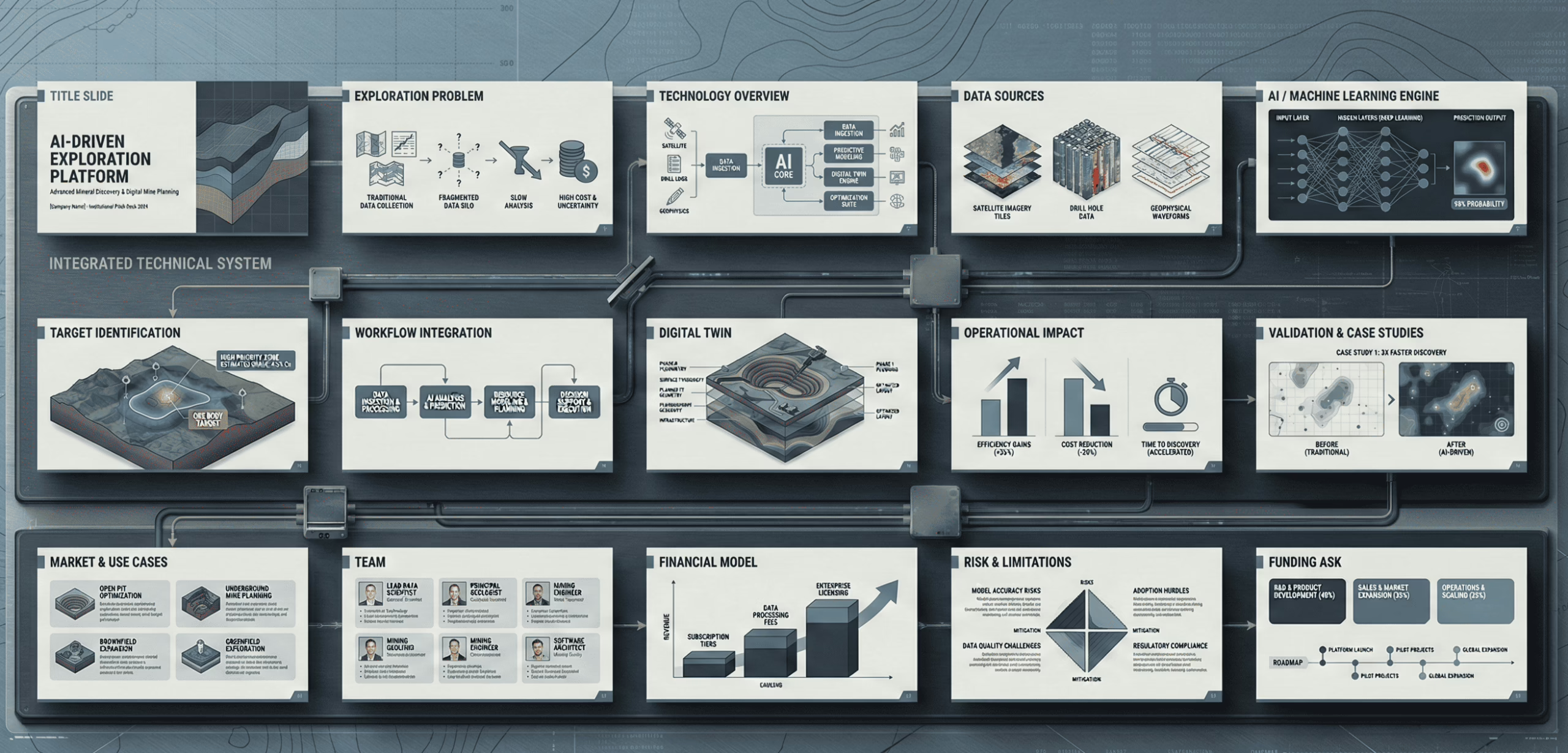
This requires defining technical terms the first time they appear, avoiding stacked acronyms, and ensuring that every chart or table has a clear takeaway sentence. The most common failure is assuming shared knowledge, which leads to slides that are internally logical but externally opaque.
Structuring content for clarity is covered in pitch decks for non-technical investors, which can be used here as a formatting and sequencing reference rather than a persuasion guide.
How to present complex data without overwhelming the slide
Mining projects generate large volumes of data. The problem is rarely lack of information. The problem is density.
A practical rule is that if a slide requires verbal explanation to be understood, it is overloaded. If a slide requires footnotes to be understood, it belongs in the appendix.
You should be deciding deliberately when to summarise and when to detail. Not everything needs to sit on the main narrative path. Over-compressed slides reduce clarity rather than increasing efficiency.
This discipline is central to the art of simplification and is reinforced by guidance on 3 pitch deck slides to split when information density becomes unmanageable.
How to avoid content mistakes that weaken technical credibility
Many mining pitch decks lose credibility not because the data is wrong, but because the language is vague, the claims are unanchored, or the transitions are missing.
Typical execution mistakes include using phrases like “significant potential” without definition, referencing studies or reports without context, and jumping between topics without structural bridges. These patterns create the impression of hand-waving even when the underlying work is solid.
The breakdown of 11 content mistakes in pitch decks: too much, too little, too vague applies directly to mining decks and highlights where credibility is usually lost.
How to prevent your mining pitch deck from looking templated
In mining, templated decks are especially damaging because they signal lack of project specificity. Reviewers can usually tell within a few slides whether a deck was adapted from a generic structure or built around the actual asset.
Templated decks often show up through repeated stock imagery, generic section headings, and layouts that do not match the type of content being shown. When the structure does not reflect the project, credibility drops.
To avoid this, the structure should be adapted to the asset, not the asset to the structure. This means resizing sections, changing slide order where necessary, and allowing the project itself to drive layout decisions.
Common patterns that cause decks to look generic are outlined in deck mistakes that make your pitch look templated.
How to adapt a mining pitch deck for different audiences without rewriting it
Mining pitch decks are often reused across multiple conversations with partners, financiers, strategic buyers, regulators, and advisors. The mistake is rewriting the entire deck each time.
A more efficient execution approach is modular adaptation. This involves expanding certain slides, compressing others, and adjusting order based on the audience. For example, an operational partner may focus more on development plan and logistics, while a financial partner may focus on economics and timeline.
This process is covered structurally in how to tailor a pitch deck for different investors and pitch decks for international investors, both of which apply as execution guides rather than strategy frameworks.
How to prepare the mining pitch deck for Q&A without adding more slides
The goal is not to add slides for every possible question. The goal is to structure the main deck so that common questions are already partially answered.
This is achieved by clarifying assumptions, showing clean transitions between sections, and using the appendix strategically. If the same questions come up in every meeting, it is usually a structural issue, not a communication issue.
Execution guidance on this approach is outlined in how to handle investor Q&A and applies directly to mining decks.
How to use AI tools when building a mining pitch deck without breaking structure
AI tools can be useful in drafting, summarising, and formatting, but they should not be used to define structure. Structure should always come from project logic, not from pattern generation.
Appropriate uses include summarising reports into slide-ready language, rewriting dense text into clearer form, and generating first drafts of explanations. Inappropriate uses include letting AI define slide order, invent technical content, or compress complex material without review.
This is covered in best AI pitch deck tools and ChatGPT pitch deck, which focus on tooling rather than automation hype.
How to check the mining pitch deck for stage-appropriate structure
A mining project evolves, and the deck should evolve with it. Early exploration decks should not look like development decks, and development decks should not look like production decks.
Structurally, this affects depth of geology, detail of economics, specificity of timelines, and certainty of permitting. If the structure does not match the stage, the deck feels either premature or evasive.
Stage alignment is addressed in pre-seed vs series A, early stage vs late stage fundraising, and pitch deck mistakes by stage, all of which apply structurally.
How to ensure the mining pitch deck does not fail in the first 15 seconds
The first three slides establish whether the deck will be read carefully or skimmed defensively. This is not about being dramatic. It is about establishing context quickly.
The title slide must clearly identify the project. The opportunity slide must explain why the project exists. The overview slide must explain what is being built. If these three slides do not form a coherent sequence, the rest of the deck is uphill.
This is addressed in the first 15 seconds test and reinforced by pitch deck headlines that hook.
How to final-check the mining pitch deck before sharing
Before sharing the deck, a procedural check should be run rather than an aesthetic one.
This includes verifying slide order, checking for missing transitions, ensuring terminology is consistent, and confirming that appendix material is clearly separated. Most last-minute issues fall into known patterns.
These patterns are covered in 10 pitch deck mistakes and pitch deck mistakes technical founders make and should be reviewed as a final quality gate.
