


This page explains how institutional capital evaluates industrial and infrastructure investment eligibility through a sector-specific lens. It applies the universal capital decision logic already established at the institutional level, and shows how that logic expresses itself when reviewing infrastructure assets, infrastructure projects, and long-duration physical systems. This is not execution guidance, not a guide to raising capital, and not an explanation of how to structure proposals. It describes how evaluators think, what constrains their decisions, and where infrastructure investment fails under review. Authority for universal capital logic remains upstream; this page exists only to show how that logic manifests in the infrastructure sector.
Sector Evaluation Context: Why Infrastructure Investment Is Treated Differently
Infrastructure investment occupies a distinct position within institutional portfolios because it combines physical irreversibility with long investment horizons. Unlike operating businesses, infrastructure assets—energy infrastructure, transmission infrastructure, data infrastructure, trade infrastructure—cannot pivot quickly, exit cheaply, or reprice risk dynamically.
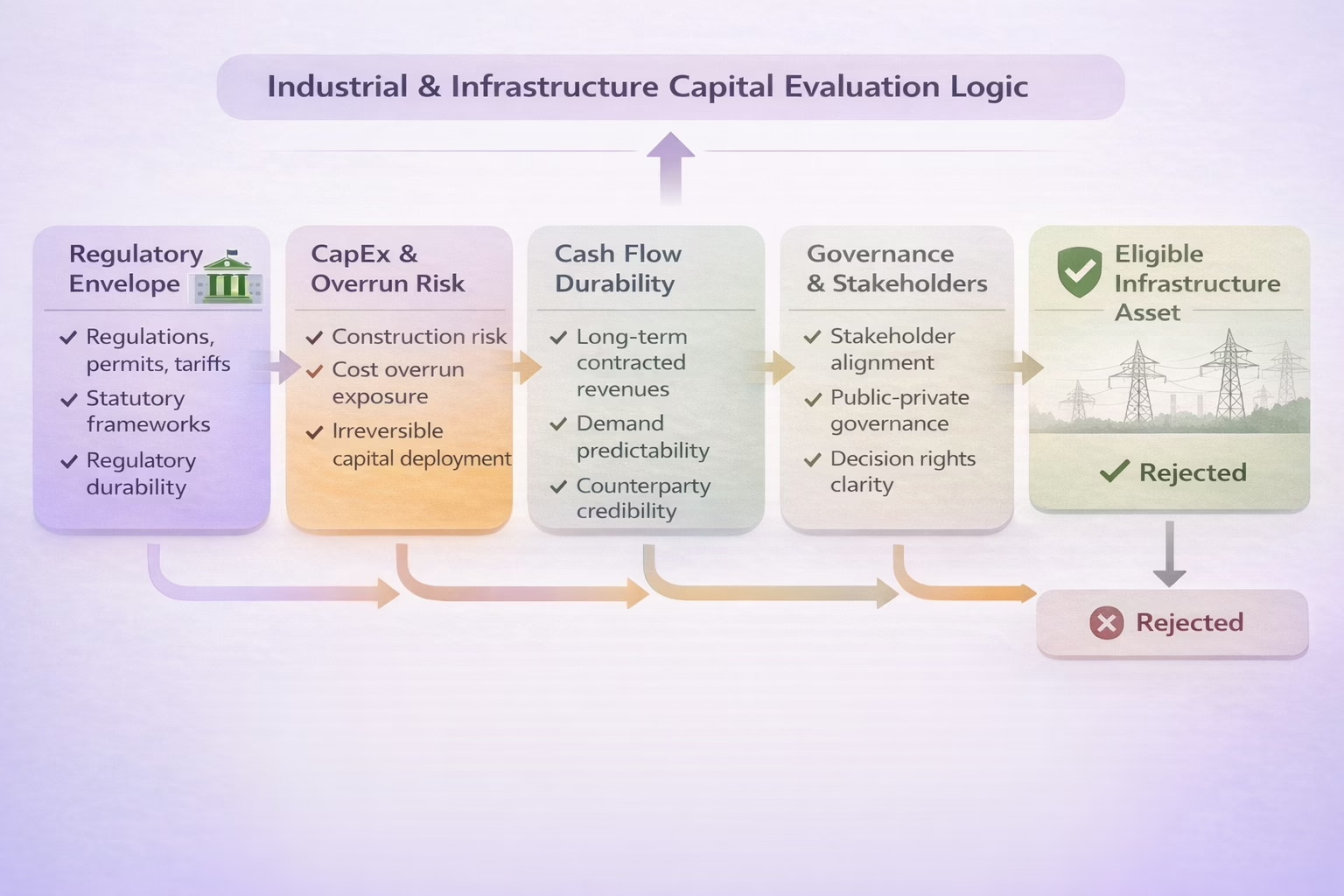
For infrastructure investors, risk is non-linear. Capital expenditure is front-loaded, cash flows are extended and predictable only if assumptions hold, and downside scenarios often involve regulatory intervention, cost overruns, or stakeholder conflict rather than market competition. As a result, infrastructure investing is less about growth optionality and more about containment of failure modes across decades, not quarters.
Regulatory Exposure as a Primary Investment Filter
Institutional investors treat regulatory exposure as a gating condition, not a variable to optimize. Infrastructure projects exist inside regulatory envelopes that define tariffs, access rights, environmental constraints, tax credits, and permitted returns. These frameworks are not negotiable at the asset level.
Projects typically fail this filter when valuation assumes regulatory stability without evidence of regulatory durability. Reviewers discount investment potential when infrastructure development depends on future rulemaking, discretionary approvals, or political goodwill rather than established statutory regimes.
Cash Flow Predictability and Valuation Discipline
Infrastructure valuations depend on stable and predictable cash flows, not narrative upside. Discount rates reflect perceived durability of demand, counterparty quality, and exposure to overrun or renegotiation. Infrastructure has historically justified lower risk premiums only when cash flow visibility is contractual, regulated, or otherwise structurally enforced.
Evaluation failure occurs when projected cash flows resemble operating business forecasts rather than infrastructure asset behavior. Overreliance on demand growth, urbanization and demographic shifts, or technologies such as AI without binding offtake, capacity payments, or long-term contracts typically triggers rejection.
Capital Expenditure, Overrun Risk, and Downside Containment
Capital expenditure is the irreversible moment in infrastructure investment. Once deployed, private capital is exposed to construction risk, supply chain disruption, and cost overruns that cannot be diversified away at the project level.
Investment committees expect evidence that overrun risk has been structurally constrained, not merely estimated. Projects fail when capex assumptions rely on optimistic benchmarks, incomplete engineering, or contingent funding structures that shift risk back to capital partners under stress.
Stakeholder and Governance Expectations
Infrastructure assets operate within complex stakeholder environments: regulators, municipalities, end users, labor, and often joint ventures with public entities. Governance failures propagate directly into asset impairment.
Infrastructure investors discount projects where stakeholder alignment is assumed rather than demonstrated. Weak governance frameworks, unclear decision rights, or unresolved public-private boundaries are treated as latent liabilities, regardless of headline investment strategies.
Sector-Specific Failure Modes in Infrastructure Capital Evaluation
Infrastructure projects are commonly rejected for structural reasons rather than poor presentation. Typical failure modes include mispriced regulatory risk, insufficient downside containment, dependence on future infrastructure spending rather than existing infrastructure, and valuation frameworks that ignore aging infrastructure realities.
Notably, these failures are rarely fixable late in review. They reflect asset characteristics, not messaging gaps.
Role of Artifacts in Infrastructure Investment Review
Pitch decks, financial models, and technical documentation function as validation artifacts in infrastructure investing. They are used to verify assumptions, test internal consistency, and confirm alignment with infrastructure investor expectations.
These artifacts can validate that infrastructure projects meet capital allocation criteria. They cannot change regulatory exposure, compress construction timelines, or convert speculative demand into predictable cash. In this sector, documents confirm eligibility; they do not create it.
Connection to Universal Capital Logic
Industrial and infrastructure capital evaluation applies the same institutional logic used across asset classes—eligibility, risk containment, governance, and portfolio fit—but expresses it through physical assets, long horizons, and constrained exit paths. The sector’s distinctiveness lies in how irreversible capital investment amplifies universal decision filters, rather than replacing them.
To understand the underlying decision framework that governs all institutional asset classes—including why these constraints exist in the first place—refer back to the core institutional capital allocation logic.
