


Institutional capital evaluates energy and climate investments through a sector-specific lens shaped by infrastructure dependency, regulatory exposure, and long-horizon resilience requirements. This page explains how investment committees, credit panels, and allocators assess eligibility and downside in the energy and climate sector by applying the universal capital allocation logic defined upstream. It does not explain how to raise capital, how to structure proposals, or how to persuade decision-makers. All foundational capital logic, risk hierarchy, and portfolio construction principles live in the upstream framework; this page describes only how those principles manifest when applied to energy systems, climate adaptation, and low-carbon technologies.
Sector Evaluation Context: Why Energy and Climate Are Treated Differently
Energy and climate sit at the intersection of physical infrastructure, public policy, and macroeconomic pressure. Unlike software or services, most investments in this sector bind capital to long-lived assets whose performance depends on regulation, grid integration, supply chains, and affordability constraints.
Risk in the energy sector is non-linear. A project may be technically sound yet fail eligibility due to subsidy exposure, procurement dependency, or misalignment with regional climate mandates. As a result, institutional investors assess not only expected returns, but whether an asset can remain operational, cost-competitive, and financeable across regulatory cycles and economic shocks.
Regulatory Exposure and Mandate Alignment
Energy and climate investments are evaluated against regulatory durability rather than short-term policy momentum. Committees assess whether revenue depends on transient subsidies, shifting emission frameworks, or jurisdiction-specific mandates that may be reinterpreted over time.
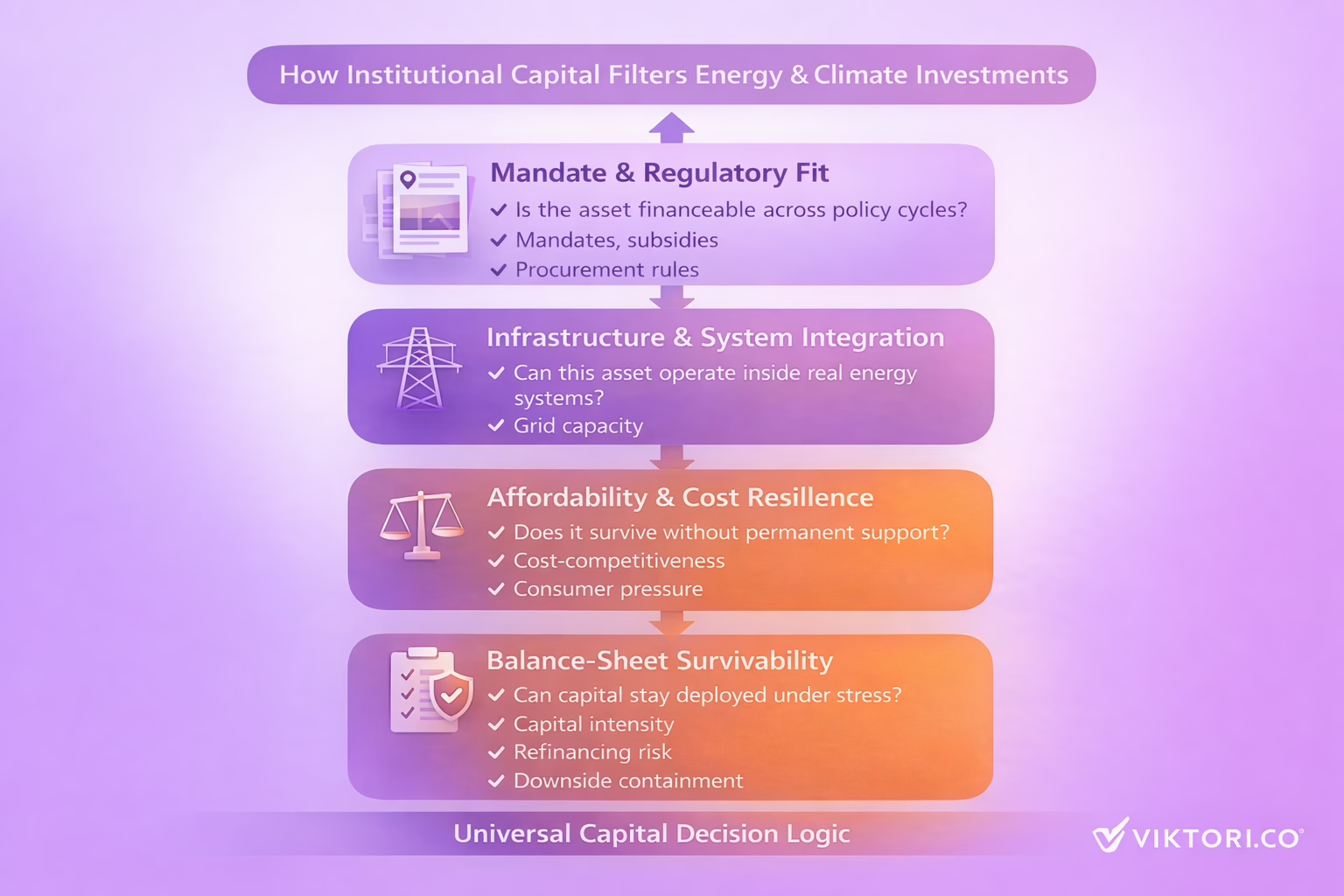
What fails at this gate is not ambition, but fragility: projects whose economics collapse if incentives change, or whose compliance burden escalates faster than cash flows. Capital does not price optimism about climate goals; it prices enforceability, continuity, and jurisdictional coherence.
Infrastructure Dependency and System Integration
Institutional capital treats energy assets as components of a broader system. Power generation, storage projects, electrification, and low-carbon technologies are evaluated based on grid readiness, interconnection risk, upstream dependencies, and downstream offtake reliability.
Failures at this filter often involve assets that perform in isolation but strain existing infrastructure, require upgrades outside the sponsor’s control, or assume frictionless deployment across energy supply chains. Scalability without system compatibility is considered a structural risk, not a growth opportunity.
Cost Competitiveness and Affordability Constraints
Private capital evaluates sustainability through affordability. Investment committees test whether renewable energy, energy efficiency, or climate adaptation assets remain viable without cost transfers to consumers, governments, or future balance sheets.
Projects that rely on optimistic cost curves, delayed breakeven, or permanent public sector support are frequently screened out. In this sector, resilience is defined by the ability to operate within real economic constraints—not by alignment with decarbonization narratives.
Balance-Sheet Risk and Capital Intensity
Energy and climate investments are capital-intensive by design. Reviewers focus on financing structures, duration of capital lock-up, and exposure to refinancing risk across cycles. High upfront deployment costs combined with long payback periods compress tolerance for execution variance.
What typically fails here are models that underestimate maintenance, overestimate utilization, or assume uninterrupted access to private investment during periods of macroeconomic tightening. Institutional capital prioritizes survivability over theoretical upside.
Sector-Specific Failure Modes
Common rejection drivers in energy and climate evaluation include:
- Revenue models dependent on unstable subsidy or procurement regimes
- Assets misaligned with existing energy infrastructure or grid capacity
- Cost structures that fail affordability stress tests
- Exposure to supply-chain fragility in fast-growing or emerging markets
- Capital structures that amplify downside during regulatory or rate shifts
These are structural failures, not presentation errors.
Role of Artifacts in This Sector
Pitch decks, financial models, and technical documentation function as validation tools, not persuasion devices. In energy and climate investing, artifacts are used to verify assumptions about deployment, regulatory exposure, capital intensity, and resilience under stress.
They can confirm internal consistency and compliance readiness. They cannot override mandate constraints, neutralize balance-sheet risk, or compensate for misalignment with institutional investment frameworks.
Connection to Universal Capital Logic
Energy and climate capital evaluation does not introduce new decision logic; it applies universal institutional principles to assets with physical, regulatory, and macroeconomic entanglement. Eligibility, risk containment, governance expectations, and portfolio fit follow the same hierarchy used across asset classes, expressed here through resilience, affordability, and infrastructure dependency.
The underlying allocation logic is defined in Institutional Capital Allocation: How Investment Committees Allocate Capital, which governs how all sector-specific evaluations ultimately resolve.
https://viktori.co/institutional-capital-allocation/
