


Revenue overestimation is rarely fraud. More often, it’s a cognitive compression error—where uncertainty, time, and probability get collapsed into a single confident number because the business feels inevitable.
This article is written for founders, early-stage operators, and anyone interpreting projections under pressure. It does not attempt to improve forecasting technique. It documents a recurring human response pattern that shows up when organizations are forced to represent the future before statistical stability exists.
When we say overestimating revenue, we mean the tendency to present revenue as more stable, repeatable, and dependable than the underlying system can actually support.
This pattern appears most often in early-stage startups (pre-PMF to early growth), founder-led sales motions, and capital-seeking environments where projections are evaluated before operating history exists.
That tension between narrative confidence and structural readiness is typically visible in how revenue logic is framed inside decks, especially in formats where recurring growth is implied early, such as the way revenue assumptions surface in the SaaS pitch deck guide and in the broader structural expectations described in what an investor pitch deck is. When founders attempt to stabilize uncertainty with a clean “numbers story,” it also tends to show up in the generalized deck architecture described in how to create a pitch deck.
The issue is not optimism. The issue is how optimism becomes numerical certainty under evaluation pressure.
Common Ways Founders Overestimate Their Startup Revenue
Overestimation rarely comes from a single bad assumption. It usually emerges from stacked micro-assumptions that feel reasonable in isolation and collapse when aggregated.
Optimistic sales forecasting.
Early wins create narrative gravity. A few strong months begin to feel like a trend even when variance has not stabilized. This reflects linear extrapolation—projecting forward from momentum rather than from process reliability.

Ignoring churn and lifetime reality.
One-time revenue, pilots, or early renewals are mentally upgraded into permanence. This manifests as revenue permanence bias: treating “money once received” as structurally repeatable without retention proof.
Counting pipeline as earned revenue.
Unclosed deals, verbal confidence, and “strong interest” are treated as near-certain outcomes. This reflects a substitution error: social affirmation is mistaken for financial commitment.
Miscalculating conversion rates.
Best-case performance quietly replaces cohort averages. Peak-performance anchoring becomes the baseline even when sample sizes are thin.
Overreliance on large customers.
A single anchor contract begins carrying the story. Continuity bias discounts renewal risk, concentration risk, and procurement shifts.
Failure to account for seasonality and cycles.
Budget timing, market cycles, and procurement windows get flattened. Temporal compression treats time as neutral.
Overoptimistic pricing assumptions.
Price is modeled as what the product should command, not what the market repeatedly accepts. Internal belief substitutes for external repeatability.
Confirmation bias and selective data use.
Supportive signals are emphasized; friction is rationalized. This isn’t necessarily deception—it’s cognitive self-protection under uncertainty.
These patterns don’t just “exist” in the founder’s head—they tend to manifest in the way growth is presented as forward inevitability, especially in the structural framing of traction and growth, the implied certainty inside go-to-market framing, and the simplifications that appear when a deck compresses complexity into clean claims, as discussed in the art of simplification.
Why Overestimation Backfires
Overestimation doesn’t fail loudly at first. It degrades decisions quietly, then compounds.
Cash flow shortages.
Costs stay real-time while revenue arrives late—or not at all. Payroll, tooling, vendors, and delivery costs don’t care about confidence.
Poor strategic decisions.
Overestimated revenue legitimizes premature hiring, expansion, and spend. The company begins operating as if it already crossed a threshold it hasn’t.
Investor distrust and dilution.
Missed targets create confidence decay. After one major miss, future projections are discounted, often tightening terms and increasing dilution pressure.
Operational stress and reputation damage.
Teams absorb the impact first—priorities shift, deadlines slip, partners notice inconsistency.
Missed opportunities due to misallocation.
Capital and time get spent on imagined scale instead of current constraints, reducing resilience.
Legal and compliance risks.
In some cases, optimistic numbers leak into commitments, reporting, or obligations. What began as confidence becomes liability because the structure couldn’t carry it.
The backfire is most visible where claims are forced into formal structure: the logic and failure modes show up in how financial sections are expected to read in how to present financials in a pitch deck, in the common projection distortions described in revenue mistakes in pitch decks, and in the broader category of presentation breakdowns that repeat across decks in 10 pitch deck mistakes.
Real-World Examples and Case Patterns
Revenue overestimation rarely looks dramatic in hindsight. It usually looks reasonable right up until it doesn’t.
A common pattern shows up in founder-led B2B startups that land a few early “enterprise-ish” contracts. The first invoices arrive, confidence spikes, and forecasts start assuming continuity. What gets missed is that procurement timing, renewal gates, and budget reallocations operate independently of founder momentum. This dynamic often becomes visible in how continuity is implied in sector-specific narratives—particularly in contexts like the banking pitch deck guide where timing, compliance, and stakeholder layers add hidden friction.

Another recurring pattern appears in SaaS-like businesses (including “SaaS-in-spirit” service hybrids) that mistake onboarding success for retention stability. Early cohorts convert well, usage looks healthy, and projections quietly assume flat churn. Later cohorts behave differently, but the model doesn’t adapt because the story already hardened. This kind of cohort drift tends to surface in category narratives that emphasize scale logic early, such as the fintech pitch deck guide where distribution, trust, and switching dynamics can change conversion behavior across cohorts.
A third pattern shows up in services and consulting models where utilization assumptions get treated as “basically guaranteed.” Founder bandwidth, delivery constraints, and client concentration are abstracted away, and revenue is modeled as scalable before the operation actually is. You can see how easily this gets structurally implied inside common service narratives in the consulting pitch deck guide, where delivery reality often has to coexist with growth storytelling.
Across these cases, what “went wrong” is rarely a lack of intelligence. It’s a predictable interaction between incomplete data, pressure to present coherence, and the human tendency to upgrade early signals into stable truth.
Diagnosing Revenue Overestimation Inside Your Business
Overestimation announces itself early—just not in the places founders prefer to look.
One warning sign is when runway feels verbally “comfortable” while payment timing, collections, and vendor pressure quietly tighten. This mismatch reflects a split between narrated momentum and operational liquidity.
Another sign is when conversion rates degrade unevenly across segments or channels, but the forecast keeps using a blended average as if the system is homogenous. The human move here is smoothing: removing uncomfortable variance because it complicates the story.
A third signal is linguistic: sales describes deals as “likely,” leadership repeats them as “expected,” and planning starts treating them as “arriving.” The certainty increases as the evidence stays the same.
This shows up especially clearly when your model depends on a small set of assumptions that aren’t structurally expressed anywhere outside the spreadsheet. When the business can’t “point” to where those assumptions live in the operating system, the number is effectively belief.
The diagnostic pressure is sharper in models where timing and external dependencies dominate outcomes—like government pitch deck contexts where procurement cadence and stakeholder gating can break clean projections—and in models where physical constraints force reconciliation, like the manufacturing pitch deck guide, where delivery capacity can’t be hand-waved without consequences.
Practical Strategies to Avoid Overestimating Revenue
Founders who avoid chronic overestimation don’t eliminate optimism. They separate optimism from commitment.
One stabilizing pattern is allowing multiple coexisting futures instead of forcing a single “official” projection. Revenue is treated as a probability field, not a destiny. The organization remains internally consistent even when scenarios disagree.
Another pattern is temporal resistance: projections stay provisional and update frequently rather than being locked early and defended emotionally. This reduces the identity cost of being wrong—and prevents early certainty from turning into irreversible spend.
More resilient companies also enforce separation between pipeline narrative and revenue reality. Pipeline can stay ambitious without being counted as earned. When that separation collapses, the business starts spending tomorrow’s money today.
Customer concentration is handled the same way: top accounts are treated as exposure, not stability. The relationship might be strong, but the dependency is still real. This becomes especially visible in models with inherently lumpy revenue (common in real estate pitch decks) and in models where revenue is tied to adoption cycles outside the founder’s control (often implicit in energy pitch deck contexts).
Finally, spending discipline tends to be expressed through explicit guardrails: hiring, tool commitments, and paid growth remain conditional on realized cash behavior—not projected confidence. You can see why this discipline matters in capital structures where stakeholder trust is slow to earn and fast to lose, such as the expectations implied in investment fund pitch structures.
Tools, Metrics, and Frameworks That Support Sustainable Growth in an Early-Stage Startup
At the early-stage, revenue realism isn’t about lowering ambition. It’s about using signals that describe repeatable behavior, not hope under pressure. This distinction matters most once a startup begins scaling, where small forecasting errors compound quickly.
The most useful financial metrics are the ones that expose fragility early. MRR and ARR only become meaningful when they reflect behavior that repeats without constant founder intervention—especially in SaaS and B2B models. When revenue depends on heroics, discounts, or exceptions, growth projections start drifting away from reality.
Churn and net revenue retention act as early warning systems. When these are smoothed away, forecasts drift toward overvaluation, setting up cash flow challenges that surface later, usually mid–funding rounds. This is why seasoned operators watch retention before celebrating acquisition velocity.
Burn multiple and cash efficiency anchor projections to reality. When burn worsens while topline grows, the business is signaling that it may not scale efficiently, regardless of how strong the narrative sounds.
These tensions are often visible in capital-heavy or operations-constrained models, where revenue cannot outrun execution. You can see how this constraint is structurally acknowledged in the manufacturing pitch deck guide, where delivery capacity, timing, and cost discipline limit optimistic assumptions by design.
Frameworks that help here are not about precision; they’re about restraint. Probability-weighted pipelines, cohort-based views, and scenario ranges prevent overly optimistic numbers from hardening into commitments before the system can carry them.
Implementation Patterns During Startup Scaling (from Adjustment to Discipline)
As startups move from experimentation into execution, the risk isn’t ignorance — it’s unrealistic expectations solidifying too early.
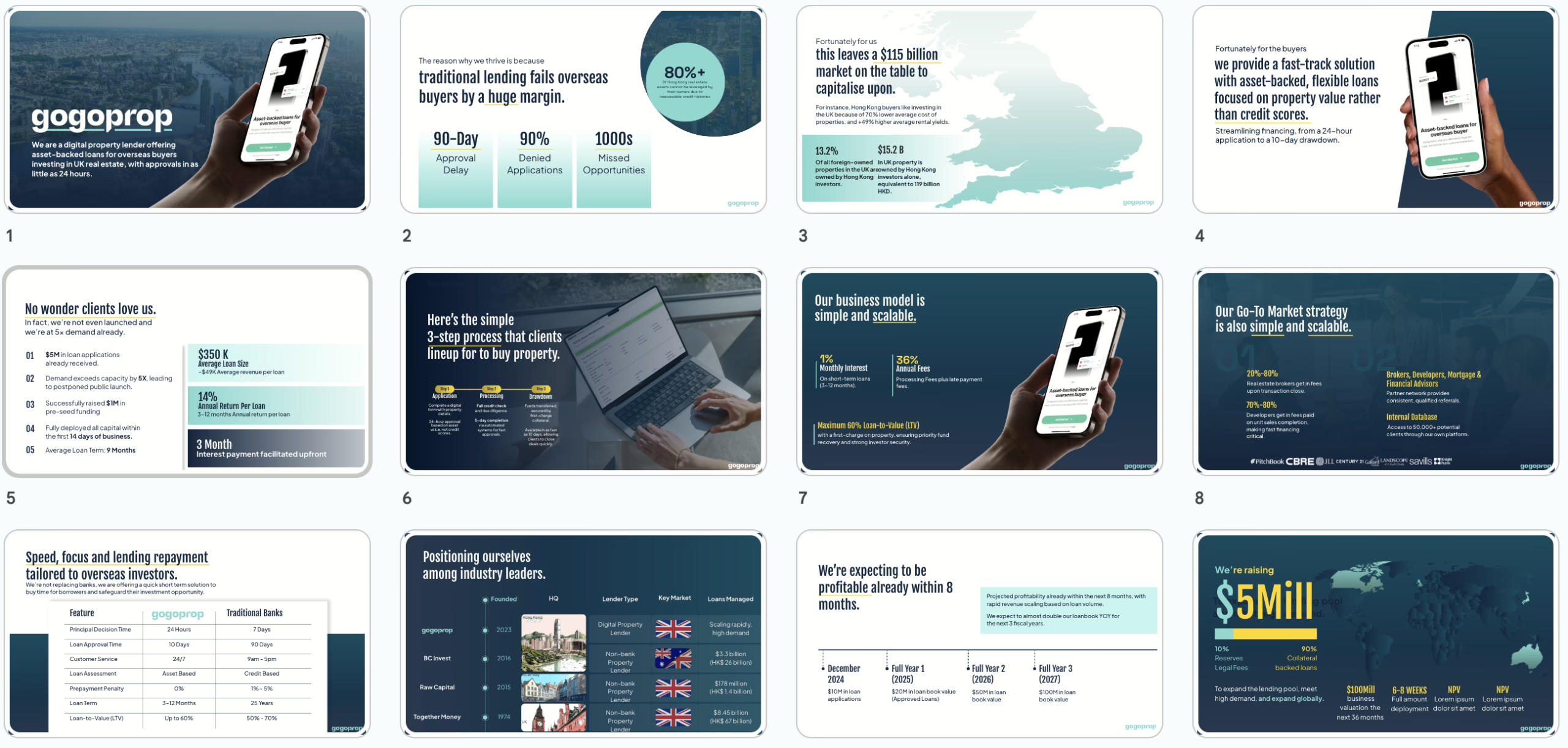
In the first phase, teams typically discover a mismatch between narrated momentum and operational truth. Revenue is “expected,” but collections lag. Deals are “likely,” but timelines slip. This is where common mistakes emerge, not because teams don’t understand the math, but because language outpaces evidence.
The next phase is about cadence. Shorter planning cycles reduce the emotional cost of revision and make it harder for mistakes founders make early on to fossilize into strategy. Teams that revisit assumptions frequently are less likely to spend against imaginary certainty.
As discipline matures, spend becomes conditional on realized behavior rather than promised outcomes. Hiring, tooling, and expansion stop being justified by confidence and start being gated by proof. This shift is often critical in models where timing, regulation, or external approvals dominate outcomes, such as those reflected in government pitch deck contexts, where projections are scrutinized against procedural reality.
What changes isn’t optimism — it’s accountability. Projections stop being identity statements and become working hypotheses.
Revenue Realism, Overvaluation, and Building a Strong Business
Revenue overestimation backfires because it turns uncertainty into obligation. Headcount, contracts, and commitments get pulled forward based on numbers that haven’t earned the right to be trusted.
For many founders, the trap is believing that aiming for the highest valuation requires telling the cleanest story. In reality, a high valuation might attract attention, but inconsistency erodes investor confidence faster than conservatism ever could. This is how overvaluation often leads to a lower valuation later, complicating relationships with investors and damaging future fundraising efforts.
Successful startups tend to internalize a different rule: realism compounds better than bravado. They focus on building a sustainable engine that supports sustainable growth, aligns sales and marketing with customer success, and respects where the tam actually converts, not where it looks impressive on a slide.
This balance plays a direct role in determining valuation, finding the right investors, and improving the chances of securing funding without having to constantly reset expectations. Ultimately, revenue projections aren’t just numbers — they play a central role in shaping how investors interpret risk, maturity, and the company’s long-term ability to grow.
When realism is embedded early, the business doesn’t just survive scrutiny — it earns it.
