


AI pitch deck generators exist for one reason: speed under uncertainty.
Most founders don’t fail because they lack ideas. They fail because their thinking never makes it into a coherent, readable, decision-ready format. Not because the idea is wrong — but because the deck collapses under its own ambiguity.
AI pitch deck tools attempt to solve that gap.
They don’t create strategy.
They don’t understand context.
They don’t read the room.
What they do is reduce friction at the earliest stage of articulation — turning raw intent into structured slides, basic narrative flow, and passable visual hierarchy.
That makes them useful in very specific situations:
- Early validation
- Internal alignment
- MVP-level storytelling
- Directional decks that are not yet under institutional scrutiny
This guide does not evaluate AI tools based on hype, novelty, or feature checklists.
It evaluates them based on how human evaluators typically process information when stakes are low, time is limited, and clarity matters more than polish.
If you’re looking for a shortcut to persuasion, this page won’t help you.
If you’re looking for tools that help structure thinking before judgment, keep reading.
How Does an AI Pitch Deck Generator Work?
An AI pitch deck generator translates language into structure.
You provide intent — a prompt, outline, or rough explanation — and the tool maps it onto a familiar pitch narrative: problem, solution, market, traction, and ask. This mirrors how early-stage founders instinctively assemble decks before formal evaluation, which is why most AI outputs resemble a generic investor pitch deck rather than a tailored one (see: what is an investor pitch deck).
The limitation is structural: AI tools apply patterns statistically, not contextually. They can arrange slides, but they don’t understand why certain information carries more weight at different stages — a distinction explored in how to create a short vs long pitch deck.
Pros and Cons of Popular AI Pitch Deck Generators
AI pitch deck tools are best understood as compression tools, not thinking partners.
They reduce friction at the point where most founders stall: turning abstract thinking into visible structure. That’s useful — especially when compared to common early-stage failures outlined in 10 pitch deck mistakes.
Where they fall short is narrative control. Emotional pacing, evaluator psychology, and framing pressure are human variables — the same dynamics unpacked in emotional storytelling for pitch decks.
Gamma (Best AI Pitch Deck Generator Tools Category Winner)
Gamma produces decks that feel closer to a product experience than a traditional slide file.
This works well for exploratory storytelling and early product narratives, where flow matters more than formal evaluation. Its scroll-based logic aligns with patterns seen in using diverse visuals to improve your pitch decks.
However, Gamma struggles when information needs to be paced rather than browsed — a requirement in investor settings where attention is controlled slide by slide.
Pricing: Free tier available. Paid plans start around $8/month.
Beautiful AI
Beautiful.ai enforces visual discipline aggressively.
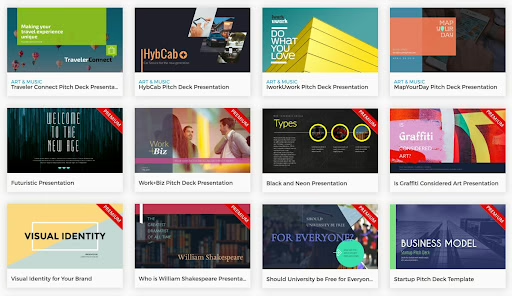
Spacing, hierarchy, and layout are automatically corrected, which prevents many of the visual errors described in pitch deck design mistakes. This makes it reliable for early drafts and internal alignment decks.
The downside is narrative rigidity. Because structure is tightly constrained, it’s harder to introduce tension, contrast, or emphasis — elements that typically separate passable decks from persuasive ones.
Pricing: Free limited version. Paid plans start at $12/month.
Pitch
Pitch positions itself as a collaboration-first presentation tool.
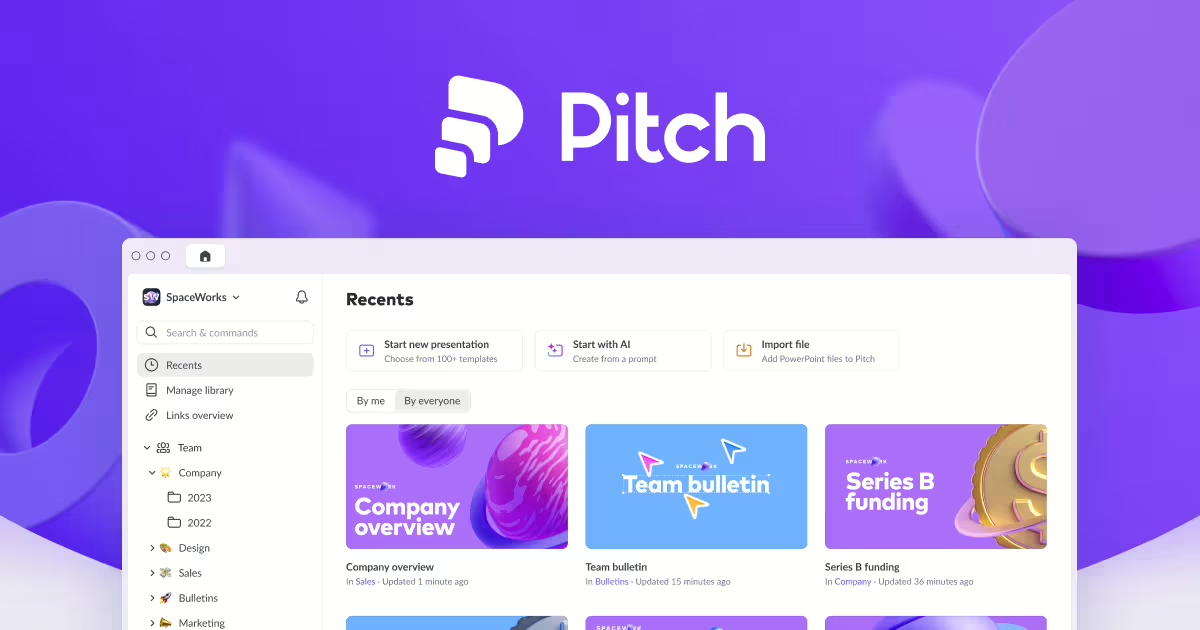
Its AI features help accelerate drafting, but storytelling and prioritization still depend heavily on the user. As a result, it works best for teams iterating internally before committing to a final structure — especially when preparing multiple versions for different audiences, a challenge explored in tailor pitch deck for different investors.
Pricing: Free tier available. Paid plans vary by team size.
Tome
Tome is optimized for narrative continuity rather than slide-by-slide optimization.

It encourages founders to think in sequences, which aligns well with classic storytelling models like the hero’s journey for pitching. This makes it effective for vision decks and conceptual storytelling.
Its weakness appears when financial clarity and data hierarchy matter — areas where narrative alone isn’t sufficient without structural rigor.
Pricing: Free starter tier. Paid plans start around $8/month.
Canva
Canva is not a pitch-native tool — and that’s both its strength and its risk.
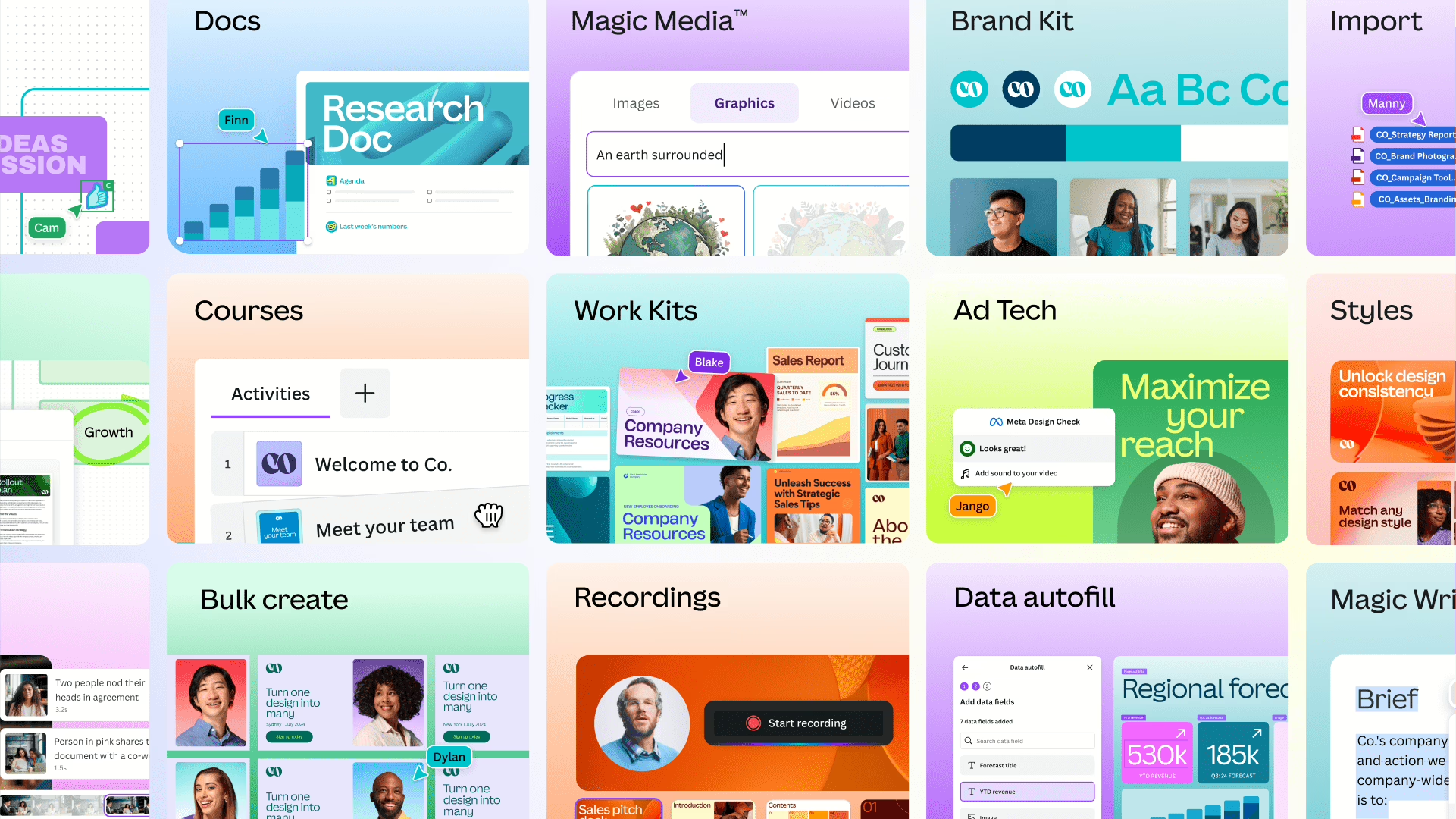
Its flexibility and massive template ecosystem make it attractive, but without narrative constraints, decks often drift into decoration over communication. This is a common failure mode discussed in 11 content mistakes in pitch decks.
Canva works best when used deliberately, with an external structure guiding what belongs on each slide.
Pricing: Free plan available. Pro version unlocks advanced assets.
Copilot in PowerPoint
Copilot integrates AI directly into PowerPoint’s traditional workflow.
For corporate or institutional environments, this reduces adoption friction and preserves familiar formatting logic. However, the outputs tend to be conservative and structurally safe — mirroring the limitations seen when founders rely too heavily on automation.
Pricing: Included in select Microsoft 365 plans.
The Final Word on How to Choose Your Tool
There is no universally “best” AI pitch deck generator.
There is only alignment between:
- your stage,
- your audience,
- and the level of evaluation pressure your deck will face.
AI tools help express intent.
They do not resolve ambiguity.
They do not replace judgment.
If the deck is disposable, speed wins.
If the deck matters, structure wins.
And structure is never generated — it’s chosen.
Frequently Asked Questions About AI Pitch Deck Generators
Can an AI pitch deck generator replace a professional pitch deck expert?
No — and it’s not designed to.
AI pitch deck generators automate layout, slide sequencing, and surface-level narrative patterns. A pitch deck expert interprets context, evaluation pressure, and audience psychology — especially when capital decisions are involved. This distinction is explained in more depth in what is a pitch deck expert.
AI tools help you express an idea. Experts help ensure the idea survives scrutiny.
Are AI-generated pitch decks good enough for investors?
That depends on the stage and the audience.
For early conversations, internal alignment, or exploratory outreach, AI-assisted decks can be sufficient. For formal investor review, they often fall apart due to weak prioritization, shallow framing, and misaligned emphasis — issues commonly seen in pitch deck mistakes technical founders make.
AI can get you in the room. It rarely carries you through the room.
What’s the biggest mistake founders make when using AI pitch deck tools?
Treating the first output as final.
Most AI decks look coherent but fail to resolve ambiguity — especially around traction, differentiation, and market logic. These gaps show up repeatedly in revenue mistakes in pitch decks and competitive analysis startups.
AI outputs should be treated as drafts, not decisions.
Is ChatGPT good for pitch deck content?
ChatGPT is useful for ideation and articulation, but unreliable for prioritization.
It can generate slide copy quickly, but without structural guardrails, decks tend to become verbose, generic, or mis-sequenced. This pattern is examined in 9 common mistakes to avoid when using ChatGPT for pitch deck content.
ChatGPT helps you think out loud. It does not think in decks.
Should I use a free AI pitch deck generator or a paid one?
Free tools are fine for testing direction. Paid tools matter when presentation quality becomes visible to outsiders.
The biggest differences are export control, branding removal, collaboration features, and narrative tooling — all of which influence how seriously a deck is perceived. This trade-off becomes obvious when comparing early drafts to finalized structures like those outlined in how to create a pitch deck.
If the deck leaves your inbox, paid usually wins.
How do I know if my AI-generated pitch deck is “good enough”?
Ask whether it resolves questions — not whether it looks good.
A strong pitch deck reduces uncertainty around:
- the problem,
- the solution,
- the market,
- the business model,
- and the next step.
If your deck still triggers confusion around these areas, it’s not ready — regardless of design quality. This evaluation lens aligns with how decks are actually reviewed, as explained in tailor pitch deck for different investors.
Clarity beats aesthetics every time.
