


Public capital evaluation operates under a fundamentally different mandate than private or institutional investment. This page explains how government funding bodies, federal agencies, and public grant evaluators assess eligibility, risk, and accountability within government grant programs. It applies the universal institutional capital logic defined in Hub 1 through a government-specific lens. This page does not explain how to apply for grants, how to write proposals, or how to persuade evaluators. It describes how evaluation committees interpret evidence, assess program risk, and determine whether public funds can be released under statutory, administrative, and political constraints.
Government Evaluation Context
Government funding is constrained by statute, appropriations law, administrative procedure, and public accountability requirements. Unlike private capital, public funds are not discretionary instruments optimized for return; they are policy tools deployed to achieve defined program objectives. Evaluation risk is therefore non-linear. A program may be economically efficient yet fail eligibility due to governance misalignment, insufficient administrative readiness, or inability to demonstrate measurable outcomes. Capital is assessed not only for feasibility, but for defensibility under audit, oversight, and public scrutiny.
Statutory and Programmatic Eligibility Filters
Government evaluators first assess whether a grant program applicant meets statutory and program-level eligibility criteria. This filter is binary. Program objectives, authorizing legislation, and funding notices define what can be funded, by whom, and for what purpose. Evaluation committees do not negotiate these boundaries. Proposals that fall outside program goals, misinterpret federal grant scope, or attempt to repurpose funds are typically rejected regardless of technical merit.
Governance, Oversight, and Accountability Assessment
Public capital requires enforceable governance structures. Evaluators assess whether grant management, oversight mechanisms, and administrative controls are sufficient to protect public funds. This includes clarity of roles, compliance capacity, reporting structures, and accountability pathways. Programs frequently fail at this stage when governance is implied rather than operationalized, or when oversight responsibilities are fragmented across agencies, contractors, or partners.
Evaluation Frameworks and Measurable Outcomes
Government funding decisions depend on the ability to evaluate outcomes, not intentions. Program evaluation frameworks are reviewed to determine whether objectives can be measured, indicators tracked, and results assessed using systematic evaluation tools. Evaluators look for alignment between stated objectives, data collection methods, and evaluation activities. Programs that rely on qualitative aspiration without measurable outcomes are viewed as high risk to evaluation integrity and long-term accountability.
Administrative Readiness and Implementation Risk
Even well-designed programs are assessed for implementation feasibility. Federal agencies evaluate administrative readiness, procurement capability, staffing adequacy, and compliance with administrative requirements. This filter exists because failure often occurs during execution, not design. Programs that cannot demonstrate readiness to manage grant funding, meet reporting obligations, or oversee contractors typically fail regardless of policy alignment.
Financial Stewardship and Expenditure Controls
Government evaluators assess whether expenditure plans align with allowable cost principles, funding timelines, and grant award conditions. The focus is not efficiency optimization but stewardship and defensibility. Misaligned budgets, unclear cost allocation, or weak financial controls introduce audit risk. Funding agencies prioritize transparency and traceability over flexibility.
Common Government Funding Failure Modes
Government grant programs are commonly rejected due to misalignment with program objectives, insufficient evaluation planning, weak governance structures, or administrative infeasibility. Proposals that emphasize innovation without demonstrating accountability, or that assume discretion where statute applies, frequently fail evaluation. Structural risk, not narrative quality, is the dominant rejection driver.
Role of Evaluation Artifacts in Government Funding
Proposals, evaluation plans, budgets, and supporting documentation function as validation instruments within the review process. They are used to verify eligibility, assess compliance, and evaluate risk containment. These artifacts can demonstrate readiness, alignment, and accountability, but they cannot override statutory constraints, alter program objectives, or compensate for governance deficiencies.
Connection to Universal Capital Logic
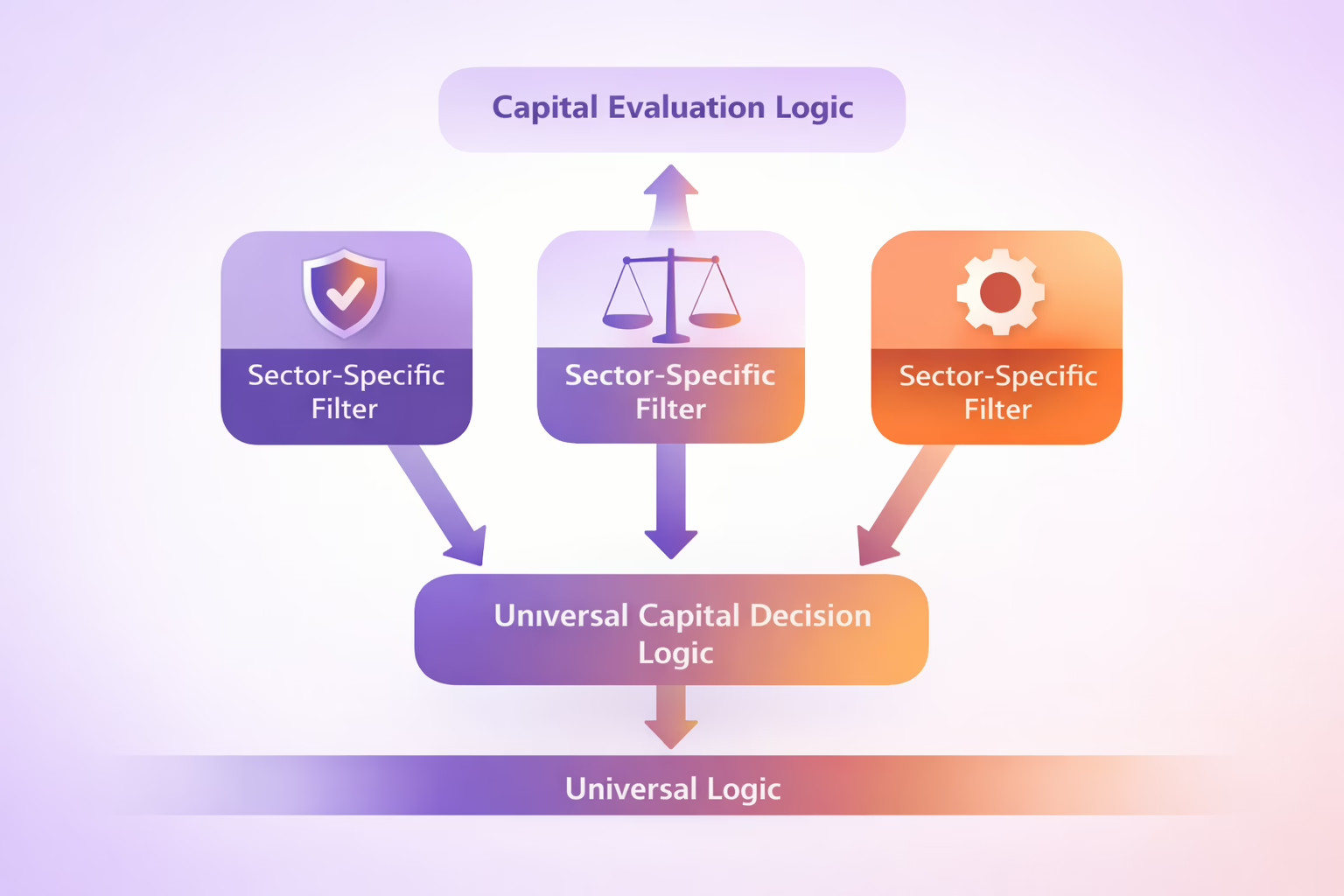
Government funding evaluation expresses the same universal capital decision logic outlined in Hub 1—eligibility first, risk containment second, alignment with mandate throughout—applied through public accountability, statutory compliance, and outcome evaluation requirements. The sector does not replace institutional logic; it constrains its expression through law, oversight, and public responsibility. For the underlying decision framework that governs all institutional capital allocation, see Institutional Capital Allocation.
