


Institutional capital evaluates healthcare and life sciences through a sector-specific risk lens shaped by regulation, clinical uncertainty, reimbursement dependency, and long-duration capital exposure. This page explains how evaluators apply those constraints when reviewing eligibility and downside containment in healthcare and life sciences investments. It does not explain execution, pitching, or capital raising mechanics. Universal capital decision logic—used across sectors—remains defined upstream and is not reinterpreted here. This page exists solely to document how that logic manifests under healthcare and life sciences conditions, where non-linear risk and asymmetric outcomes dominate institutional review.
Sector Evaluation Context
Healthcare and life sciences occupy a constrained position within the capital market because value creation is mediated by regulators, payers, and clinical validation rather than direct customer demand. Unlike many sectors, revenue realization is rarely aligned with development timelines. Clinical trials, reimbursement frameworks, and regulatory compliance introduce long latency periods where capital is exposed without operating feedback.
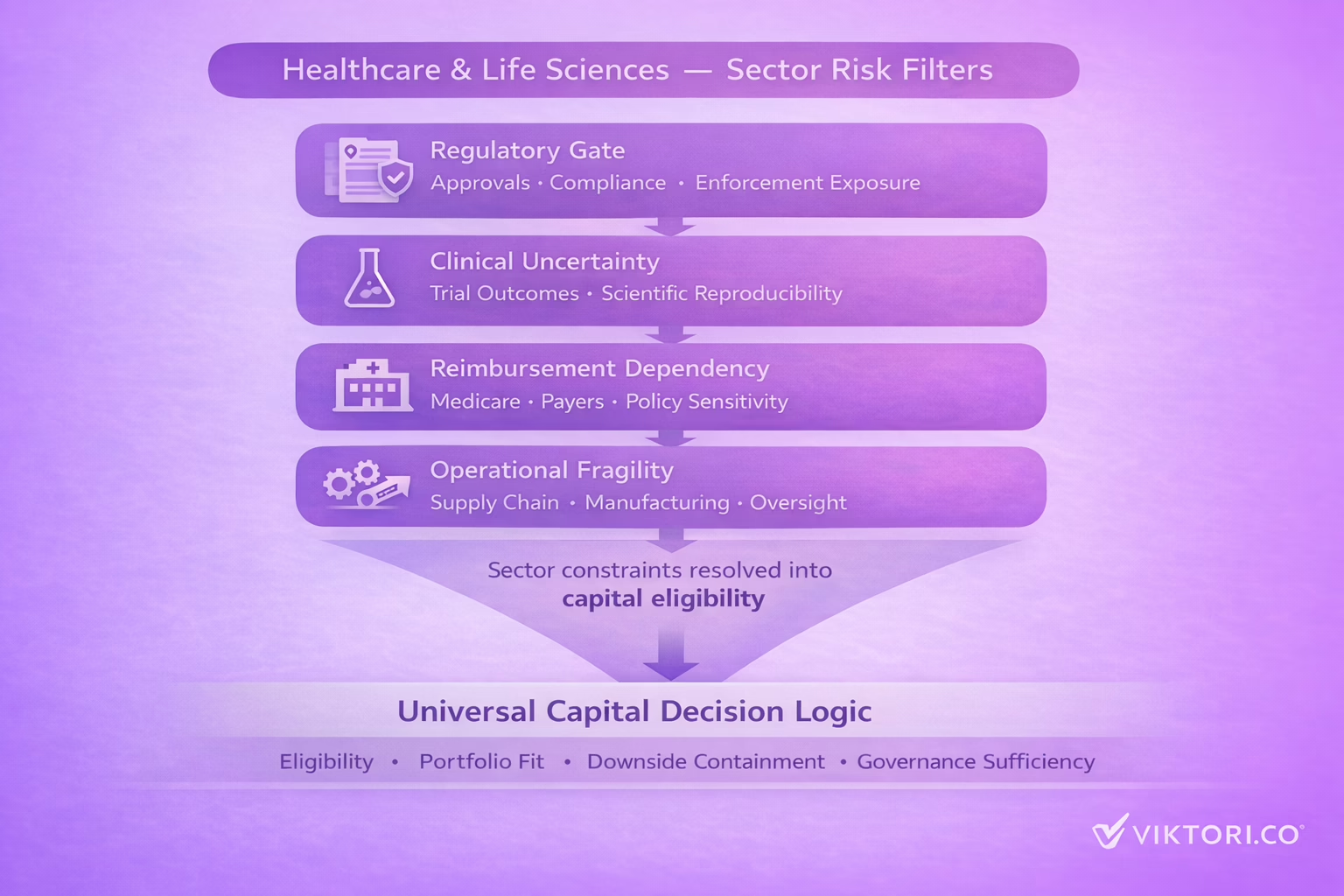
Risk is non-linear by design. A single regulatory decision, adverse clinical outcome, or reimbursement change can invalidate years of accumulated value. As a result, healthcare and life sciences investments—across biotech, biopharma, medical devices, healthcare services, and digital health—are evaluated less on growth narratives and more on risk containment, governance strength, and system-level dependency mapping.
Regulatory Exposure as a Primary Gate
Regulatory compliance functions as a binary filter rather than a gradient consideration. Evaluators assess whether the life sciences company operates within a clearly navigable regulatory pathway—across pharmaceutical approvals, medical device classification, clinical trial design, and healthcare services licensing.
Failures at this gate typically involve misaligned regulatory assumptions, incomplete understanding of approval dependencies, or governance structures unable to withstand regulatory scrutiny. Capital committees do not assume regulatory flexibility; they assume enforcement, delay, and retroactive exposure as baseline conditions.
Clinical and Scientific Risk Containment
Clinical trial outcomes represent irreversible capital inflection points. In life sciences investment, evaluators distinguish between scientific promise and capital durability. Drug discovery, gene therapy, oncology therapeutics, and biotechnology platforms are assessed for reproducibility, endpoint clarity, and translational risk between trial phases.
What fails here is not ambition, but overexposure—platforms where a single clinical result determines enterprise viability. Institutional reviewers favor structures where negative outcomes limit loss rather than cascade across the portfolio.
Reimbursement and Payer Dependency
Revenue in healthcare is mediated through reimbursement systems rather than market pricing. Medicare, national healthcare frameworks, pharmacy benefit managers, and health plans shape realized value far more than end-user demand.
Capital evaluation focuses on reimbursement predictability, policy sensitivity, and payer concentration. Healthcare providers, hospitals and health systems, and related services are scrutinized for exposure to policy shifts, pricing compression, and delayed collections. Structures dependent on optimistic reimbursement assumptions typically fail institutional screens.
Operational and Supply Chain Fragility
Healthcare and life sciences companies operate within tightly coupled supply chains—clinical sites, manufacturing partners, distribution networks, and outsourced biopharma services. Evaluators map where operational failure can halt clinical progress or service delivery entirely.
Medical device manufacturing, pharmaceutical supply chains, and life sciences tools are assessed for redundancy, compliance resilience, and geographic risk. Fragility at any node is treated as systemic, not isolated.
Governance and Oversight Expectations
Governance in healthcare and life sciences is not a formality; it is a risk control mechanism. Institutional capital evaluates board composition, clinical oversight, compliance infrastructure, and decision rights with the assumption that governance failures translate directly into capital impairment.
Common failures include founder-dominated control structures, inadequate regulatory expertise at the board level, and insufficient separation between scientific leadership and capital oversight.
Sector-Specific Failure Modes
Healthcare and life sciences investments are most often rejected for structural reasons rather than market fit. Typical rejection drivers include:
- Clinical dependency that concentrates risk into a single trial or indication
- Reimbursement exposure misaligned with policy reality
- Regulatory pathways treated as timelines rather than gates
- Supply chain structures unable to absorb compliance shocks
- Governance frameworks insufficient for regulated operations
These failures are categorical. They are not mitigated through presentation or narrative.
Role of Artifacts in This Sector
Pitch decks, financial models, and clinical documentation serve as validation tools—not persuasion instruments. Evaluators use artifacts to verify internal consistency, regulatory awareness, portfolio exposure, and governance discipline.
Artifacts can confirm preparedness and alignment. They cannot override clinical uncertainty, regulatory risk, or reimbursement dependency. In healthcare and life sciences capital evaluation, artifacts document risk—they do not reduce it.
Connection to Universal Capital Logic
Healthcare and life sciences express the same universal capital allocation principles applied across sectors—eligibility, risk containment, governance, and downside protection—but under amplified constraints. Regulatory exposure replaces market volatility as the dominant risk vector; clinical outcomes replace execution velocity as the primary uncertainty driver.
The sector-specific mechanics described here are expressions of a broader institutional decision framework governing capital eligibility, portfolio construction, and downside control across all asset classes.
