


This page explains how institutional capital evaluates fintech opportunities. It describes the decision logic used by investment committees, credit officers, regulators, and capital allocators when assessing fintech-related risk and eligibility.
This page does not explain how to pitch, how to design a pitch deck, or how to structure fundraising materials. It assumes familiarity with universal institutional capital allocation logic and applies that logic to the specific constraints of the fintech sector.
The single question this page answers is:
How does institutional capital decide whether fintech risk is allocatable?
Sector Evaluation Context
Fintech is evaluated differently from most sectors because it sits at the intersection of financial risk, regulatory exposure, and technical dependency. Institutional capital does not treat fintech as a pure technology play or a pure financial services business. It is assessed as a hybrid risk category with layered failure modes.
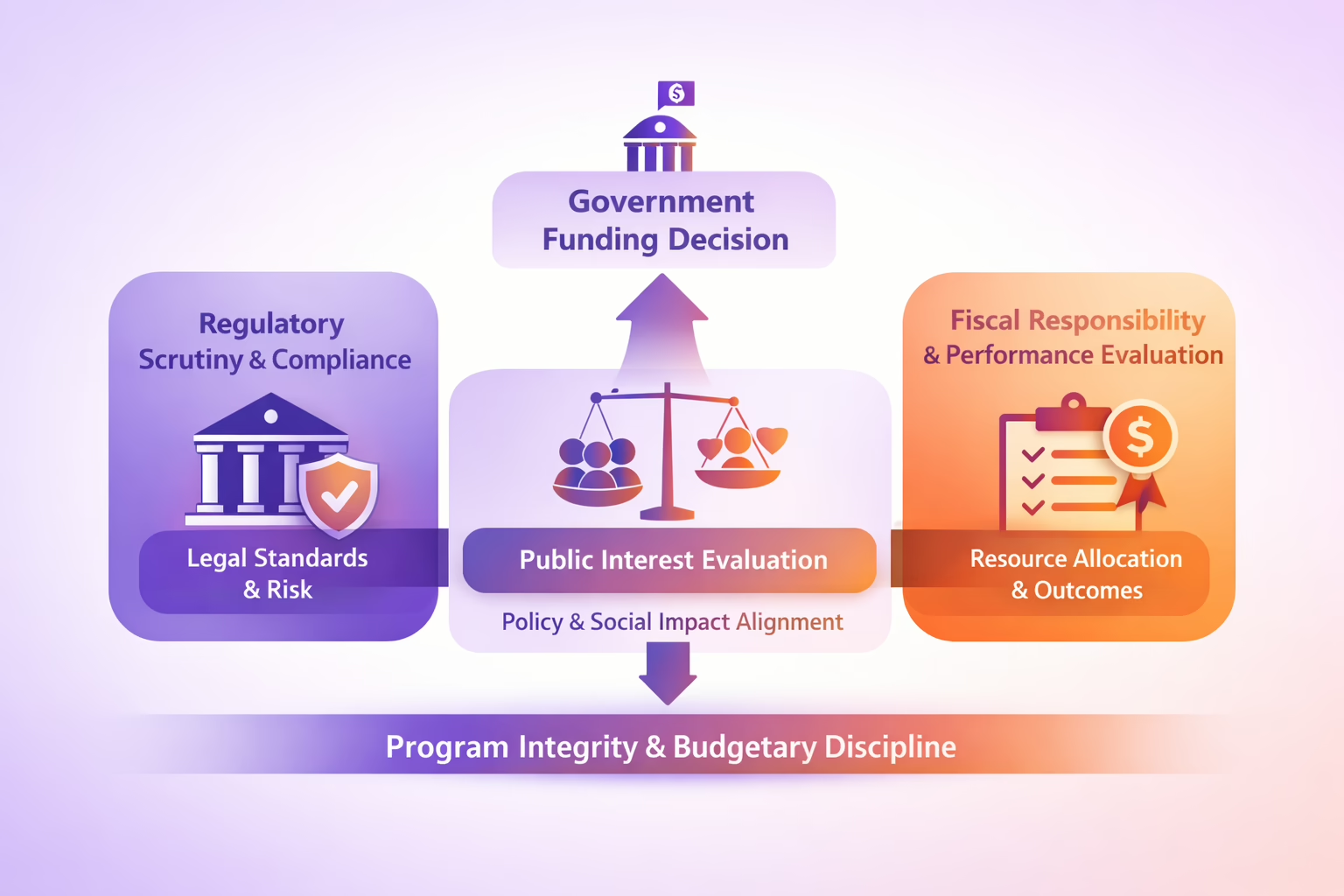
Capital allocators approach fintech with heightened caution because failure rarely remains isolated. Regulatory breaches, consumer harm, or infrastructure failure can propagate quickly through financial systems, triggering enforcement actions, reputational damage, or forced shutdowns. As a result, fintech evaluation places disproportionate weight on downside containment, compliance posture, and operational control, often before growth potential is meaningfully considered.
Where other sectors may allow experimentation at scale, fintech capital decisions are governed by permissioned risk. The question is not whether innovation is compelling, but whether exposure can be tolerated within institutional mandates.
Primary Evaluation Filters in Fintech
Regulatory Exposure as a Gatekeeper
Regulatory exposure is the first hard filter applied to fintech opportunities. Institutional reviewers assess whether the business operates within regulated financial activities, adjacent regulated infrastructure, or unregulated financial tooling. Each category carries different eligibility thresholds.
Capital committees examine licensing requirements, jurisdictional complexity, regulatory dependencies, and enforcement risk. Proposals that rely on future regulatory approval, regulatory arbitrage, or unclear compliance positioning are frequently screened out before commercial analysis begins.
The presence of revenue or user growth does not offset unresolved regulatory exposure. In fintech, compliance uncertainty disqualifies opportunity before upside is discussed.
Infrastructure Dependency and Systemic Risk
Fintech businesses are rarely standalone systems. They depend on payment rails, banking partners, data providers, identity verification systems, and clearing infrastructure. Institutional evaluators map these dependencies explicitly.
Capital allocation decisions consider concentration risk, single-point failures, partner termination rights, and service-level fragility. A fintech opportunity may be commercially attractive yet deemed unallocatable if critical dependencies introduce uncontrollable downside risk.
Committees prioritize system resilience over feature differentiation.
Financial Risk Transmission
Unlike software-only sectors, fintech often carries embedded financial risk. Lending exposure, settlement risk, liquidity timing, chargeback risk, and fraud loss are evaluated as balance-sheet risks, not product features.
Institutional reviewers assess whether risk is retained, transferred, insured, or structurally limited. Models that obscure risk ownership or rely on optimistic loss assumptions fail early in evaluation.
Fintech capital decisions focus on loss containment mechanics, not just revenue mechanics.
Revenue Durability and Margin Reality
Fintech revenue is examined through the lens of durability under stress. Committees analyze fee compression risk, regulatory fee caps, partner renegotiation risk, and customer switching behavior.
High growth rates are discounted if margins depend on conditions unlikely to persist under regulatory scrutiny or market normalization. Durable revenue under constrained conditions is valued more highly than rapid expansion under permissive assumptions.
Sector-Specific Risk Considerations
The dominant risks in fintech are non-linear. Regulatory intervention, partner withdrawal, or systemic failure can rapidly shift a business from growth to insolvency. Institutional capital evaluates not just probability of failure, but speed and irreversibility of failure.
Fintech risk assessment emphasizes scenarios where operations halt abruptly rather than decline gradually. Capital committees are sensitive to exposures that do not allow time for intervention, restructuring, or exit.
As a result, fintech opportunities are often rejected not because expected returns are insufficient, but because failure modes are too abrupt to manage within institutional constraints.
Governance and Oversight Expectations
Governance standards in fintech are closer to those of financial institutions than technology startups. Institutional reviewers expect clear accountability structures, separation of duties, risk oversight functions, and documented control processes.
Weak governance signals — founder-dominated control, informal risk ownership, or unclear escalation paths — materially increase perceived risk. In fintech, governance is not viewed as administrative overhead but as a prerequisite for capital eligibility.
Capital allocators assess whether governance frameworks are sufficient to absorb regulatory scrutiny and operational stress.
Common Rejection Patterns in Fintech
Fintech proposals commonly fail institutional review due to:
- reliance on future regulatory clarity rather than current compliance
- dependency on a single financial partner without redundancy
- unclear ownership of credit, fraud, or settlement risk
- revenue models vulnerable to regulatory or partner intervention
- governance structures insufficient for regulated exposure
These failures are structural rather than presentational. They persist regardless of narrative quality or documentation polish.
The Role of Artifacts in Fintech Evaluation
Pitch decks, financial models, and regulatory documentation are reviewed as evidence, not persuasion. They are used to validate assumptions, confirm risk ownership, and test internal consistency.
Artifacts cannot compensate for regulatory ambiguity, unmanaged risk exposure, or governance deficiencies. Strong documentation may accelerate rejection by making misalignments more visible.
In fintech, artifacts clarify risk — they do not reframe it.
Connection to Universal Capital Allocation Logic
Fintech capital evaluation applies the same universal principles that govern all institutional capital allocation: eligibility precedes attractiveness, downside is prioritized over upside, and governance constrains opportunity.
What differentiates fintech is not the logic itself, but the density of constraints applied before capital becomes allocatable. Regulatory exposure, infrastructure dependency, and embedded financial risk compress tolerance for uncertainty.
This sector-specific expression of universal logic explains why fintech decisions often appear conservative relative to innovation narratives.
Fintech capital decisions operate within the same institutional capital allocation logic, expressed through tighter regulatory and risk constraints.
