


Building an FMCG pitch deck is less about hype and more about execution discipline. Consumer brands are evaluated against specific expectations around product clarity, distribution logic, unit economics, and scalability — and those expectations exist whether founders acknowledge them or not.
This guide focuses on how FMCG pitch decks are typically structured, assembled, and presented once those expectations are already understood. It does not define how consumer brands are evaluated or how capital decisions are made. Instead, it translates common review standards into practical slide mechanics, examples, and templates that help teams execute cleanly.
If you’re looking for decision criteria or evaluation logic, that lives upstream. This guide focuses on execution mechanics. It does not define how consumer brands are evaluated or how capital decisions are made. The evaluation standards for consumer brands are outlined in the consumer brand capital evaluation framework.
What Is An FMCG Pitch Deck?
An FMCG pitch deck is a structured presentation used to explain a consumer brand’s product, market positioning, operating model, and growth plan in a format suitable for external review.
In practice, FMCG pitch decks are used to present how a brand operates within a fast-moving, margin-sensitive, and distribution-driven environment. As a result, they typically include slides covering the product offering, market context, business model, competitive positioning, go-to-market approach, team background, financial projections, and capital requirements.
This guide treats the FMCG pitch deck as an execution artifact — a way of organizing and presenting information — rather than a decision framework. Let’s see the exact steps to take in order to execute it.
Step By Step Execution Guide
1. Define the review context before opening slides
Clarify where and how the deck will be used (initial review, internal circulation, follow-up). This determines structure density and slide count, not strategy.
Execution mistakes at this stage often stem from ignoring deck length constraints by context, which is why pitch deck length matters early: https://viktori.co/pitch-deck-length/
2. Lock slide order before writing content
Decide the entire slide sequence upfront. FMCG decks fail when structure evolves mid-build.
Structural drift is a common issue in decks that later feel templated or incoherent.
3. Write one sentence per slide (maximum)
Before designing, define one sentence per slide that states its sole job.
If you struggle here, the issue is usually framing, not copy.
4. Define the product operationally, not emotionally
Explain what the product is, how it’s used, and how often it’s purchased.
Slides that over-describe features usually violate basic simplification principles.
5. Frame the problem as a market condition
Describe the problem as a behavioral or structural condition, not a mission statement.
Poor problem framing is one of the most common rookie errors.
6. Establish the problem–solution relationship clearly
Ensure the solution slide directly maps to the stated condition.
Misalignment here often creates unnecessary slide splitting.
7. Express the value proposition as a trade-off
Clarify what improves, what stays the same, and what is sacrificed.
This is where decks often fall into persuasion instead of clarity.
8. Break market size into logical layers
Present total category, addressable segment, and entry slice with clear assumptions.
Many FMCG decks fail due to compressed or inflated TAM logic.
9. Position competition visually, not verbally
Use positioning maps instead of comparison tables.
Execution issues here mirror broader competitive slide failures.
10. Explain the business model step by step
Walk through pricing, margins, repeat behavior, and cost drivers.
Revenue slides often collapse due to vague mechanics.
11. Show go-to-market as a sequence
Present what happens first, then next, not everything at once.
Execution confusion here often reflects poor audience alignment.
12. Present traction only if it exists
Use real signals: sales, distribution, repeat usage.
If traction is early or soft, structure momentum carefully.
13. Design slides for scanning, not reading
Slides should communicate in under 10 seconds.
Common failures stem from layout and hierarchy mistakes.
14. Use storytelling frameworks sparingly and structurally
Narrative should help sequence information, not dramatize it.
Overuse of story devices often distracts from mechanics.
15. Present financials as assumptions → outcomes
Make inputs traceable. Avoid outcome-only charts.
Most financial slides fail due to presentation, not math.
16. Pressure-test financial credibility
Check sensitivity, timelines, and constraints.
Projection breakdowns are often structural, not numerical.
17. Introduce the team by execution relevance
Highlight roles, ownership, and directly relevant experience.
Team slides often fail due to misplaced emphasis.
18. State the ask with operational boundaries
Specify amount, allocation, and milestones tied to use.
Ask slides often break due to framing errors.
19. Anticipate follow-up questions structurally
Prepare backup slides based on where decks typically get challenged.
Poor preparation often leads to reactive explanations.
20. Use appendices deliberately
Appendix content should support, not repair, the core deck.
This mistake appears consistently across weak decks.
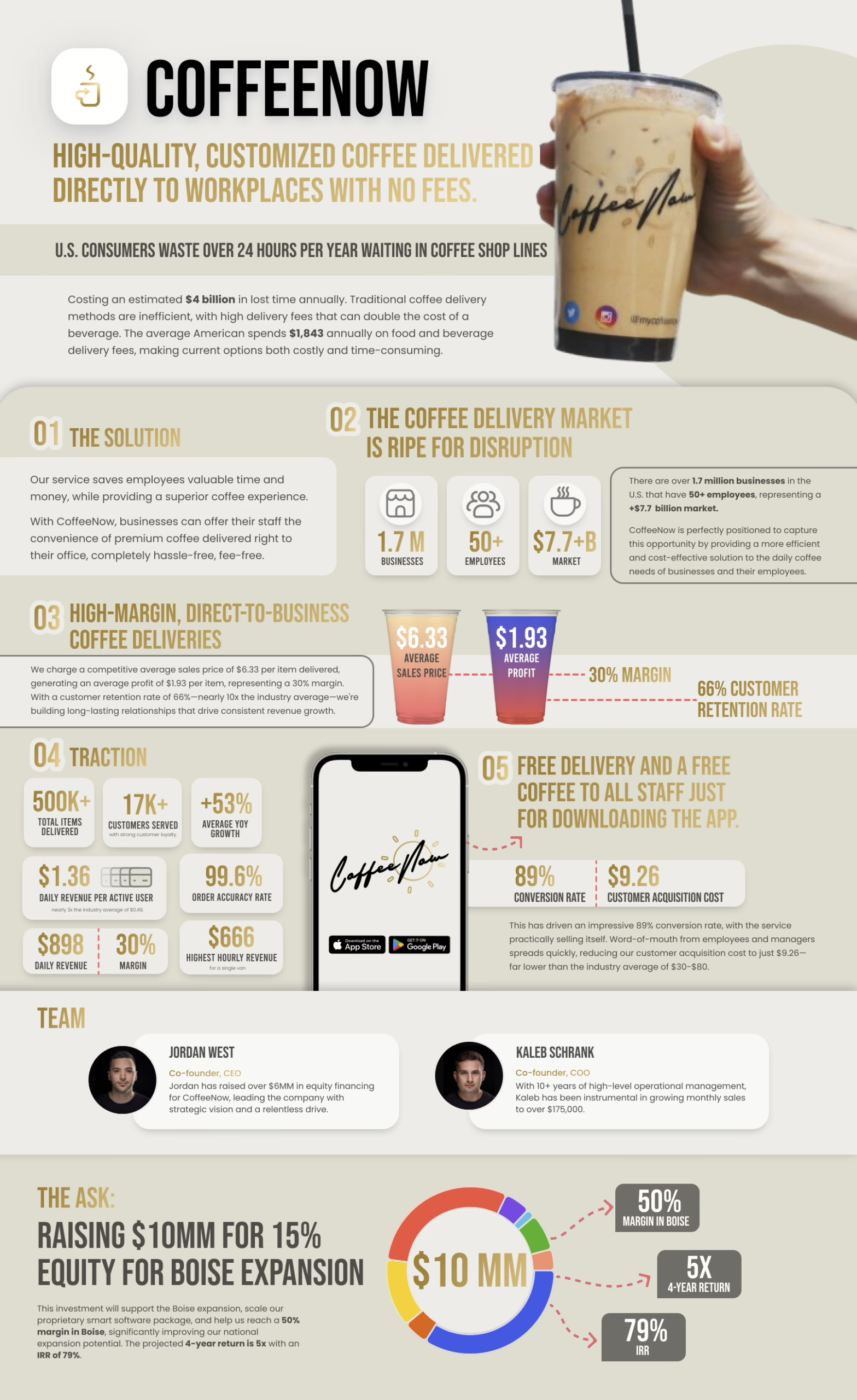
FMCG Pitch Deck Template
(Execution & Structure — Slide by Slide)
Slide 1 — Cover
Purpose: Identify the deck.
Include:
- Brand name
- Product category
- One-line descriptor
- Date / version
Execution note:
Cover slides fail most often due to overdesign. Keep hierarchy clean and readable at distance — a common issue in decks that violate basic layout discipline, similar to those outlined in pitch deck layout mistakes.
Slide 2 — The Market Condition (Problem)
Purpose: Describe the condition the product operates within.
Include:
- Observable consumer behavior
- Where the friction appears (shelf, price, habit, channel)
Execution note:
Problem slides tend to over-explain. If your slide reads like a paragraph, it likely violates the “single-slide, single-idea” principle explained in problem–solution slide structure.
Slide 3 — The Product
Purpose: Explain what exists today.
Include:
- SKU or format
- Usage moment
- Core functional outcome
Execution note:
If this slide becomes text-heavy, you’re drifting into explanation instead of communication — a common failure pattern in text-heavy vs image-heavy pitch decks.
Slide 4 — Value Proposition (Trade-Offs)
Purpose: Clarify positioning through contrast.
Include:
- What improves
- What stays the same
- What the customer gives up
Execution note:
Clear value propositions rely on simplification, not persuasion. This slide often benefits from techniques described in the art of simplification.
Slide 5 — Market Scope
Purpose: Show where the product fits commercially.
Include:
- Category size
- Addressable segment
- Initial entry slice
Execution note:
Market slides frequently break when TAM logic is compressed into one number. Structural errors here mirror those covered in TAM slide mistakes.
Slide 6 — Competitive Landscape
Purpose: Position alternatives visually.
Include:
- Direct competitors
- Substitutes
- Simple positioning map
Execution note:
Competitive slides should frame position, not superiority. If your slide turns into a comparison checklist, review competitive analysis execution pitfalls.
Slide 7 — Business Model
Purpose: Explain revenue mechanics.
Include:
- Unit price
- Margin logic
- Repeat behavior
- Cost drivers
Execution note:
Business model slides often fail due to vague revenue descriptions. Structural clarity here overlaps with common errors in revenue slides.
Slide 8 — Go-To-Market Execution
Purpose: Show sequence, not ambition.
Include:
- First channel
- Acquisition method
- Expansion logic
Execution note:
Overloaded GTM slides usually signal unclear sequencing — a pattern also seen in decks that ignore deck length constraints: https://viktori.co/pitch-deck-length/
Slide 9 — Traction (If Applicable)
Purpose: Present evidence, not forecasts.
Include:
- Sales
- Distribution
- Repeat behavior
Execution note:
When traction is weak or early, avoid inventing metrics. Structuring momentum without hard numbers is addressed in traction slides without metrics.
Slide 10 — Operating Model
Purpose: Explain how the business runs.
Include:
- Production logic
- Supply chain
- Key dependencies
Execution note:
Operational slides often collapse into abstraction. Visual hierarchy matters here — see visual storytelling techniques for pitching.
Slide 11 — Financial Overview
Purpose: Show assumptions → outcomes.
Include:
- Revenue drivers
- Cost structure
- Timeline view
Execution note:
Financial slides fail most often due to unreadable structure, not wrong numbers. Execution guidance overlaps with how to present financials.
Slide 12 — Unit Economics (If Relevant)
Purpose: Show sustainability at product level.
Include:
- Contribution margin
- Sensitivities
- Scalability limits
Execution note:
If unit economics require long explanations, structure likely needs refinement similar to issues described in financial projections breakdowns.
Slide 13 — Team
Purpose: Establish execution ownership.
Include:
- Roles
- Relevant experience
- Responsibility split
Execution note:
Team slides often drift into biography. Structural focus should remain execution-based, as highlighted in pitch deck mistakes by stage.
Slide 14 — The Ask
Purpose: Define capital usage.
Include:
- Amount
- Allocation
- Operational milestones
Execution note:
Ask slides break when they imply outcomes instead of allocations. This aligns with structural issues seen in framing your pitch deck.
Slide 15 — Timeline & Milestones
Purpose: Show execution sequence.
Include:
- Near-term steps
- Clear checkpoints
Execution note:
If timelines feel aspirational rather than operational, revisit sequencing logic similar to early vs late stage fundraising structure.
Slide 16 — Risks & Constraints (Optional)
Purpose: Surface known limits.
Include:
- Operational risks
- Market constraints
Execution note:
This slide improves clarity when handled neutrally and mirrors patterns in investor red flags, without adopting evaluator tone:
👉 https://viktori.co/investor-red-flags/
Slide 17 — Appendix
Purpose: Support reviewRule:
Appendix content should never repair unclear core slides — a common failure discussed in 10 pitch deck mistakes.
FMCG Pitch Deck FAQ
What makes an FMCG pitch deck different from other startup decks?
FMCG pitch decks are typically more operational and margin-sensitive than decks in software or marketplaces. Product repeatability, distribution logic, and unit economics usually require clearer explanation at the slide level.
Execution differences often show up in how decks balance visuals and information density, which is why issues covered in text-heavy vs image-heavy pitch decks frequently surface in FMCG decks: https://viktori.co/text-heavy-vs-image-heavy-pitch-deck/
How long should an FMCG pitch deck be?
There is no fixed number, but FMCG decks tend to require slightly more slides to explain product, supply chain, and distribution mechanics clearly.
Problems usually arise when teams compress too much into single slides instead of splitting content cleanly, a pattern described in when to split pitch deck slides.
Should FMCG pitch decks focus more on product or market?
From an execution standpoint, both need to be present, but clarity beats emphasis. The product slide should explain what exists today, while the market slides explain where and how it fits.
Decks that overcorrect in either direction often suffer from framing imbalance, which is addressed in framing your pitch deck.
How detailed should FMCG financial slides be?
Financial slides should be traceable, not exhaustive. Inputs, assumptions, and constraints matter more than complex charts.
Overly dense financial slides are a common execution issue, especially when teams skip basic structure outlined in how investors think (used here strictly as a presentation lens, not authority).
Do FMCG pitch decks need a strong storytelling angle?
Storytelling helps with sequence and coherence, not persuasion. In FMCG decks, narrative should support understanding of product flow, customer behavior, and scaling steps.
When storytelling becomes decorative, decks often lose clarity — a pattern discussed in visual storytelling techniques for pitching.
How should competition be shown in an FMCG pitch deck?
Competition is best shown through positioning, not feature comparisons. Visual maps or category placement usually communicate faster than tables.
Execution breakdowns in competition slides are commonly linked to mistakes outlined in competitive landscape slides.
Is it necessary to include an exit slide in an FMCG pitch deck?
Exit slides are optional and should be treated as contextual, not predictive. If included, they should remain factual and high-level.
Overloading exit slides with speculation often creates more confusion than clarity — a structural issue similar to those in rejection when pitching.
How visual should an FMCG pitch deck be?
FMCG decks benefit from strong visuals, but only when visuals replace explanation, not decorate it.
Common visual execution errors are covered in visual design errors founders make in pitch decks.
Should FMCG pitch decks be customized for different audiences?
Customization usually happens at the depth and ordering level, not by changing the core story. Slide emphasis may shift, but structure should remain stable.
Execution guidance for adapting decks without breaking structure is covered in tailoring pitch decks for different audiences.
When should appendices be added to an FMCG pitch deck?
Appendices should be added after the core deck works on its own. They exist to support follow-up review, not to compensate for unclear slides.
Misuse of appendices is a recurring execution mistake discussed in 11 content mistakes in pitch decks.
Need Help Building an FMCG Pitch Deck?
An FMCG pitch deck needs to make the product feel commercially attractive, not just nicely packaged.
Investors, retailers, distributors, and partners need to understand the product range, customer demand, category opportunity, pricing, margins, distribution strategy, brand positioning, traction, and growth plan.
If you are building a pitch deck for an FMCG brand, packaged goods company, consumer product, food and beverage business, personal care brand, or retail-ready product, I can help you turn the story, strategy, and design into a clearer investor-ready deck.
Explore my pitch deck design services to see how I can help.
