


Data doesn’t land in a vacuum. In any pitch environment, people are sorting for meaning, not just information — especially when attention is fragmented by meetings, memos, and five other decks waiting in the queue. That’s why storytelling still matters in 2026, even with ChatGPT summaries and “just give me the bullet points” culture.
The Hero’s Journey persists because it matches how humans naturally map change: a stable “before,” a disruption, friction, adaptation, and a clear after-state. In other words, it’s a story structure that helps an audience orient themselves fast — which is exactly what a pitch is supposed to enable. If you want the clean baseline of what a pitch artifact is (as a format, not a performance), this aligns closely with how an investor narrative is typically expressed in an investor pitch deck.
This same dynamic shows up outside the boardroom too. On LinkedIn, the content that tends to compel isn’t the “here’s what we built” post — it’s the “here’s what changed, what we learned, and what that transformed” post. That’s personal branding as an unfolding narrative arc, not a highlight reel. If you want adjacent context on how this pattern surfaces in practice, it’s consistent with the logic discussed in emotional storytelling for pitch decks and the broader storytelling frameworks you’ve already mapped.
Definition
The Hero’s Journey, coined by Joseph Campbell, is a descriptive model of recurring narrative patterns across myths, religion, modern cinema, and nonfiction explanation. It’s often called the monomyth because it keeps showing up: Cinderella, Star Wars, Lord of the Rings — different worlds, same psychological spine.
In a business context, the Hero’s Journey isn’t “a trick to persuade.” It’s a way to describe how audiences expect transformation narratives to unfold when stakes are present. Under evaluation pressure, people look for:
- what the ordinary world looked like (baseline),
- what created the call to adventure (disruption),
- what had to be confronted (friction),
- what changed (transformation),
- and what the return looks like (resolution).
It overlaps with the three-act structure (setup → confrontation → resolution), but the difference is that Campbell’s model emphasizes identity shift — not just events. That’s why it tends to resonate deeply in founder-led narratives and customer transformation stories, including founder story arcs that play well on LinkedIn when they’re grounded in real constraints and lessons learned.
If you want a tight comparison point for how story logic gets translated into a pitch artifact, it maps cleanly onto the structural flow discussed in how to create a short vs long pitch deck and the “compression” logic behind a one-pager pitch deck.
How the Hero’s Journey Looks
Think of this as a set of plot points that reliably appear when an audience is trying to understand uncertainty and change — whether they’re reading a memo, watching a keynote speaker, or scanning a pitch deck.
Ordinary World
This is “setting the stage”: what the status quo looked like before pressure arrived. In pitch terms, it often shows up as context that makes the problem feel real, not theoretical — the same logic you’ll recognize in how the problem slide typically carries weight.
Call to Adventure
The trigger. A constraint changes, a market shifts, a system breaks, regulation moves, a workflow becomes impossible. In a startup story, this is rarely “inspiration.” It’s usually friction that forces a decision.
Threshold + Tests
Once the “new world” begins, credibility becomes about what happens under stress: experiments, iteration, early adoption, resistance, and competitive pressure. This is where evaluators begin searching for signals of momentum, even when metrics are minimal — which aligns with how traction can be framed in traction and growth in your pitch deck.
Ordeal
The moment where the narrative confronts what’s actually hard. Not performative struggle — the real operational bottleneck, the failed launch, the retention wall, the sales cycle reality. This is typically where clarity and simplification matter most, because complexity spikes here — which is why this stage aligns withFC with principles in the art of simplification.
Transformation + Return
The “after” state. What’s different now, and why it matters. In pitch language, this tends to be expressed through the unique value proposition and the visible change it creates — which maps directly to how a value proposition slide is expected to function.

This is why the framework can feel magnetic when done properly: it mirrors how humans process “risk → adaptation → triumph → takeaways,” which is a far more natural memory structure than a straight line of bullet points.
A Guide on How to Apply It to Pitch Deck Narratives
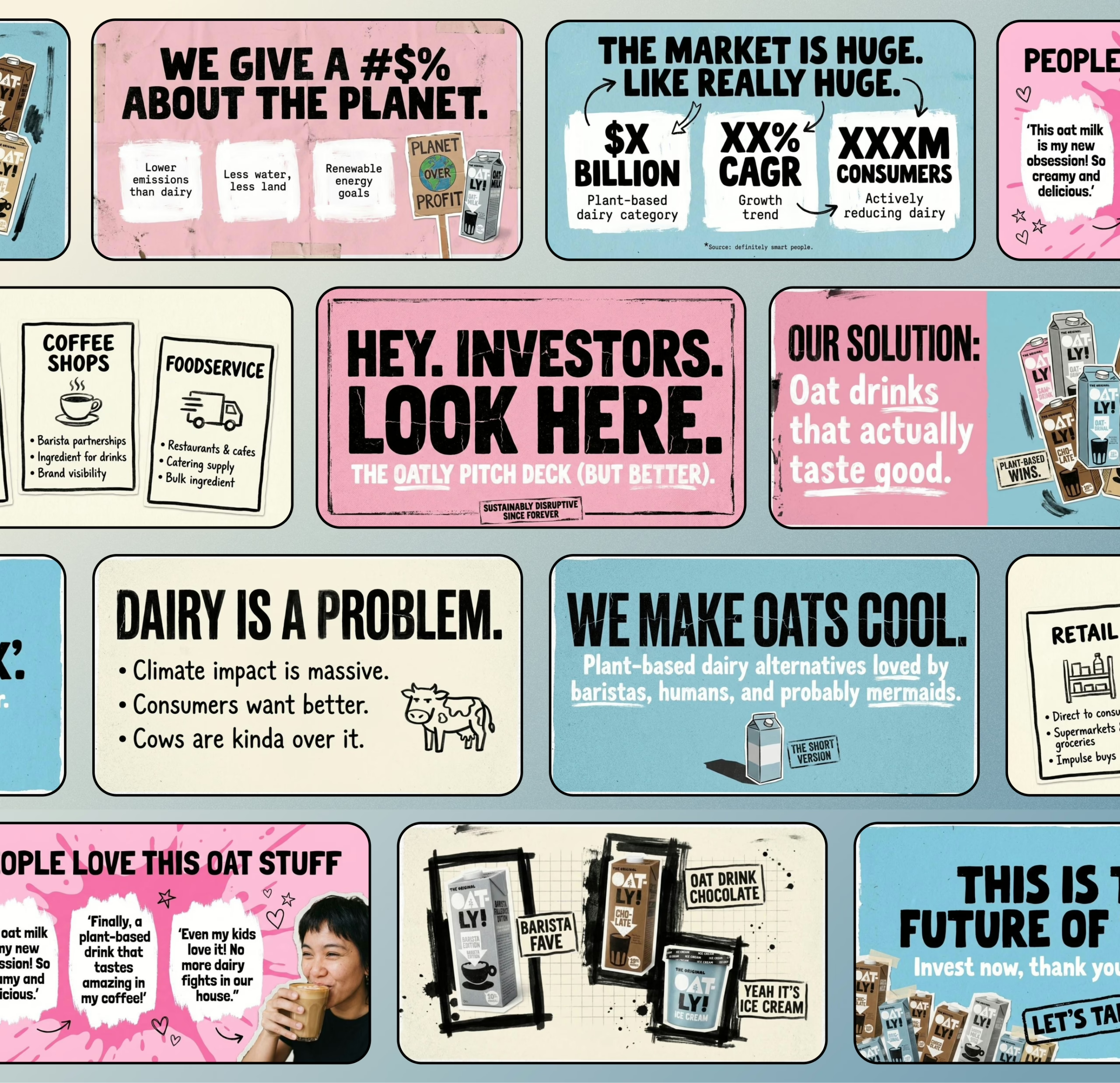
A pitch deck is a compressed decision interface. When a Hero’s Journey pattern is present, it usually isn’t announced — it’s embedded in how information is sequenced and how the audience’s mental model is shaped.
1) The deck opens by establishing the audience’s baseline
This is the “ordinary world” as evaluators understand it: category reality, workflow constraints, existing alternatives, or market friction. The narrative isn’t “what we do.” It’s “what reality currently looks like.” This tends to align with the role of an elevator pitch slide when it’s doing its job: orientation, not explanation.
2) The problem is framed as a disruption, not a complaint
The call to adventure is not “we noticed a gap.” It’s “a system constraint now demands change.” When this is weak, the pitch becomes nonfiction noise. When it’s clear, it tends to compel because the audience can locate the stakes. This is also where audience mismatch often happens — especially with technical teams — which is why the same structural issue shows up in pitch deck for non-technical investors.
3) The solution is positioned as a transformation mechanism
Not “features,” not “benefits,” but the mechanism that makes a different after-state possible. In practice, this aligns with how a pitch deck solution slide expresses change: before → intervention → after.
4) Traction functions as the ‘tests’ phase signal
Traction doesn’t just prove growth; it signals adaptation capacity under real conditions. If you want a clean expression of how this is typically structured, it maps to creating an impactful traction slide and the “signal selection” logic behind 10 ways to show momentum even with minimal metrics.
5) The close operates as ‘return with the elixir’
This is where the pitch stops being a description and becomes a coherent outcome. The elixir is not “our vision statement.” It’s the durable change: what becomes true if this exists at scale. This often shows up as a clean forward arc in the go-to-market slide and the overall narrative alignment described in how to present financials in a pitch deck (because financials are where fantasy gets exposed).
