


A pitch deck isn’t “a deck.” It’s a decision surface—a compressed view of a business idea that lets a specific evaluator decide what happens next. When people call a deck “weak,” they usually mean “it doesn’t match the evaluation context,” not that the slides are ugly.
This is why different types of business pitches matter. The same startup pitch deck can read as coherent in one room and scattered in another, simply because the audience is using a different scoring system. That distinction is the core tension behind the pitch deck vs pitchbook split, and it’s cleanly framed in how a pitch deck differs from a pitchbook.
Definition of a pitch deck
A pitch deck is a slide-based narrative that translates an opportunity into an evaluator-friendly structure: what the business is, what the market opportunity is, why it’s credible, and what the “next decision” is. It’s not a business plan, and it’s not meant to carry every detail—its job is to make the shape of the opportunity legible.
That “shape” tends to stabilize around a familiar slide logic (problem → solution → market → proof → team → ask), which is typically expressed through the structure outlined in how information is organized in a pitch deck.
Why different types matter
Different types of pitches exist because different audiences penalize different gaps.
- An investor pitch deck gets scrutinized for credibility, market size, competitive advantage, and growth potential.
- A sales pitch deck gets judged on clarity of value proposition, proof, and whether the buyer can map it to their own pain.
- A partnership pitch is evaluated through alignment, integration friction, and whether the incentives actually match.
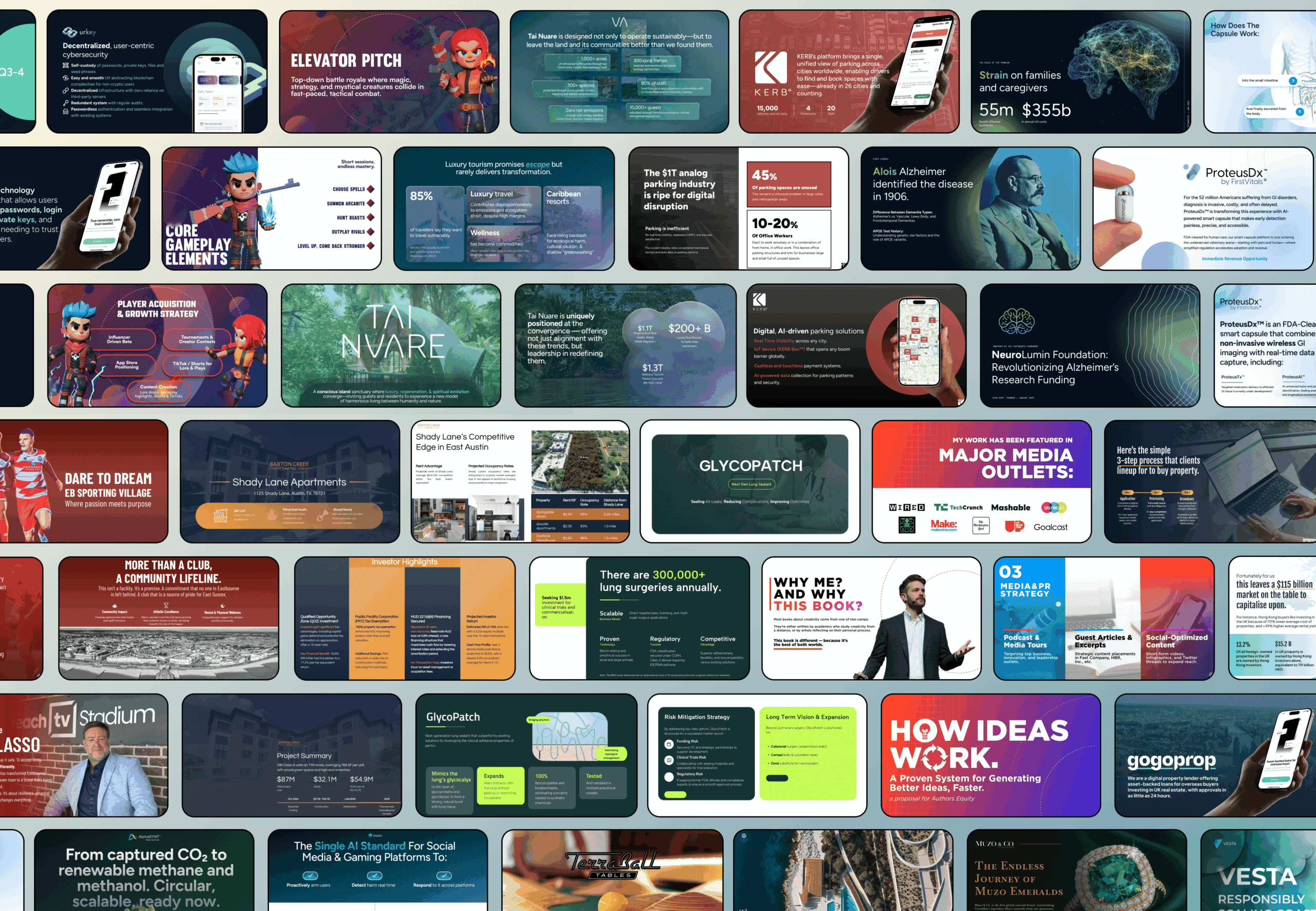
So “good content” isn’t universal—it’s conditional. A market opportunity slide can be essential in one pitch deck type and unnecessary in another. That mismatch is one reason teams accidentally ship the same set of slides everywhere and then wonder why the room’s energy dies.
This pattern shows up most clearly when teams try to reuse investor logic for non-investor audiences, which is exactly what tailoring a pitch deck for different investors is really about: changing what gets emphasized, not just changing words.
How to choose the right pitch deck
Choosing the right type of pitch deck is basically choosing the evaluator’s reading path. You can do it without overthinking:
- Audience: Who is this for (potential investor, customer, partner, internal team)?
- Objective: What decision must they make after the last slide?
- Stage + proof: What evidence exists right now (traction, customer testimonials, financial projections, competitive landscape)?
- Constraints: Time, attention span, and how technical the room is.
When those inputs are clear, the deck type becomes obvious—because the slide order naturally reorganizes itself around what the room can interpret as proof. If you want a clean example of how interpretation changes when the audience isn’t living inside startup metrics all day, this dynamic is visible in how pitch decks read differently for non-technical investors.
High-level Categories of Pitch Decks
Most pitch deck examples fall into a small set of categories because evaluation environments repeat.
The deck changes when the decision changes: raising capital, converting customers, aligning partners, demonstrating a product, aligning internal execution, recruiting, or reporting progress.
A useful way to separate categories is by what kind of proof the room treats as “real.” In fundraising contexts, proof is traction, market size, and financial projections; in sales contexts, it’s outcomes and customer testimonials; in partnerships, it’s operational fit and shared incentives. This dynamic is easy to see in how market opportunity language gets formalized, especially when teams use the familiar TAM/SAM/SOM framing described in how market sizing is typically expressed.
Fundraising decks
A fundraising deck is built for a potential investor who is evaluating risk, scale, and credibility under time pressure. It’s less about “telling the story” and more about aligning the slides with how capital decisions get made—what the business is, whether it can grow, and what evidence exists today.
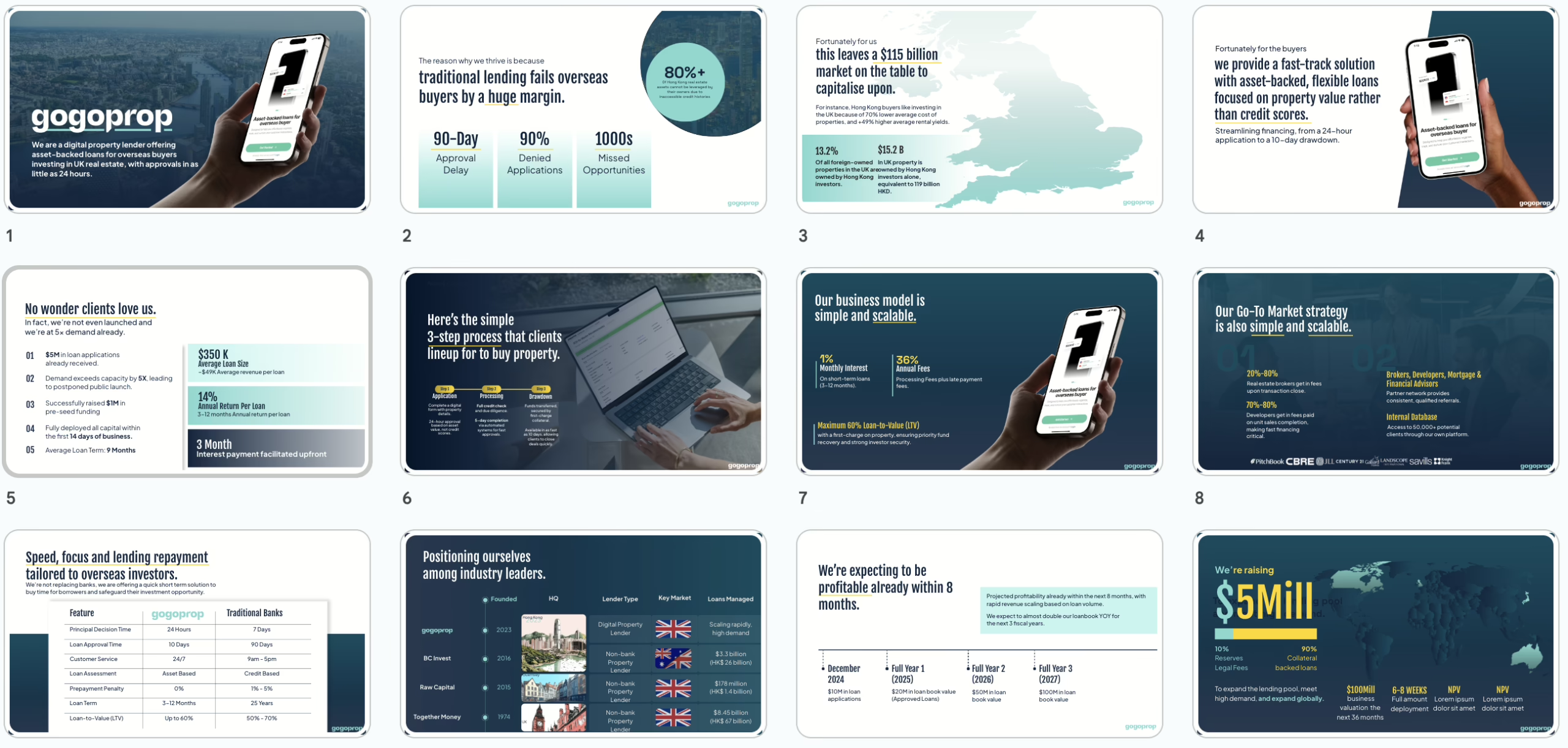
The process itself has a predictable rhythm (targeting, outreach, meetings, follow-ups), which is why fundraising decks tend to converge toward similar slide logic reflected in how the fundraising process typically unfolds.
Because the investor lens is evidence-first, fundraising decks usually make traction carry more weight than narrative style. That emphasis shows up as a dedicated proof sequence—metrics, usage, revenue signals, retention, pipeline—mirroring what’s described in how traction and growth are usually represented in a pitch deck.
Sales and commercial decks
A sales pitch deck is a customer pitch: it exists to help a buyer map your product or service to their own problem, then decide whether to move forward.
The “best pitch deck” in sales isn’t the most impressive—it’s the one with the clearest value translation, with proof placed where skepticism naturally shows up.
This is why sales decks lean hard on a clean value proposition, and that logic usually becomes explicit in a slide that behaves like a decision filter. You can see how that slide is commonly structured in what a value proposition slide tends to express.
Sales decks also tend to live or die on narrative compression: buyers don’t want your whole business model—just the part that solves the problem and reduces risk. That’s where clarity rules like the “10/20/30” constraint show up as an enforcement mechanism, not a design trend, as discussed in how the 10/20/30 rule shows up in pitch decks.
Partnership and collaboration decks
A partnership pitch is not a sales deck and not an investor pitch deck—it’s a coordination document.
The audience is typically asking: Does this align strategically? Can we integrate it? What does success look like together? The deck wins (or loses) on feasibility and incentives, not hype.
Because partnership decisions often hinge on “how we go to market together,” these decks usually need a clear integration + distribution story. That’s why the structure often manifests as a joint GTM narrative—roles, channels, ownership, milestones—which maps closely to what’s outlined in how a go-to-market slide is typically framed.
Partnership decks also require a sharper competitive frame than most teams expect, because partners don’t want to inherit ambiguity. This is where competitive landscape language becomes a coordination tool, consistent with how competitive analysis tends to be expressed for startups.
Product and demo decks
A product or demo deck exists for one job: reduce ambiguity about what the product or service actually does.
Unlike a fundraising deck (which is evaluated through growth potential and risk), a demo pitch is evaluated through comprehension and confidence—can the audience picture the workflow, the use case, and the outcome without needing a narrator to rescue the slide?

This is why product/demo decks often compress into fewer, tighter slides than people expect. That compression pattern is especially visible in formats like a one-pager deck structure, where clarity carries more weight than breadth.
Internal and team decks
Internal decks don’t exist to persuade outsiders—they exist to align interpretation inside the company.
The real output isn’t “a nice slide deck.” It’s shared understanding: what matters, what doesn’t, what’s next, and what the team will treat as evidence.
That’s why internal decks tend to lean on narrative scaffolding even when nobody calls it “storytelling.” The dynamic shows up as a familiar sequence—context → priorities → tradeoffs → milestones—which maps closely to the way teams borrow structure from common storytelling frameworks without turning internal alignment into theatre.
Recruiting and employer branding decks
Recruiting decks are evaluated like brand signals, not business plans. Candidates aren’t scanning for market size; they’re scanning for believability: mission, culture, expectations, growth path, and whether the team feels coherent. The deck works when it makes the company legible as a place to spend years, not weeks.
Because hiring decisions are heavily perception-driven, design choices don’t behave as decoration—they behave as cues. That’s why employer brand decks often benefit from the same perception mechanics discussed in color psychology as it shows up in pitch decks.
Investor update and milestone decks
Investor updates (and board-style decks) are evaluated through signal quality: what changed, what the numbers imply, what risks emerged, and what support is needed.
The deck is less a narrative arc and more a recurring measurement instrument—especially once the company has operating cadence.
This is also where sloppy numbers get punished fastest, because “good storytelling” can’t compensate for unclear runway, noisy KPIs, or muddled financial logic. That’s why these decks often mirror the structural expectations described in how financials are typically expressed in pitch decks.
Design and Content Principles Across Types
Regardless of deck type, strong pitch decks follow the same underlying rules—they just express them differently depending on audience and objective.
First, clarity beats completeness. A deck isn’t a data room.
Overloading slides weakens signal and slows evaluation, which is why decks that respect slide economy and hierarchy consistently outperform dense ones. This principle is reinforced in how effective decks manage slide count, pacing, and attention as outlined in guidelines around slide discipline and structure.
Second, audience-first customization is non-negotiable. The same metric can signal strength or irrelevance depending on who’s reading it. Good decks don’t just swap words—they re-weight slides based on what the audience treats as evidence.
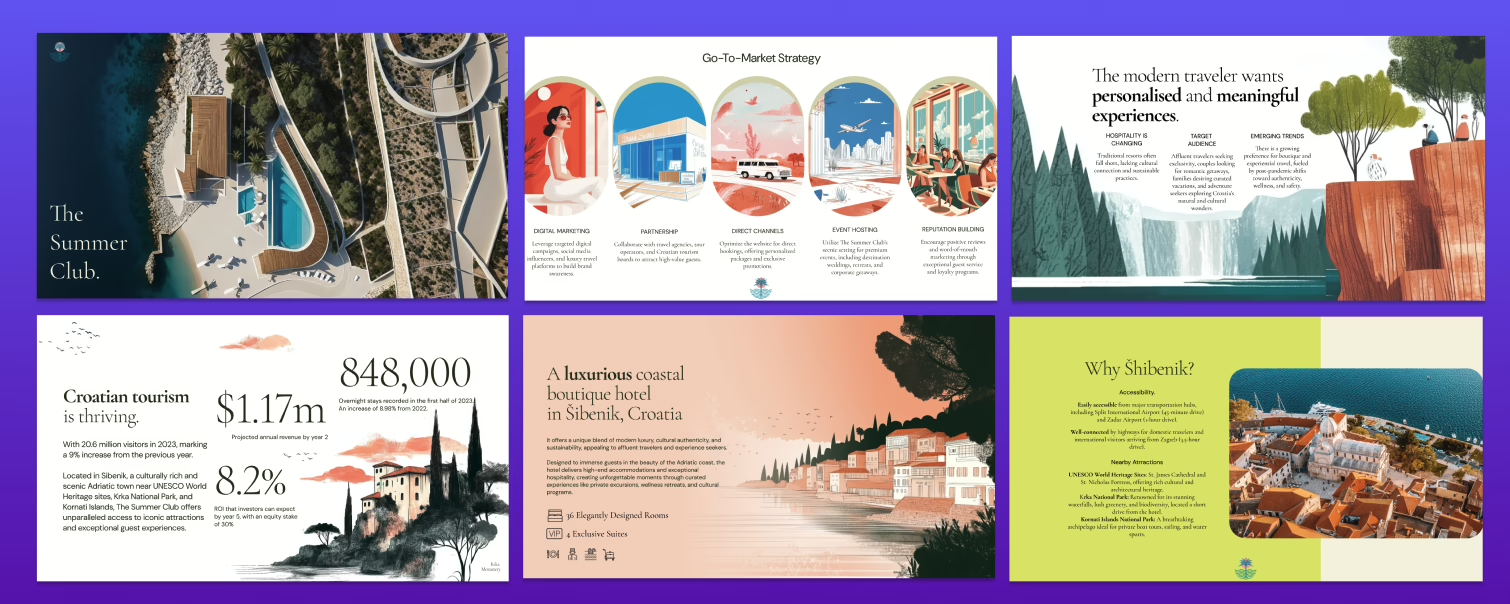
Third, claims must be evidence-backed. Whether that evidence is traction, customer proof, technical validation, or execution history depends on the deck type—but unsupported claims are punished in every context.
Finally, visual hierarchy and narrative flow matter more than visual flair. Branding should reinforce trust and comprehension, not distract. This is why consistent layout logic, typographic restraint, and repeatable slide patterns tend to show up across the strongest decks, regardless of industry.
When to Use Each Pitch Deck Type — Decision Guide
Choosing the right deck becomes easier when you map business scenarios to evaluator intent.
- If the goal is raising capital → use a fundraising deck
- If the goal is closing customers → use a sales or proposal deck
- If the goal is alignment with another company → use a partnership deck
- If the goal is explaining functionality → use a product/demo deck
- If the goal is internal execution → use an internal roadmap deck
- If the goal is attracting talent → use a recruiting or employer brand deck
- If the goal is reporting progress → use an investor update or board deck
A simple checklist helps prevent mismatch:
- Who is the audience?
- What decision are they making?
- What stage demonstrates credibility?
- What data actually exists today?
When those answers are clear, the deck type stops being a guess—and becomes an obvious constraint.
Common Mistakes and How They Vary by Deck Type
The most common mistake across all pitch decks is trying to do too much at once.
Fundraising decks often fail by overexplaining the product and under-explaining traction.
Sales decks fail by pitching the company instead of the outcome.
Partnership decks fail by selling upside without addressing integration friction.
Product decks fail by assuming context the audience doesn’t have.
Internal decks fail by being inspirational instead of operational.
Recruiting decks fail by promising culture without showing behavior.
Investor updates fail by telling stories instead of reporting signals.
Most of these failures trace back to one issue: the deck is optimized for the creator, not the reader.
Practical Tips for Customizing Any Deck
Start by cutting before adding. Remove slides that don’t directly support the decision at hand.
Next, prioritize slide order based on evaluator attention, not storytelling instinct. The first five slides do most of the work.
Then, pressure-test every claim: if asked “how do you know this?”—is the answer on the slide or one click away?
Finally, prepare for Q&A as a continuation of the deck, not a separate event. Good decks anticipate objections; great decks make the follow-ups predictable.
FAQ
What is a pitch deck and what is its purpose?
A pitch deck is a presentation designed to give an overview of your business and help an audience make a decision. The purpose of a pitch depends on context—raising money, winning customers, securing partners, or aligning a team. A well-crafted pitch deck highlights the most important aspects of your business model in a concise, compelling way.
What are the different types of pitch decks?
There are several types of business pitches, but most fall into 5–6 core types of pitch decks: fundraising decks, sales pitch decks, product pitch decks, partnership decks, internal decks, and investor update decks. Each type of pitch deck exists because different audiences evaluate opportunities differently.
How do I choose the right type of pitch deck?
To choose the right type of pitch, you need to identify your audience and objective. A startup pitch deck for a potential investor focuses on traction and growth, while a sales pitch deck focuses on customer pain points and outcomes. The best pitch deck is the one that matches how the audience makes decisions.
What should a startup pitch deck include?
A typical startup pitch deck includes slides covering the problem, solution, market opportunity, business model, traction, team, and funding ask. The goal is not to include everything, but to include what helps investors decide whether to invest in your business.
What are the best pitch deck examples to learn from?
The best pitch deck examples are real examples from successful startups that clearly show how the slide deck supports a winning pitch. Inspiring pitch deck examples work because they are tailored to a specific audience and purpose, not because they follow a generic template blindly.
Are pitch deck templates actually useful?
A pitch deck template is useful when it enforces structure and clarity. The right template helps you create a pitch deck faster while avoiding common mistakes. However, templates should always be customized—no single pitch deck template works for every type of pitch.
What is the difference between a sales pitch deck and an investor pitch deck?
A sales pitch deck is built to convert customers, while an investor pitch deck is built to help investors evaluate risk and return. Sales decks focus on benefits, use cases, and proof that the product works. Investor decks focus on market size, traction, and the ability to raise money at scale.
How many slides should a pitch deck have?
There’s no fixed rule, but most pitch deck presentations work best with 10–15 slides. The slide count matters less than clarity. A great pitch deck keeps the pitch tight, uses minimal text, and prioritizes the slides that drive the decision forward.
What makes a pitch deck compelling?
A compelling pitch combines a clear narrative, strong evidence, and clean presentation design. The most successful pitch decks focus on clarity, not decoration, and keep the pitch deck concise while still showing why the opportunity matters now.
Can a pitch deck help beyond fundraising?
Yes. Pitch decks are used to showcase products, pitch to customers, align internal teams, recruit talent, and report progress. Customer decks, product pitch decks, and internal decks all use the same core principles, adapted to different audiences and goals.
Conclusion
There is no single “perfect” pitch deck—only the right deck for the right moment.
Fundraising, sales, partnerships, product demos, internal alignment, recruiting, and investor updates all demand different proof, structure, and narrative emphasis. When teams choose the correct deck type first, everything else—design, content, and delivery—gets easier.
The next step is choosing the deck that matches the decision you’re asking someone to make.
