


Hold onto your hard hats—this is a practical execution guide for building a manufacturing pitch deck that clearly documents how your business works.
Manufacturing is evolving fast. New processes, new materials, new supply-chain realities. That pressure shows up in how manufacturing startups are reviewed. This guide doesn’t explain how capital decisions are made—that logic lives upstream—but it translates those expectations into build-level mechanics: what slides exist, what they contain, and how to structure operational clarity without noise.
I’m Viktor. I’ve spent the past 13+ years working at the execution layer of pitch decks—helping teams structure materials so complex businesses can be reviewed without guesswork.
If you’re looking for the broader industrial capital evaluation context, that lives here:
Industrial & Infrastructure Capital Evaluation
This page assumes that logic already exists—and focuses on how to implement it cleanly.
What Is a Manufacturing Pitch Deck?
A manufacturing pitch deck is a structured presentation used to document how a manufacturing business operates, scales, and maintains control across production.
At the execution level, this type of deck focuses less on abstract vision and more on operational clarity. It typically outlines how products are made, how processes are controlled, how quality is maintained, and how capacity expands without breaking margins or timelines.
Unlike decks in purely digital sectors, manufacturing decks must translate physical constraints—equipment, labor, supply chains, throughput, compliance—into slides that can be reviewed consistently. The goal is not persuasion; it’s making the operation legible to external reviewers who need to understand whether the system holds together.
Now, let’s see the step by step execution of a pitch deck for a manufacturing startup.
Step 1: Lock your deck type (what you’re building)
Before slides, decide which version you’re producing:
- Teaser deck (10–12 slides): fast overview, minimal detail
- Full review deck (15–20 slides): includes operations, unit economics, capacity logic
- Data-room companion (optional): deeper appendices (process maps, QA, specs)
Rule: Don’t cram “data room” material into the core deck. Put it in appendix or supporting docs. Deck length constraints vary by stage and context, which is why pitch deck length matters when deciding what belongs in the core deck versus the appendix.
Step 2: Write the “one-line operational truth”
One sentence that forces clarity:
“We manufacture [product] using [process] to deliver [measurable advantage], at [cost/time/quality target].”
If you can’t write this, your slides will waffle. This sentence functions similarly to an elevator constraint, forcing clarity before slides expand—especially useful when refining a one-sentence elevator pitch before deck assembly.
Step 3: Map the factory story (your slide order)
Manufacturing decks get messy when they jump between “market” and “machines.”
Use this sequencing logic:
- What it is → 2) Why it exists → 3) How it’s made → 4) How it scales → 5) How quality stays intact → 6) How money works
That’s it. That’s the spine. Slide order failures usually stem from weak framing logic, which is why framing your pitch deck early prevents narrative jumps later.
Step 4: Build your operational proof stack (assets you’ll need)
Collect these before you design:
- Process overview (5–7 steps, simple)
- Capacity numbers (current + next 12–24 months)
- Cost structure (unit economics drivers)
- QA/QC standards + testing flow (high level)
- Supply chain inputs (critical items + risk points)
- Photos: prototype, production setup, outputs
- Any certifications/compliance (if relevant)
Rule: If you don’t have numbers, use ranges + assumptions and label them. Manufacturing decks often collapse under excess detail, a common issue explored in text-heavy vs image-heavy pitch deck execution.
Step 5: Choose 3 “review anchors” and repeat them
Manufacturing decks are judged on clarity, not creativity.
Pick 3 anchors and use them across slides:
- Throughput (units/time)
- Yield/defect rate (quality)
- Unit economics driver (cost per unit, margin per unit)
Your deck becomes readable when these recur. Repeating operational anchors improves clarity, a principle borrowed from visual storytelling techniques used in complex pitch decks.
Step 6: Draft slide copy in bullets first (no design yet)
Do not design until the bullets work.
- Max 5 bullets per slide
- Each bullet should be one claim + one proof hook
- Avoid paragraphs
If a slide needs paragraphs, it’s usually two slides. When bullet density creeps up, it’s often a symptom of unresolved layout issues outlined in common pitch deck layout mistakes.
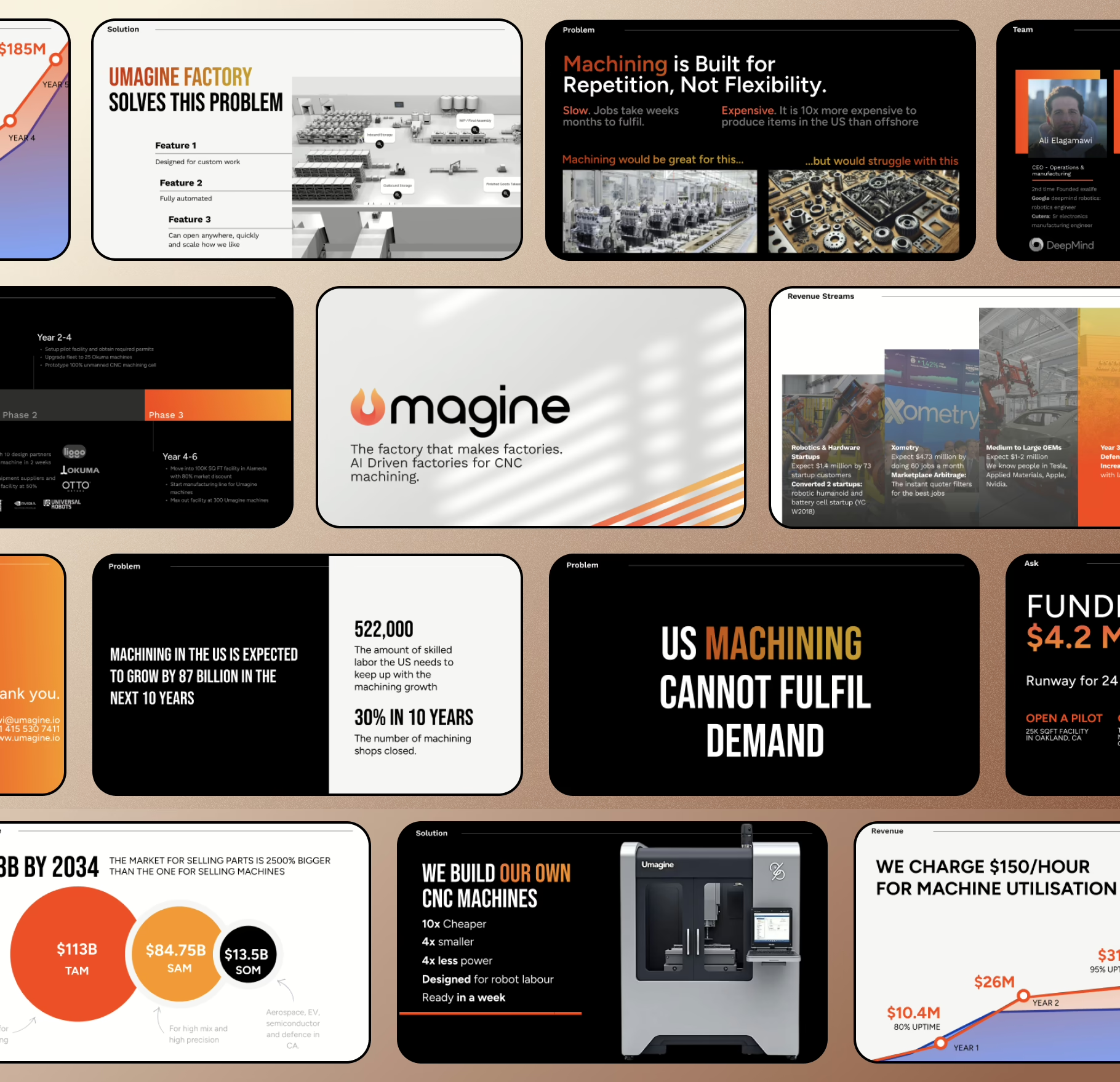
Step 7: Convert bullets into visuals (make complexity legible)
Manufacturing needs diagrams, not adjectives. Use:
- Process diagram (inputs → steps → output)
- Capacity ladder (today → next → scaled)
- Cost waterfall (materials, labor, overhead)
- Quality loop (inspection points + feedback)
- Supply chain map (critical dependencies)
If a slide can be spoken and understood in 10 seconds, you’re good. Many visual breakdowns trace back to avoidable design errors covered in visual design mistakes founders make in pitch decks.
Step 8: Add “constraint honesty” (without self-sabotage)
Good execution decks don’t hide constraints—they frame them.
Include:
- what’s constrained (equipment / suppliers / hiring / certification)
- what you’ve done about it (mitigation)
- what the next unlock is (capex / partner / facility / tooling)
This reduces “interpretation risk” during review. Constraint framing is frequently mishandled, often triggering unnecessary concern as described in investor red flags caused by execution gaps.
Step 9: Stress test the deck with the “non-expert read”
Give it to someone who doesn’t know manufacturing.
Ask them to answer:
- What do you make?
- How do you make it?
- What makes it hard to copy?
- What breaks at scale?
- How does the business make money?
If they can’t answer in 2 minutes, tighten. This quick-read test aligns with the first 15 seconds test used to assess initial deck clarity.
Step 10: Package your deliverables (deck + appendix + numbers)
Final output should be:
- PDF deck
- Appendix (optional): deeper specs/process/QA
- Financial model snapshot (even if basic)
Your deck shouldn’t carry every document. It should point to them cleanly.
Manufacturing Pitch Deck Execution Template (Copy/Paste)
Use this as your default slide build. You can run it as 12 slides (tight) or expand to 18 (full review).
Slide 1 — Title
Company name + what you manufacture + one-line operational truth
Optional: facility/location, stage (prototype/pilot/production)
Slide 2 — The Problem (real-world, operational)
Describe the pain in physical terms:
- cost
- lead time
- reliability
- compliance
- waste
Avoid: generic “industry is big” talk here.
Slide 3 — Solution (what it is + why it’s different)
- What you produce
- What’s new about it (materials/process/design)
- What outcome improves (time/cost/quality)
Slide 4 — Product Snapshot (show it)
- Photo/render
- key specs (3–5)
- variants (if any)
Execution tip: Make this slide visual-first.
Slide 5 — Manufacturing Process (the core diagram)
A simple 5–7 step flow:
Inputs → Process steps → Output → QC points
This is the “no guesswork” slide.
Process slides fail most often when structure isn’t simplified, which is why the art of simplification applies directly to manufacturing diagrams.
Slide 6 — Quality Control & Standards (high-level)
- how quality is measured
- where inspection happens
- standards/certs (if applicable)
- defect/yield targets (even ranges)
Slide 7 — Supply Chain & Sourcing (critical dependencies)
- top 3 critical inputs
- key suppliers/regions (high-level)
- risk points + mitigation (one line each)
Slide 8 — Capacity & Scalability (the ladder)
Show:
- current throughput
- next capacity milestone
- scaled target
- what unlocks each step (tooling, facility, hires, partner)
Slide 9 — Unit Economics (manufacturing version)
Keep it mechanical:
- major cost drivers (materials/labor/overhead)
- target margin range
- what improves with scale (learning curve, yield, purchasing)
Unit economics confusion typically surfaces in projections, a problem detailed in revenue mistakes commonly found in pitch decks.
Execution tip: Don’t fake precision—label assumptions.
Slide 10 — Go-To-Market (manufacturing reality)
- who buys
- how you sell (direct, channel, integrators, OEM)
- sales cycle (range)
- pricing logic (simple)
Slide 11 — Traction (proof of movement)
Use any credible signals:
- pilots
- LOIs (label them clearly)
- production runs completed
- partnerships
- repeat orders / reorders
- test results
Slide 12 — The Ask / Next Build Phase
Frame as execution needs:
- what’s being funded (tooling, hiring, facility, certification, inventory)
- what it unlocks (capacity milestone)
- timeline (90/180/365 days)
Optional Expansion Slides (use when needed)
Slide 13 — Competitive Alternatives (not “competitors”)
Compare process/cost/time/quality vs existing alternatives.
Slide 14 — Team (operators + builders)
Show who owns operations, engineering, QA, supply chain.
Slide 15 — Roadmap (manufacturing milestones)
Pilot → small batch → repeatability → scaled run.
Slide 16 — Risks & Mitigation (mature, calm)
Supply risk, certification risk, ramp risk—what you’re doing about each.
Slide 17 — Financials (simple, tied to capacity)
Revenue tied to throughput assumptions (clearly labeled).
Financial credibility usually breaks when projections disconnect from capacity logic, which is why how to present financials in a pitch deck matters at the execution stage.
Slide 18 — Appendix (optional)
Process detail, specs, photos, test results.
Let’s move on to some of the most frequently asked questions.
Frequently Asked Questions (Execution)
How long should a manufacturing pitch deck be?
Most manufacturing decks fall between 12–18 slides, depending on how much operational detail is required. The goal is clarity, not compression. Detailed process documentation can live in appendices.
Should manufacturing certifications be included in the deck?
Only at a high level. Certifications and compliance markers should be referenced briefly, with deeper documentation available separately if requested.
Do I need a full factory layout diagram?
No. A simplified process flow is usually sufficient. Detailed layouts are better placed in supporting materials rather than the core deck.
How detailed should unit economics be?
Unit economics should focus on key cost drivers and assumptions. Precision is less important than traceability between production capacity and financial outcomes.
Is it acceptable to show estimated or projected capacity?
Yes, as long as assumptions are clearly labeled and tied to specific execution milestones (equipment, hiring, facilities).
What’s the most common execution mistake in manufacturing decks?
Overloading slides with technical detail instead of structuring information so it can be reviewed quickly and consistently.
Final Notes on Execution
A manufacturing pitch deck doesn’t succeed because it sounds ambitious—it succeeds because it removes ambiguity.
Clear process flows, realistic capacity logic, traceable unit economics, and honest constraints make a deck easier to review, easier to discuss, and easier to validate. When those elements are structured cleanly, the deck stops trying to persuade and starts functioning as documentation.
This guide is designed to help you assemble that documentation with discipline. If each slide answers a specific operational question—and no slide tries to do more than one job—the deck holds together under scrutiny.
At this stage, quality is less about polish and more about coherence. Build for clarity first. Refinement comes later
