

Author: Viktor
Pitch Deck & Fundraising Consultant. Ex Advertising. Founder of Viktori. $500mill In Funding. Bald Since 2010.
The 12 Slide Plastic Bottle Recycling Pitch Deck Template
Slide 1 – Elevator Pitch
Headline:
Turning the world’s plastic waste crisis into a profitable, sustainable resource.
Subtext / Supporting Line:
We recycle plastic bottles into high-quality raw materials, helping companies cut costs, meet ESG targets, and reduce ocean and landfill waste.
Visual Cue:
Side-by-side: “Plastic Waste Pile” → “New Bottles / Products”
Keep it bold and simple.
Talking Point:
“This isn’t just recycling—it’s transforming a global problem into a scalable circular economy solution.”
Slide 2 – Investor Highlights
Headline:
Why Invest in Plastic Bottle Recycling Now
Key Bullets (customizable placeholders):
Massive Market: $XX billion global recycling industry growing at X% CAGR.
High Demand: Governments and corporations under pressure to meet sustainability targets.
Proven Solution: Our technology achieves XX% higher yield at XX% lower cost.
Scalable Model: Modular facilities that expand with demand.
Impact + ROI: Every bottle recycled delivers profit and environmental benefit.
Visual Cue:
Infographic showing “Market Size,” “Growth Rate,” and “Scalability.”
Slide 3 – The Problem (Name the Enemy)
Headline:
The World is Drowning in Plastic Bottles
Key Data Points:
Over 1 million plastic bottles are purchased every minute globally.
91% of plastic is not recycled.
By 2050, oceans could contain more plastic than fish (World Economic Forum).
Landfills and incineration release toxins and CO₂.
Visual Cue:
Striking photo: ocean plastic pollution or landfill stacked with bottles.
Talking Point:
“The enemy isn’t just plastic—it’s the outdated, inefficient systems that fail to reclaim and reuse it.”
Slide 4 – The Market Opportunity
Headline:
A Trillion-Dollar Circular Economy
Content Structure:
TAM (Total Addressable Market): Global plastic packaging market = $XXB.
SAM (Serviceable Market): Recycled plastics market = $XXB, growing at X%.
SOM (Serviceable Obtainable Market): Entry niche (e.g., PET bottle recycling in North America/Europe).
Drivers:
Regulations: bans on single-use plastics, mandates for recycled content.
Consumer pressure: brands committing to sustainable packaging.
Corporate ESG investment.
Visual Cue:
TAM–SAM–SOM bullseye diagram.
Slide 5 – The Unique Solution
Headline:
The Missing Piece in Plastic Recycling
Key Value Props (generic placeholders):
Higher Quality: Produces food-grade PET that matches virgin plastic.
Lower Cost: XX% reduction in energy and processing expenses.
Scalable Design: Modular units adaptable for local and global rollouts.
Verified Impact: Traceable recycling with blockchain or digital tracking.
Visual Cue:
“Before & After” visual: Waste bottles → New bottles/products.
Talking Point:
“Our process doesn’t just recycle—it creates a continuous loop where bottles become bottles again, at scale.”
Slide 6 – How It Works (Show, Don’t Tell)
Headline:
From Waste to Value: A Simple Process
Process Flow (visual roadmap):
Collection: Bottles sourced from municipalities, retailers, and partners.
Sorting & Cleaning: Automated systems remove contaminants.
Processing: Proprietary technology converts bottles into high-grade resin/pellets.
Resale & Reuse: Resin sold back to manufacturers to create new bottles and packaging.
Visual Cue:
Linear flow diagram with arrows and icons.
Talking Point:
“Our system integrates with existing waste management, turning plastic into a renewable raw material without disrupting supply chains.”
Slide 7 – Customer Benefits (Sell Benefits, Not Features)
Headline:
Why Customers Choose Recycling-as-a-Service
Stakeholder Benefits:
Beverage & Packaging Companies: Lower raw material costs, meet mandatory recycled-content regulations, strengthen brand reputation.
Governments & Municipalities: Reduce landfill volumes, meet sustainability goals, create green jobs.
Investors: Profitable returns in a high-growth sustainability sector with long-term regulatory tailwinds.
Visual Cue:
3-column chart: “Corporates – Governments – Investors” with benefits listed under each.
Talking Point:
“This isn’t just about recycling; it’s about delivering measurable business value to every stakeholder.”
Slide 8 – Traction / Proof (Build Trust)
Headline:
Validation and Early Momentum
Content Options (customizable):
Pilot Projects: Successful demonstration with [brand/municipality placeholder].
Partnerships: LOIs or MOUs with beverage producers, retailers, or governments.
Impact Metrics: Tons of plastic recycled, CO₂ emissions saved, cost reductions achieved.
Patents/Tech Validation: Certifications for food-grade recycled PET.
Visual Cue:
Logos of partners (or placeholders).
Chart showing recycling volume growth.
Talking Point:
“We’ve proven our process works—and the market is already engaging with us.”
Slide 9 – Business Model
Headline:
Multiple Revenue Streams in a Growing Market
Core Revenue Streams:
Material Sales: Selling recycled PET pellets to packaging and consumer goods companies.
Licensing Model: Licensing recycling technology to regional operators.
Service Contracts: Long-term recycling partnerships with corporations and governments.
Carbon Credits & ESG Incentives: Additional monetization through verified impact reporting.
Visual Cue:
Simple revenue wheel or pie chart showing breakdown.
Talking Point:
“Our model generates recurring revenue while aligning profitability with sustainability.”
Slide 10 – Go-To-Market Strategy
Headline:
Scaling from Local Impact to Global Reach
Phased Approach:
Phase 1: Secure pilot partnerships with beverage brands and municipalities.
Phase 2: Establish regional facilities near high plastic waste concentrations.
Phase 3: Expand globally through licensing and joint ventures.
Channels & Leverage:
Strategic alliances with FMCGs.
Government partnerships for collection rights.
ESG-driven investors backing expansion.
Visual Cue:
World map with rollout phases.
Talking Point:
“Our growth strategy mirrors the scalability of our technology—modular, adaptable, and global.”
Slide 11 – Financials & Projections
Headline:
Clear Path to Scale and Profitability
3–5 Year Projection (placeholders):
Year 1: $X revenue, initial pilot projects.
Year 3: $X revenue, multiple regional facilities.
Year 5: $X revenue, international expansion with strong EBITDA margins.
Key Assumptions:
Cost per ton reduced by XX%.
Growing adoption driven by regulations.
Long-term contracts ensuring stable cash flows.
Visual Cue:
Bar chart of projected revenue and EBITDA growth.
Talking Point:
“With regulatory momentum and customer demand, growth is not speculative—it’s systemic.”
Slide 12 – Team & Vision
Headline:
A Team Built for Scale and Impact
Team Structure (placeholders):
CEO / Founder: [Background in recycling/cleantech/operations].
CTO: [Expert in polymer science, process engineering].
COO: [Experience scaling industrial operations].
Advisors: [Regulatory experts, FMCG veterans, sustainability leaders].
Vision Statement:
“To eliminate plastic bottle waste worldwide by creating a circular economy where every bottle has endless life.”
Closing Call-to-Action:
“Join us in building a world where sustainability and profitability go hand-in-hand.”
Visual Cue:
Team photos (or placeholders) with expertise tags.
Inspiring background image (clean ocean, recycling loop graphic).
Need a customized pitch deck template?
1000s of individuals like you asked for a tailored version of this template to help them craft a better pitch deck. Get yours for just $44. As soon as I get your request, I’ll follow up with one question to confirm what exactly is that are you pitching. This will help me nail the content for you.
What you’ll get is a 3+ page editable word document that contains a fully fleshed out slide by slide deck content for your pitch.
Alternatively, book a call and you’ll brief me on the specifics of your pitch.
Book The Free 30 Min Call
5/5 Upwork Rating | 100% TrustPilot

Plan on building the pitch deck yourself?
Option 1: Do It Yourself
If you’ve done a few presentation in the past, then this is the option you should take. Follow these simple steps:
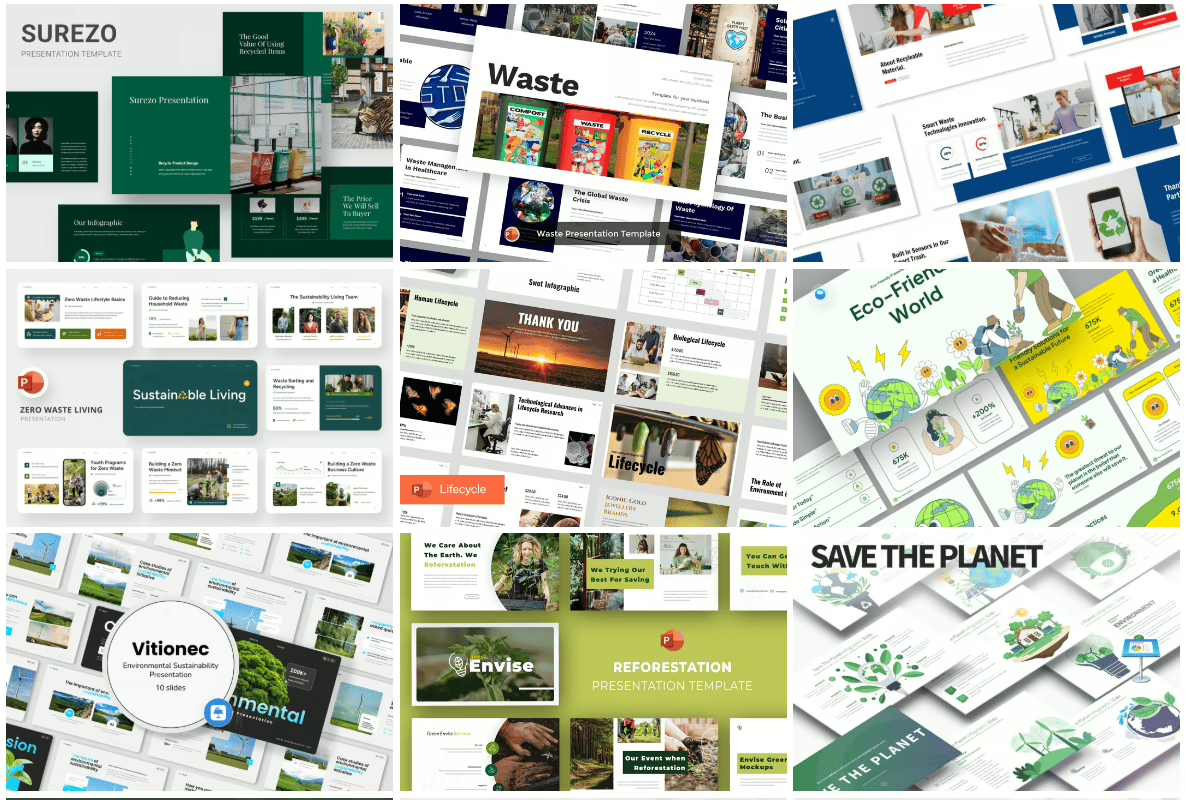
- Pick one of the premium Envato templates by clicking on the image below,
- Answer the slide by slide questions I listed in the section below the image
- Follow the pitch deck guide I linked out to, next to the questions,
And build your own deck. It’s as easy as that.
Key Questions to Ask Yourself And Write The Plastic Bottle Recycling Pitch Deck Slides
Slide 1 – Elevator Pitch
What is your one-sentence description of the company/solution?
What problem are you solving, and for whom?
How is your solution different from existing approaches?
If you had 10 seconds with an investor, what would you say?
Slide 2 – Investor Highlights
What are the top 3–5 reasons an investor should pay attention?
What is the size of the market you are entering?
What traction or early wins do you have (partnerships, pilots, revenue)?
What makes your solution uniquely investable right now (timing, regulations, tech)?
Slide 3 – The Problem (Name the Enemy)
What is the biggest pain point in the plastic bottle lifecycle?
What happens if this problem is not solved (environmental, regulatory, financial costs)?
Who feels this pain the most (governments, corporations, consumers)?
Can you share 1–2 powerful statistics that show urgency?
Slide 4 – The Market Opportunity
What is the total size of your target market (TAM)?
Which portion of that market is realistically serviceable (SAM)?
What share do you plan to capture initially (SOM)?
Who are your first target customers?
What industry trends, regulations, or consumer shifts support rapid growth?
Slide 5 – The Unique Solution
What is your core technology or process?
How does it work in simple terms (as if explaining to a 10-year-old)?
What makes your solution better (cheaper, faster, more sustainable)?
Do you have IP (patents, proprietary methods)?
What’s the “before and after” transformation for customers or the environment?
Slide 6 – How It Works
What are the key steps in your recycling process?
How does your solution integrate with existing waste collection systems?
What outputs are created (e.g., pellets, food-grade PET, energy)?
How long does the process take vs. traditional recycling?
What proof exists that this process delivers consistent quality?
Slide 7 – Customer Benefits
Who are your primary customers (corporates, governments, NGOs)?
What top 3 benefits do they get (cost savings, compliance, brand value)?
How do you measure these benefits (metrics, ROI, impact reports)?
Do you have testimonials, pilot data, or case studies?
Slide 8 – Traction / Proof
What traction do you have so far (pilots, LOIs, paying customers)?
What measurable results can you show (tons recycled, costs saved, CO₂ avoided)?
Which partnerships or endorsements validate your approach?
Do you have regulatory or third-party certifications?
Slide 9 – Business Model
How do you make money (direct sales, licensing, service contracts, carbon credits)?
What are your pricing models (per ton, per contract, subscription)?
What are your margins today, and how will they improve with scale?
Do you have recurring revenue opportunities?
Slide 10 – Go-To-Market Strategy
Who are your first customers/partners, and how will you reach them?
What sales channels or partnerships are most important?
What is your phased rollout (local → regional → global)?
What barriers to entry exist, and how will you overcome them?
How will you differentiate from competitors?
Slide 11 – Financials & Projections
What are your projected revenues and costs over 3–5 years?
What assumptions drive these numbers (adoption rate, facility capacity, cost reductions)?
When do you expect to break even?
What is the CAPEX/OPEX required for scaling?
What is the investor return potential (IRR, multiple)?
Slide 12 – Team & Vision
Who are the founders and core team members?
What unique expertise or track record do they bring?
Do you have advisors, partners, or industry veterans backing you?
What is your long-term vision for impact and scale?
If successful, what does the world look like in 10 years because of your company?

Follow My Recycling Pitch Deck Guide
A detailed guide with the steps outlined to get to a investor ready deck.
Related Recycling Pitch Deck Templates

Other Resources




Viktori. Pitching your way to your next funding.
Locations
Office 1: 633 North Wells Street Chicago, IL, United States, 60654
HQ: Boulevard P.O. 10000 Skopje, North Macedonia
Pitch Deck Resources
Case Studies
Client Reviews