


A pitch deck isn’t a PDF you “send over.” It’s a compressed story that answers one brutal question: “Should we lean in… or move on?” Investors don’t fall in love with your feature set. They buy into a trajectory—a problem that’s expensive, a solution that’s inevitable, and a team that looks annoyingly capable of pulling it off.
Storytelling is what makes that trajectory feel obvious. Not fluffy “hero’s journey” theatre—real-world clarity: who hurts, why it matters now, what changes with you, and what proof reduces risk. If your deck does that, it becomes memorable. If it doesn’t, it becomes “nice deck” (which is investor-speak for “no”).
Here’s the structure I use to turn a pile of startup facts into a pitch that reads clean, lands fast, and holds up under questions.
TL;DR
A strong pitch deck is not a design exercise or a slide presentation full of facts. It’s a structured narrative that helps investors quickly decide whether a startup is clear, credible, and worth leaning into.
The most effective pitch deck does three things well:
- Captures attention fast with a specific problem and sharp insight.
- Conveys a clear mechanism showing how the solution actually works.
- Builds conviction through metrics, validation, and a believable path to scale.
Great storytelling in a pitch is less about theatrics and more about coherence. The story must be easy to follow, grounded in reality, and built around a trajectory investors can visualize:
current state → solution → traction → scale.
A powerful pitch balances emotional relevance (why this matters) with logical structure (why this works). When done well, it transforms complex ideas into something investors can evaluate quickly and remember accurately.
High-performing decks typically:
- Focus on one key idea per slide
- Use visuals and metrics to support claims
- Show clear ROI potential and market relevance
- Demonstrate traction or validation
- End with a precise fundraising ask and next step
If your pitch deck presentation feels cohesive and easy to follow, investors spend less time decoding and more time evaluating. That shift alone can dramatically improve fundraising outcomes.
Principle 1: audience-first narratives.
A pitch deck is read inside an evaluation environment. That matters because the “default” mindset isn’t curiosity—it’s comparison. The same set of slides can feel coherent to a founder and incoherent to an investor, simply because the investor is sorting information by risk, path-dependence, and what would need to be true next.
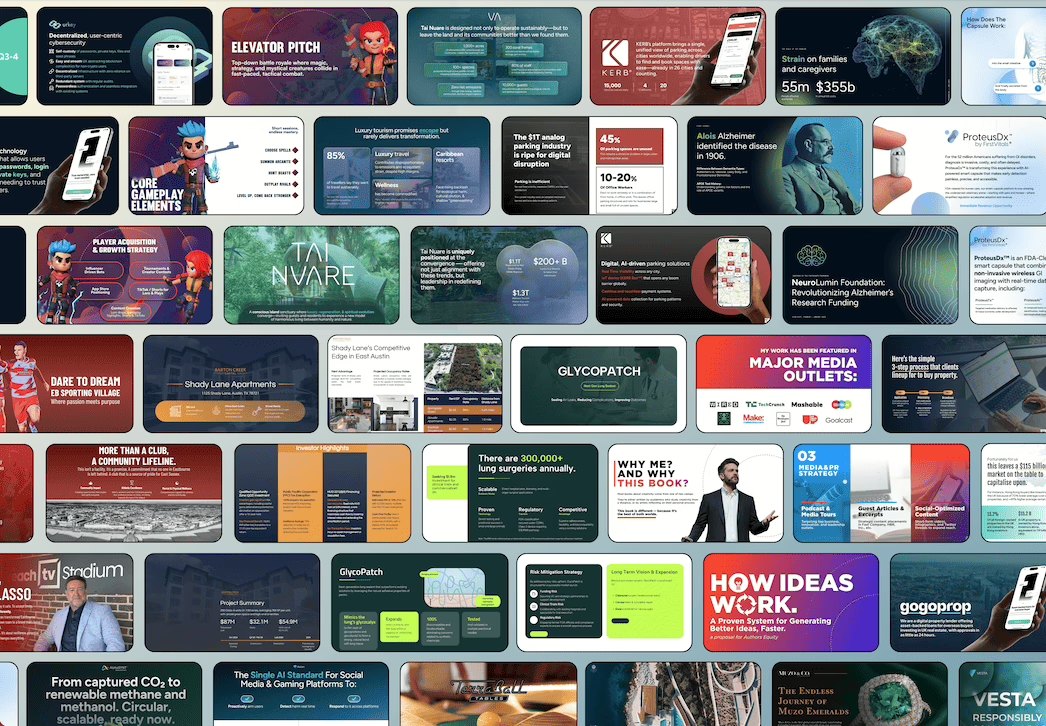
This dynamic reflects why decks tend to land better when they’re explicitly shaped by audience context rather than founder chronology. You can see this framing pressure described in how decks are adapted across different investor contexts in tailoring a pitch deck for different investors.
Principle 2: Simplicity.
Most decks overload because founders are trying to “be thorough.” But under attention pressure, thoroughness becomes noise. When a slide carries multiple claims, the audience chooses one and drops the rest—or tries to integrate everything and loses the thread.
This pattern shows up as decks that feel like a Wikipedia page: technically informative, practically unreadable. The corrective principle isn’t minimalism for aesthetics; it’s reduction for comprehension. That reduction logic is described directly in the art of simplification.
Principle 3: Emotional + logical balance
A deck doesn’t start as a spreadsheet in the reviewer’s mind. It starts as a question: Is this problem real enough to reorganize capital around? That “real enough” assessment is partially quantitative (cost, frequency, urgency), but it’s also interpretive (does it feel like a persistent constraint, or a founder’s pet annoyance).
Emotion here isn’t performance. It’s materiality—human or operational consequences that make the problem feel heavy. This dynamic is treated as a response pattern (not a tactic) in emotional storytelling for pitch decks.
Principle 4: Clarity of trajectory
Many decks “say” the future, but they don’t show the transition. Investors track movement because movement implies causality: current state → intervention → new state. When that causality is unclear, later slides (market, traction, financials) stop behaving; they feel inflated, detached, or decorative.
This is typically expressed through clean contrasts (before/after), crisp milestones, and a visible path of de-risking, rather than aspirational language.
Principle 5: Credibility.
Credibility rarely arrives as a single killer slide. It accumulates when each part of the narrative matches the others: your problem definition matches your buyer, your buyer matches your channel, your channel matches your sales motion, your motion matches your unit economics.
The most fragile point is usually the early framing of pain—because it defines what later proof should look like. That framing pressure shows up in the structural expectations around the problem slide.
Narrative arc for a pitch deck
A pitch deck is often described as “telling a story,” but the useful version of that statement is simpler: the deck needs to behave like a coherent argument. Investors aren’t primarily absorbing your narrative voice; they’re testing whether the sequence of claims holds together under scrutiny.
Hook: attention is allocated, not granted
The hook exists because attention is scarce and the evaluator has alternatives. It works when it makes the problem feel inevitable rather than merely interesting: a sharp observation, a data point that reframes the market, a founder moment that immediately reveals the constraint.
The hook is also where decks often go wrong by trying to be “grand.” Big statements without grounding create skepticism, not curiosity.
Problem: specificity creates belief
A problem statement is believed when it’s bounded: who experiences it, how often it occurs, what it costs, what breaks when it persists. If the problem is vague, everything downstream becomes difficult to evaluate because the audience can’t tell what the solution is actually solving.
This dynamic reflects why problem framing is treated as its own structural unit rather than “part of the intro,” and you see the solution-to-problem relationship formalized in problem–solution slide patterns.
Solution: mechanism is the point, not features
Once the problem is accepted, the evaluator shifts from “is this real?” to “does this actually work?” At this moment, vague language is expensive. The deck needs to show the mechanism clearly enough that a skeptical reader can trace cause to effect.
This is typically expressed through product clarity—screens, flows, diagrams, or a crisp value mechanism—rather than feature lists. You can see this structural emphasis in the solution slide framing.
Market: context that constrains, not context that inflates
Market slides are strongest when they function like boundaries, not bragging. A big TAM doesn’t reduce uncertainty by itself. But a clear entry wedge, a visible ICP, and a segment that matches your go-to-market motion does.
That boundary-setting logic is typically expressed through TAM / SAM / SOM framing when it’s used as segmentation discipline, not as hype math.
Traction: proof beats promise
Traction isn’t “good news.” It’s the point where the story becomes anchored in reality. It works when the metrics match the earlier claims: if you said the problem is urgent, the adoption behavior should reflect urgency; if you said switching is hard, the retention behavior should reflect stickiness.
This pattern shows up as coherent proof arcs in traction and growth framing.
Business model + GTM: the narrative meets physics
Once the deck hits business model and go-to-market, the evaluator is looking for alignment: pricing logic that matches buyer psychology, sales motion that matches deal size, channels that match time-to-close, margins that don’t collapse at scale.
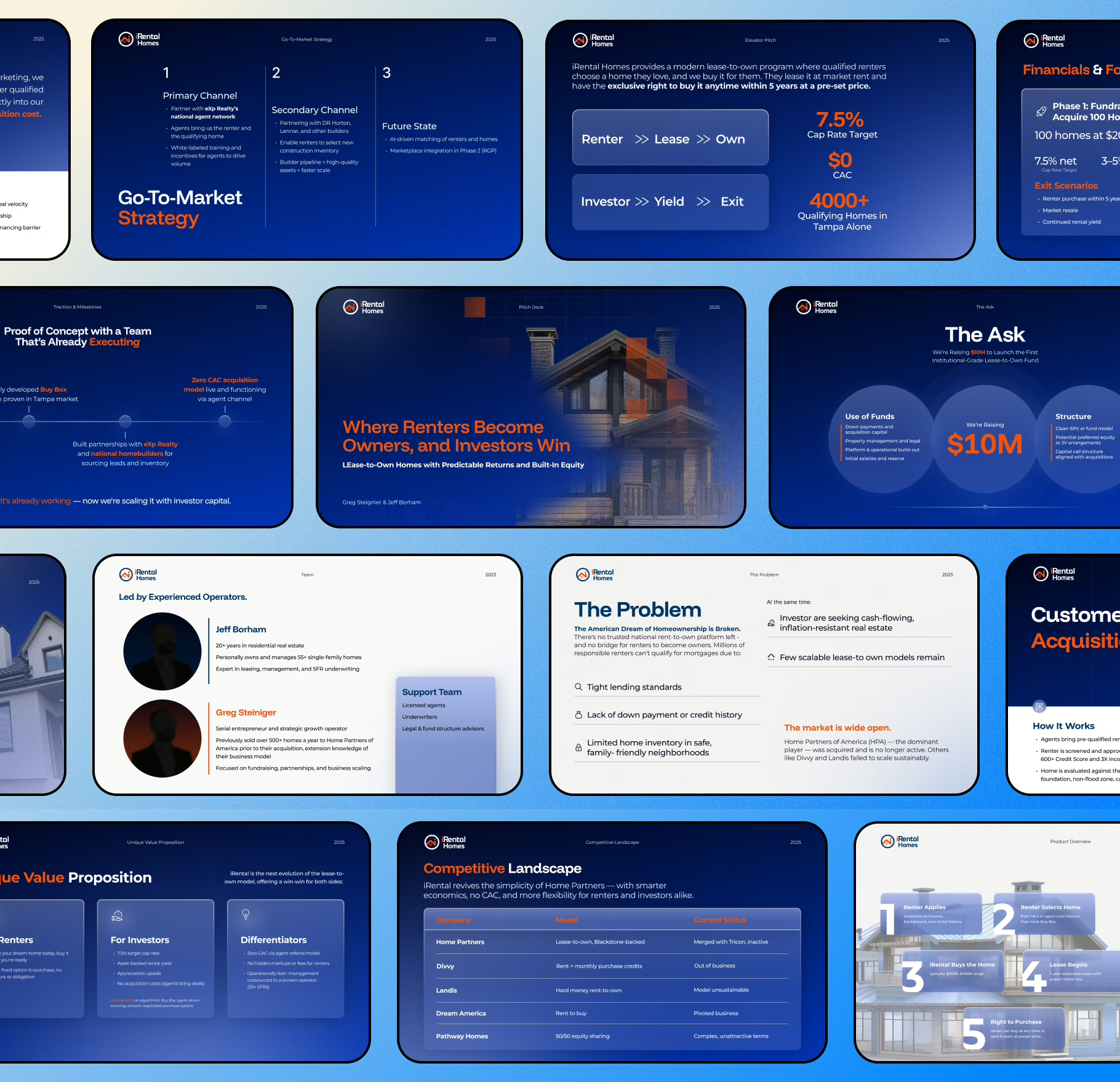
You can see the “motion-first” way of expressing this in the structure expected for a go-to-market slide.
Competition + team + financials: execution probability becomes the theme
Competition isn’t there so you can declare you’re different. It’s there to establish the landscape and make your position legible. Team isn’t there for ego; it’s there to map competence to the specific constraints of this market. Financials aren’t there to predict the future; they’re there to show assumptions that don’t break instantly.
This defensive clarity shows up as structured positioning in competitive analysis framing.
Slide-by-slide outline and why this order tends to hold
A slide outline isn’t sacred. But some orders reduce cognitive friction because they mirror how evaluators naturally process uncertainty: relevance → mechanism → context → proof → path → defensibility → plan.
Title / one-liner
The title slide isn’t a formality. It’s an immediate categorization moment: what you are, what changes, and why that change matters. If the one-liner is unclear, the rest of the deck becomes translation labor.
Hook / opening frame
This frames the “why pay attention” question. It works when it makes the subsequent problem feel expected, not introduced.
Problem
This is where the narrative earns relevance. Strong problem slides create a stable foundation so later slides can be interpreted correctly rather than skeptically.
Why now
Why-now isn’t a trend collage. It’s a timing argument: the constraint exists, and the conditions that make your approach viable have changed (distribution, regulation, cost curves, behavior, tooling).
Solution / product
The solution should feel like a direct mechanical answer to the earlier constraint. When it doesn’t, investors assume you started with a product and reverse-engineered the problem.
Value proposition
Value proposition is the “translation” slide: converting mechanism into outcomes the buyer recognizes. This dynamic is typically expressed through value proposition slide structure because it forces a before/after frame rather than generic benefit claims.
Market opportunity
Here, market sizing becomes credible only if it’s consistent with the earlier buyer definition and the later go-to-market approach.
Business model
This slide exists to show economic behavior, not to list revenue streams. The question underneath is: “If adoption happens, does the business become stronger or more fragile?”
Traction & KPIs
This is where the story stops being hypothetical. The metrics here should act like narrative beats: they arrive exactly where the audience needs proof.
Go-to-market
This is your path from “works” to “scales.” It’s where many decks reveal whether they understand their own distribution constraints.
Competition & moat
This section is strongest when it clarifies category and position without theatrics: who exists, how buyers decide, and what is hard to replicate.
Financials & ask
Even early-stage decks need a plan that behaves. Assumptions matter more than precision. The evaluator is asking whether the ask matches the milestones and whether the milestones actually de-risk the business.
Storytelling techniques and devices that hold up in investor evaluation
Start with a character, not a concept
People process meaning through concrete agents: a buyer, a user, a founder moment. A character doesn’t make the deck “emotional.” It makes it legible, because it grounds the problem in a real decision context.
Show consequences, not just inconvenience
A problem becomes investable when the consequences are material: money lost, time wasted, compliance risk created, churn increased, margin compressed, or opportunity cost locked in. This reframes the problem from “annoying” to “structural.”
Contrast is your fastest clarity device
Before vs after. Old workflow vs new workflow. Incumbent constraints vs your approach. Contrast isn’t style—it’s cognitive compression. It allows the evaluator to grasp value without reading paragraphs.
Use numbers as beats, not wallpaper
Metrics function best like drum hits in a story: a few clear numbers that arrive at the exact moment the reader needs grounding. Charts are often less persuasive than one clean metric callout paired with a short interpretation.
Keep stakes tied to timing
Why now is not an add-on slide; it’s a narrative stabilizer. Without timing, the idea can feel like something that could be attempted any time—so the urgency evaporates.
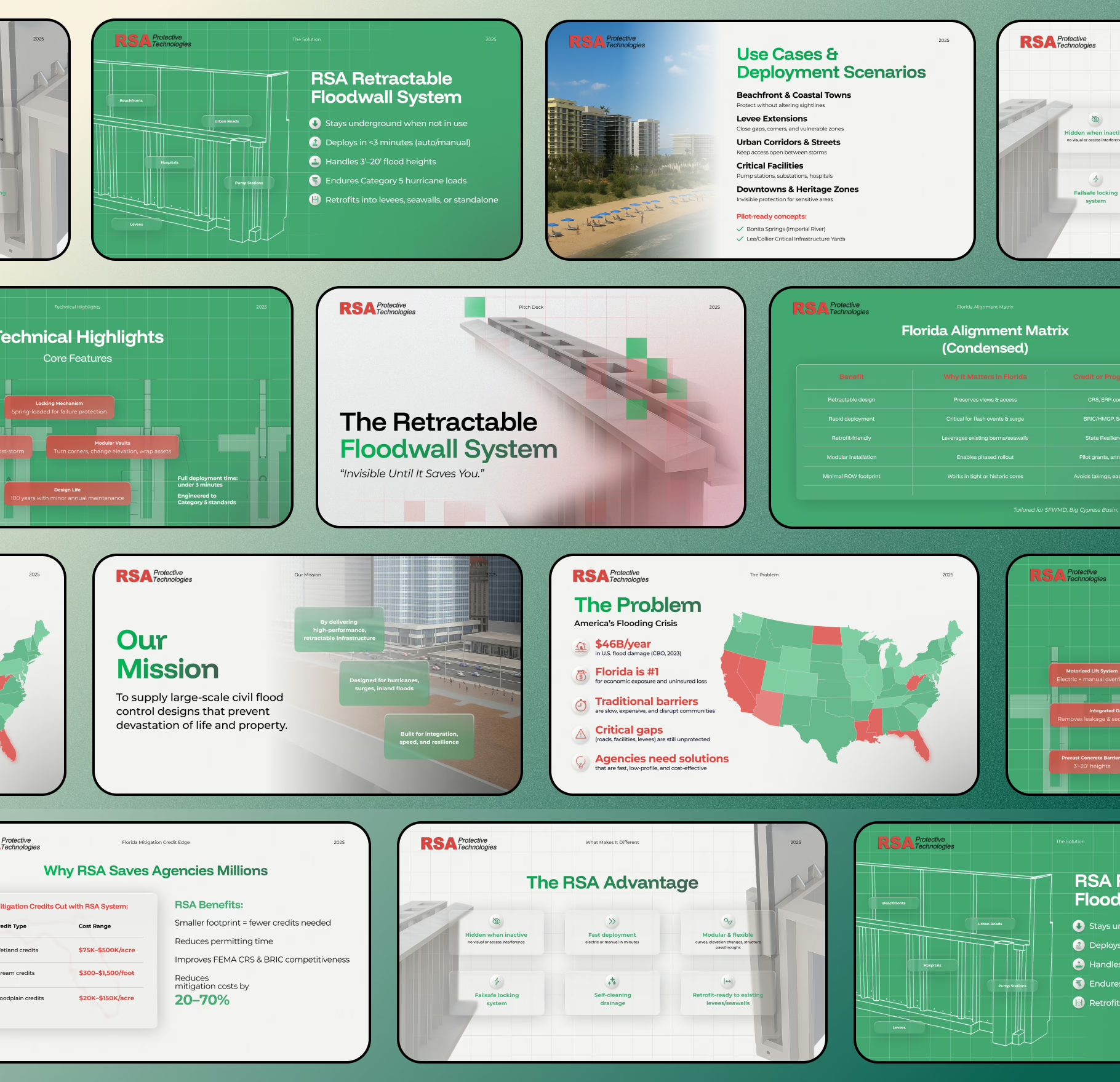
Anchor claims with evidence that matches the claim
Evidence is only useful if it matches the risk being evaluated. Testimonials matter when the risk is buyer need. Retention matters when the risk is stickiness. Pipeline matters when the risk is distribution. The more precisely your proof maps to the risk, the more the deck reads as controlled rather than hopeful.
Visual & design guidelines
Design is not “making it pretty.” It’s making the argument readable.
A pitch deck slide is a tiny courtroom. Every element either supports the claim or distracts from it. When investors say “the deck felt unclear,” they’re usually reacting to visual cognition problems: the slide didn’t tell them where to look first, what mattered most, or what the takeaway was.
That’s why “design” starts with hierarchy.
Hierarchy: control the order of attention
A slide should have a clear reading path:
- Headline (the claim)
- Proof (the evidence)
- Context (the minimum needed to interpret the proof)
If your slide’s headline is vague, the viewer can’t form a hypothesis. If the proof is noisy, they can’t validate it. If context is bloated, they get stuck in the weeds.
This also ties into trust: people subconsciously associate clean hierarchy with controlled thinking—especially in high-stakes categories like finance or regulated markets.
One focal visual per slide (one “exhibit”)
Treat each slide like an exhibit:
- one chart or
- one screenshot or
- one diagram or
- one comparison frame
If you need three visuals to make the point, you probably have three points. Split them. The investor’s brain is already doing enough work; don’t make it choose between competing “centers.”
Typography and color psychology are not optional
You don’t need to overthink aesthetics, but you do need to manage perception:
- Typography sets tone: modern/technical, institutional, playful, premium.
- Color creates emotional context: urgency, trust, calm, authority.
If you want to handle this without turning into a design philosopher, use the applied frameworks in font psychology for pitch decks and pitch deck color psychology. They keep you focused on decision impact, not vibes.
Charts: show the insight, not the spreadsheet
A chart in a deck is not a data dump. It’s an argument in visual form.
Good pitch charts:
- have one takeaway
- reduce everything else
- label what matters directly on the chart
- remove non-essential legends, grids, and series
If the presenter has to “walk through the chart” for 60 seconds, the chart failed. The chart should land before the narration arrives.
Tooling note (because this comes up constantly)
If you’re using AI tooling to speed up layout drafts, treat it like a first draft generator—not a final designer. The workflow is: generate → simplify → reassert hierarchy → rewrite headline → remove noise. If you’re experimenting with this approach, Gemini Instant Presentation Builder review is a decent starting point for what it can and can’t do.
Common pitfalls to avoid
The “everything we’ve done” deck
Founders often treat the deck like a scrapbook. Investors treat it like a filter.
If your deck tries to include every feature, every market segment, every experiment, every partnership conversation, it stops being persuasive and becomes exhausting. The investor isn’t impressed by volume; they’re impressed by selection—what you chose to emphasize and what you were confident enough to cut.
The “concept soup” deck
This is the deck that sounds smart but never becomes concrete:
- big themes
- big markets
- vague claims
- few hard constraints
- no visible mechanism
When the narrative doesn’t touch the ground, the investor assumes the company doesn’t either.
The “I’m allergic to specifics” trap
Specificity is what makes a deck investable:
- who buys
- what they pay
- why they switch
- what changes in workflow
- what improves measurably
If the deck avoids specifics, it reads like uncertainty disguised as confidence.
Technical founders: your most common failure mode is not “too much detail”
It’s wrong kind of detail.
Technical decks often go deep on architecture and light on adoption physics. Investors rarely reject a startup because the tech is too strong; they reject it because the deck doesn’t show how the world adopts it.
If that’s you (or your clients), bookmark pitch deck mistakes technical founders make. It’s basically a mirror with better lighting.
The “we’ll figure it out after funding” ending
If the ask slide feels detached—like it was stapled on at the end—investors interpret it as lack of a plan. Your ask should feel inevitable because the story already set it up:
- here’s what’s true
- here’s what’s working
- here’s what’s next
- here’s what capital unlocks
FAQ: Practical checklist before presenting
Can you compress the whole deck into one sentence without lying?
Not a slogan. A truthful compression.
If you can’t do this, it usually means one of these is unclear:
- category
- buyer
- core mechanism
- outcome
A useful way to force this discipline is building the one-slide version first: the elevator pitch slide.
Does every slide have a single job?
You should be able to name the slide’s job in five words:
- “prove problem is expensive”
- “show why now is real”
- “explain mechanism clearly”
- “validate demand with proof”
- “show how we acquire buyers”
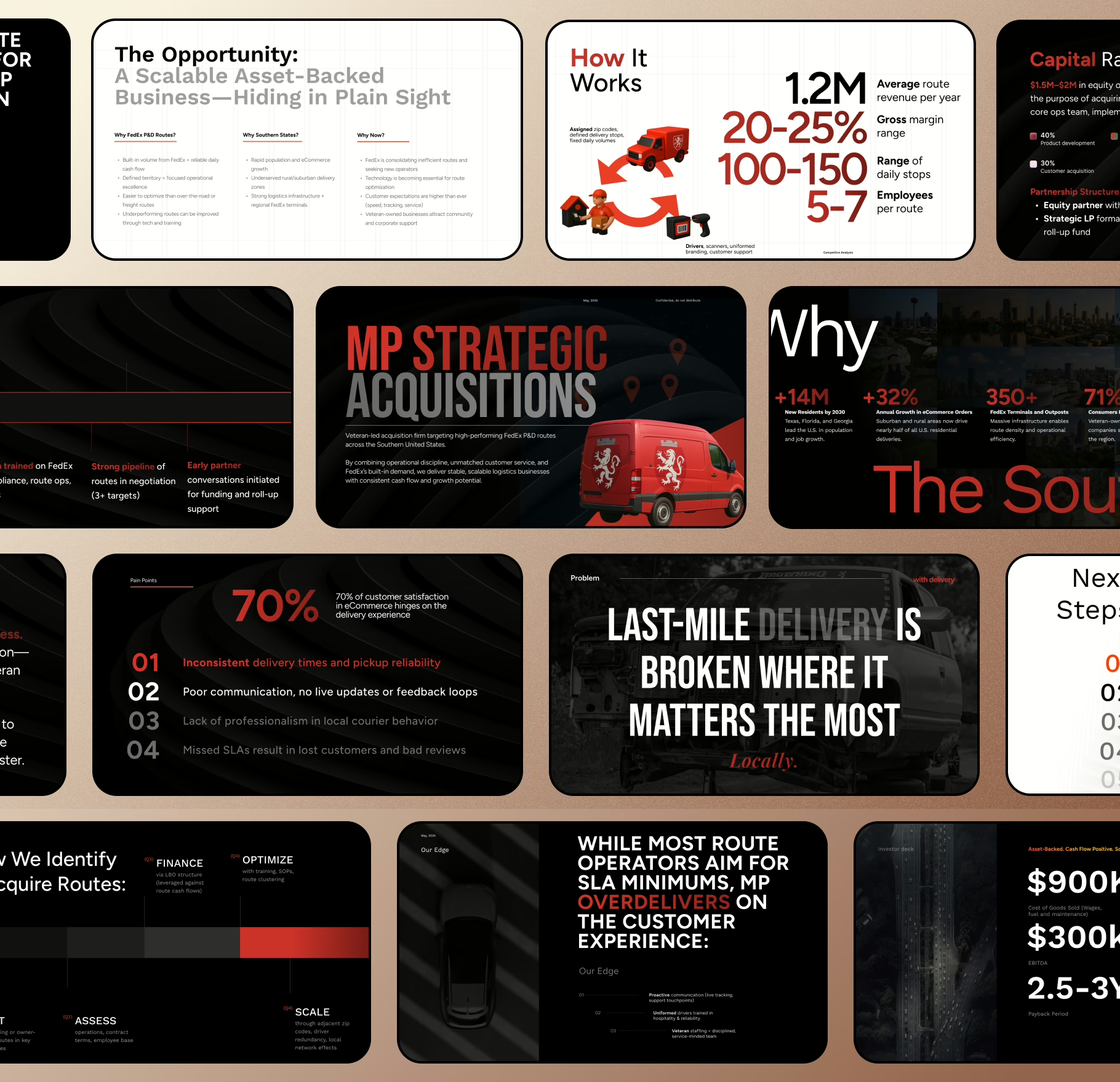
If you can’t name the job, the slide is probably doing “general info,” which is deck purgatory.
Are you defending the right assumptions?
Founders often defend the easy assumptions and hide the hard ones.
The hard assumptions are usually:
- switching cost / workflow change
- sales cycle reality
- margin behavior at scale
- retention drivers
- why the incumbent can’t copy this quickly
Put the hard assumptions on the table, lightly but honestly. You’ll look more serious, not less.
Do you have three rehearsed versions?
Not because investors demand theatre—but because time constraints vary.
- 3 minutes: coherence test
- 10 minutes: coherence + proof
- 20 minutes: coherence + proof + risk control
When you can compress and expand without breaking the story, you’re in control.
Is your close a coordination point?
End with a clear next step:
- what you’re raising
- what it funds
- what milestone it gets you to
- what you want from this investor (follow-up, diligence, intro, pilot, etc.)
If the close is vague, even interested investors drift.
Example frameworks & templates
Frameworks aren’t magic. They’re compression tools. Investors like them because they recognize structure fast and can compare you against patterns they’ve already funded (or passed on).
Problem → Mechanism → Proof (early-stage, high clarity)
For early-stage decks, “vision” is cheap. Mechanism + proof is valuable.
This framework works when:
- the problem is clear and expensive
- your approach is distinct in how it works
- you can show even small signals that the world responds
If you’re building proof slides (especially traction), you’ll get more mileage from focused execution guidance like creating an impactful traction slide than from generic “add metrics” advice.
Persuasion-first structure (when the room is skeptical)
Some pitches are inherently uphill: regulated categories, crowded markets, commoditized features, “me too” optics. In those rooms, the deck must be built like persuasion under skepticism:
- acknowledge the default objection
- reframe the category
- present evidence as de-risking beats
If you want a structured take on that, use persuasion in pitch decks as your backbone, and pair it with the mental model summary in Persuasion IQ when you’re refining phrasing and sequencing.
Industry templates (when the investor expects “category-native” structure)
A SaaS investor expects certain slides and metrics. A fintech investor expects different risks and proof. A real estate investor expects different “truth signals.” Using category-native structure doesn’t make you generic—it makes you legible.
Pick the closest template and adapt it:
Bias-aware storytelling (when attention is the constraint)
Investors are humans. Humans use shortcuts.
You don’t need to manipulate people—you need to respect how cognition works under time pressure: salience, contrast, framing, and avoidance of ambiguity. If you want that lens without turning your deck into a psychology lecture, cognitive biases in pitching is the practical version.
To end this article, let’s look at some of the questions founders usually dabble with.
What makes an effective pitch deck for fundraising?
An effective pitch deck presents a significant problem, a clear solution, and proof that the market cares. Investors look for a compelling story supported by metrics, validation, and a realistic growth path. The goal is not just to inform but to create conviction that the startup can generate meaningful ROI.
How does storytelling improve a startup pitch?
Storytelling helps transform complex ideas into a relatable, structured narrative. When founders weave story arcs into their pitch, the presentation becomes easier to follow and more memorable. Investors process information faster when it’s delivered as a cohesive narrative rather than disconnected slides.
How long should a startup pitch deck be?
Most impactful pitch decks stay around 10 slides for initial review. This forces clarity and prioritization. A concise deck that captures key points and conveys traction is more effective than a long, overloaded presentation.
What storytelling techniques work best in pitch decks?
The most effective storytelling techniques include:
- Starting with a specific problem
- Showing consequences and opportunity size
- Using contrast (before vs after)
- Supporting claims with metrics and validation
- Ending with a clear vision and fundraising ask
These techniques help grab attention and maintain momentum throughout the pitch deck presentation.
How can founders create a compelling story for investors?
To create a compelling story:
- Focus on one core narrative about transformation
- Use real customer or market insights
- Highlight measurable traction
- Showcase how capital accelerates growth
A compelling story should convey why the startup matters now and why the team can execute. The narrative must feel grounded, not theatrical.
What role do visuals play in an effective pitch deck?
Visual communication helps capture attention and simplify complex ideas. Screenshots, charts, and diagrams make claims easier to understand and remember. Strong use of visuals also signals professionalism and preparation, which builds investor confidence.
What do investors want to see in impactful pitch decks?
Most VCs look for:
- Clear market opportunity
- Strong value proposition
- Evidence of traction or validation
- Scalable business model
- Cohesive narrative and team credibility
An effective pitch shows not just potential, but a believable path to scale within a competitive ecosystem.
Can AI help optimize pitch deck storytelling?
AI can help founders optimize structure, polish messaging, and refine visual communication. However, it should support—not replace—strategic thinking. The strongest decks still come from founders who deeply understand their market, customers, and growth mechanics.
Why do many startup pitch decks fail?
Most decks fail because they:
- Try to say too much
- Lack a cohesive story
- Avoid specifics
- Overestimate market size
- Don’t clearly convey traction or ROI
A successful pitch deck must capture attention quickly, convey credibility, and leave investors with a clear sense of next steps.
How can entrepreneurs transform their pitch for better results?
Entrepreneurs improve outcomes when they treat the deck as a decision tool rather than a brochure. Focus on clarity, proof, and structure. Polish visuals, simplify messaging, and ensure each slide supports the overall narrative.
