


Let’s be real: pitching pharma is not the same as pitching SaaS.
A startup can “move fast and break things.”
Pharma teams move slow, avoid breaking anything, and document everything they didn’t break along the way.
This guide focuses on how pharma pitch decks are built in practice—the structure, slide order, evidence depth, and documentation patterns that repeatedly show up in fundable pharmaceutical decks. It covers execution mechanics such as regulatory proof, clinical data presentation, market framing, and the slides reviewers typically scan first.
You’ll also see practical templates, real-world examples, and breakdowns you can adapt—so the deck reflects current review expectations without reinventing the wheel.
The sector-level expectations that shape how pharma pitch decks are reviewed are outlined separately in our guide to healthcare investor and gatekeeper evaluation standards.
2026 Update: Execution Adjustments Pharma Decks Now Require
The pharma fundraising environment in 2026 looks very different from the capital-abundant period of 2020–2021. Review standards have tightened, timelines are scrutinized more closely, and decks are expected to surface proof earlier and more explicitly.
As a result, pharma pitch decks have adjusted in several consistent ways:
- Regulatory realism appears earlier
Decks now surface IND/CTA readiness, CMC maturity, and realistic timelines upfront rather than deferring them to later slides. - Safety signals are documented sooner
Toxicity assumptions and early safety data are increasingly shown before Phase I narratives, not after. - Mechanism clarity is more explicit
MoA differentiation is visualized and contextualized earlier to avoid pipeline overlap confusion. - Commercial logic is less abstract
Reimbursement pathways, payer friction, and pricing constraints are outlined in concrete terms rather than implied. - Manufacturability is treated as a constraint, not a footnote
Especially for biologics, RNA, and cell/gene therapies, decks now show how scale impacts cost and timelines. - Capital efficiency is modeled more granularly
Burn, staged trial design, and phase-level cost logic are increasingly visible at the slide level. - Partnership dependencies are acknowledged early
CROs, CDMOs, KOLs, and regulatory advisors are positioned as execution requirements, not future options.
This guide reflects those execution shifts—not to redefine evaluation standards, but to help decks align with how reviews are currently conducted.
What Is a Pharma Pitch Deck?
A pharma pitch deck is a structured, data-backed presentation used to document the scientific, regulatory, and commercial logic behind a pharmaceutical program.
Unlike general startup decks, pharma pitch decks are built to handle:
- scientific complexity
- long development timelines
- regulatory constraints
- capital-intensive milestones
They are commonly used by:
- early-stage pharma founders
- biotech spinouts and university-originated programs
- drug discovery and platform teams
- advanced therapeutics startups (cell, gene, RNA)
- CRO, CDMO, and AI–drug discovery hybrids
At an execution level, pharma pitch decks typically surface:
- clinical rationale and disease context
- mechanism of action (MoA) clarity
- safety and efficacy evidence (or plans to generate it)
- regulatory pathway assumptions (FDA, EMA, MHRA)
- IP positioning and defensibility
- timeline and cost structure realism
This is why pharma pitch decks are structured differently from SaaS decks. The goal is not speed or storytelling alone, but clear documentation of risk, progress, and feasibility across science, regulation, and commercialization.
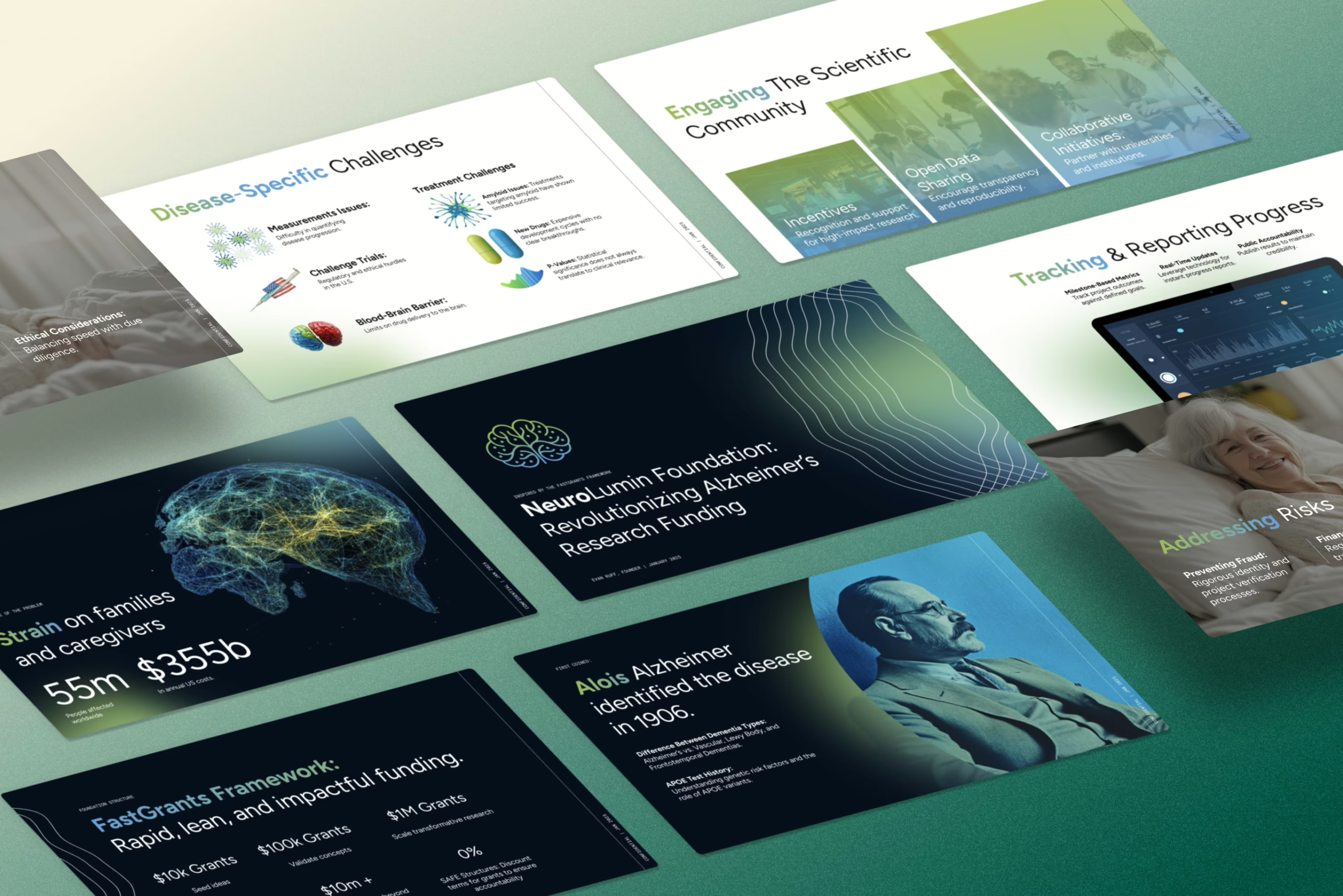
Step-by-Step Build Order for a Pharma Pitch Deck
This section outlines the practical assembly sequence used when constructing a pharma pitch deck. Each step exists to support the next. Skipping or reordering them usually creates gaps that surface later during review.
Step 1: Define the Review Context Before Building Slides
Before any slides are assembled, pharma teams typically clarify why the deck exists and where it will be reviewed.
Different review contexts impose different constraints on:
- slide depth
- data density
- regulatory detail
- timeline assumptions
Common contexts include:
- early funding discussions
- licensing or BD reviews
- internal board or committee updates
- partner or strategic evaluations
At this stage, teams are not optimizing messaging. They are setting structural boundaries so the deck doesn’t over- or under-document critical areas later.
Step 2: Identify Audience Constraints (Not Preferences)
Once the context is clear, teams usually map audience constraints, not opinions.
This includes understanding:
- how technical the audience is
- which risks must be explicitly documented
- what level of regulatory and clinical detail is expected
- how much commercial framing is required versus scientific depth
The goal here is not tailoring a narrative, but preventing misalignment — for example, showing discovery-level science to a review that expects development-stage clarity.
Step 3: Lock the Core Slide Structure
With context and constraints defined, the deck structure can be locked.
Most pharma pitch decks follow a predictable structural spine, even when the content varies. This typically includes:
- problem framing and disease context
- scientific rationale and mechanism of action
- supporting data (preclinical or clinical)
- regulatory pathway assumptions
- IP positioning
- development roadmap and milestones
- commercial logic and market framing
- capital requirements and timelines
At this stage, teams focus on order and inclusion, not polish. The objective is to ensure nothing critical is missing before refinement begins.
Step 4: Populate Slides With Evidence, Not Assertions
Once the structure is set, slides are populated with documented evidence.
In pharma decks, this usually means:
- summarizing data visually rather than descriptively
- distinguishing between generated data and planned data
- clearly labeling assumptions versus results
- avoiding unsupported claims, even if directionally true
This step is where many decks fail — not because the science is weak, but because the evidence is poorly surfaced or inconsistently framed.
Step 5: Translate Complexity Into Review-Readable Slides
After content is in place, attention shifts to readability.
This includes:
- reducing text density without removing substance
- using diagrams to explain mechanisms and pathways
- aligning charts, timelines, and tables for fast scanning
- maintaining consistent terminology across slides
The goal is not simplification for its own sake, but clarity under time pressure.
Step 6: Stress-Test the Deck for Gaps and Friction
Before finalizing, teams typically stress-test the deck by asking:
- Where would a reviewer pause or question assumptions?
- Which slides require verbal explanation to make sense?
- Where are timelines, costs, or dependencies unclear?
- Are regulatory, clinical, and commercial narratives aligned?
Any slide that only works when explained verbally usually needs revision.
Step 7: Prepare the Deck for Live or Asynchronous Review
Finally, the deck is prepared for how it will actually be used.
This may involve:
- adding appendix slides for deeper data
- ensuring the deck stands on its own when shared
- preparing backup slides for common review questions
- adjusting pacing for live versus async review
At this point, the deck is structurally complete and ready for circulation.
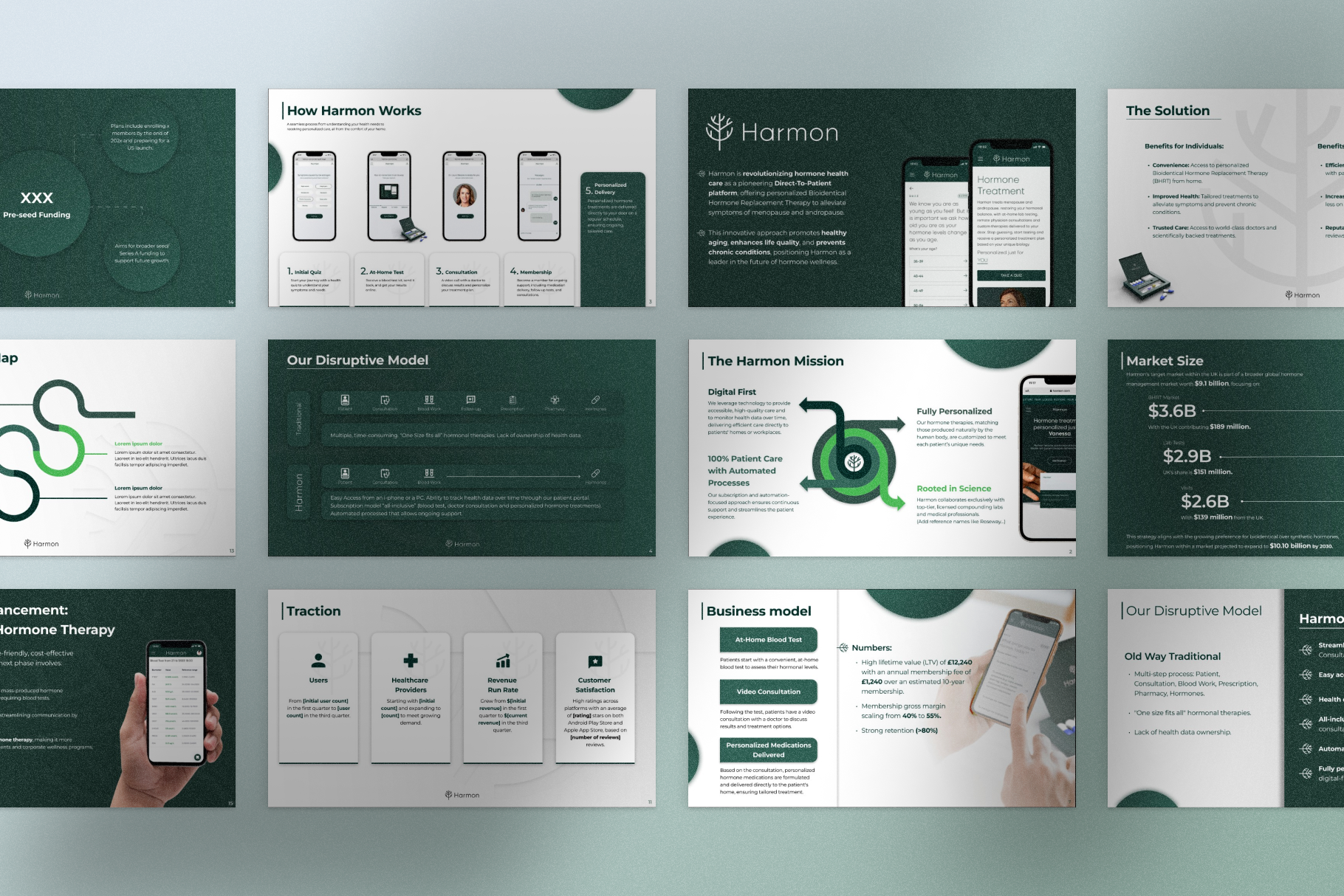
The 12-Slide Structure Used in Most Pharma Pitch Decks
This 12-slide structure reflects the most common assembly pattern used in pharma pitch decks. The order is not about storytelling flair—it exists to control cognitive load, surface risk progressively, and prevent review friction.
Individual programs may compress or expand sections, but deviations usually happen after this baseline structure is in place.
1. Elevator Overview
This slide establishes orientation, not persuasion.
It typically answers three questions in one screen:
- what is being developed
- which problem or disease area it addresses
- why this program exists now
Because this slide sets expectations for everything that follows, its length and density are constrained by early-review attention limits, which is why pitch deck length matters.
2. Program Snapshot / Highlights
This slide functions as a reference layer, not a summary pitch.
It usually includes:
- development stage
- core asset type
- regulatory status (if any)
- one or two differentiating facts
Teams often struggle with balance here, which is why separating what belongs on a one-pager versus a full deck helps prevent duplication later.
3. Disease Context & Unmet Need
This slide frames the clinical and system-level context in which the program exists.
Execution-wise, it works best when:
- prevalence and burden are quantified
- current standards of care are clearly limited
- the gap is stated without exaggeration
Overloading this slide is a common error, especially when teams blur context with solution framing, which is one of the reasons problem–solution slides frequently fail.
4. Market Scope (TAM / SAM / SOM)
This slide documents scope, not ambition.
Most pharma decks use a simple progression:
- total disease market
- addressable patient segment
- realistically reachable segment
Errors here are structural, not numerical, which is why TAM–SAM–SOM framing matters at the slide level.
5. Scientific Rationale & Mechanism of Action
This slide explains why the program should work.
Execution typically involves:
- a simplified MoA diagram
- pathway relevance to disease biology
- differentiation versus known mechanisms
Visual clarity matters more than narrative depth here, which is why visual storytelling techniques are often used to replace dense text.
6. Supporting Data (Preclinical / Clinical)
This slide surfaces evidence, not interpretation.
Best practice execution includes:
- separating completed data from planned studies
- labeling cohorts, models, or endpoints clearly
- avoiding mixed timelines on a single chart
When data presentation fails, it’s usually due to layout and hierarchy issues, not weak results, which is why how to design a pitch deck applies directly here.
7. Competitive Landscape
This slide positions the program relative to alternatives, not superior by default.
Execution commonly includes:
- mechanism-based comparison
- stage-of-development mapping
- non-visualized pipelines where relevant
Competitive slides often break when teams overclaim differentiation, which is why competitive analysis mechanics matter more than slogans.
8. Regulatory Pathway & Development Plan
This slide documents process feasibility.
It typically shows:
- expected regulatory route
- key milestones
- dependencies between phases
Because timelines and assumptions are often misread, teams benefit from applying timeline framing techniques used in longer decks versus short decks.
9. Intellectual Property Position
This slide establishes defensibility, not legal completeness.
Execution usually includes:
- patent families and jurisdictions
- filing status
- relation to core mechanism
IP slides fail when they are text-heavy, which is why text-heavy vs image-heavy pitch deck decisions matter here.
10. Business Model & Commercial Logic
This slide explains how value is realized, not projected dominance.
Common execution elements:
- revenue mechanism (licensing, sales, milestones)
- pricing logic at a high level
- market access constraints
Because financial credibility often breaks at this point, how to present financials in a pitch deck becomes relevant even before full projections.
11. Team & Execution Capability
This slide demonstrates execution capacity, not resumes.
It usually highlights:
- domain-relevant experience
- prior program outcomes
- functional coverage gaps
Team slides often suffer from layout and hierarchy mistakes, which overlap with common pitch deck layout errors.
12. Capital Use & Forward Plan
This slide closes the structural loop.
Execution typically includes:
- use-of-funds categories
- milestone linkage
- time-bound objectives
This slide works best when it aligns directly with earlier roadmap and financial mechanics, which is why financial projections structure matters even at a summary level.
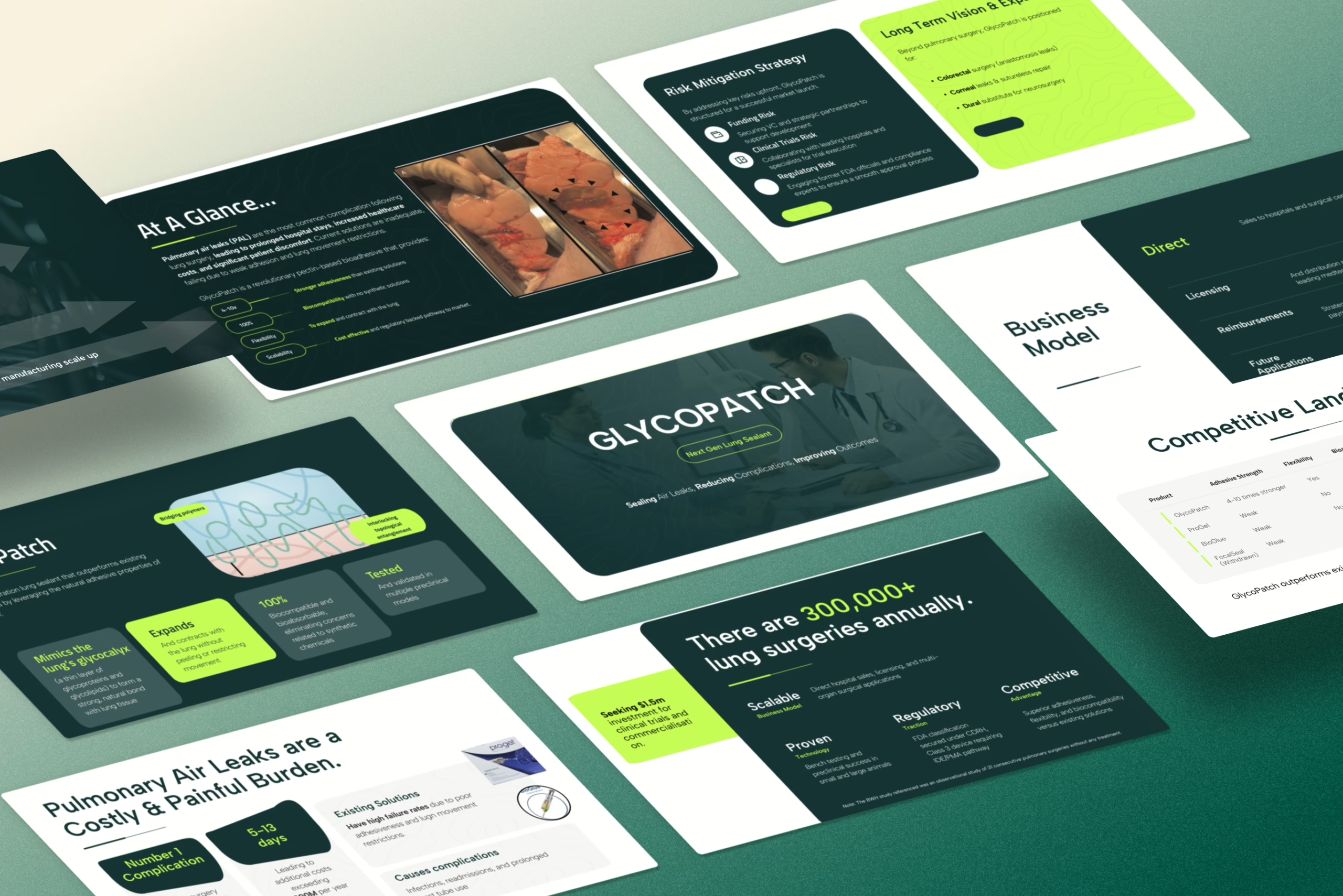
Pharma vs Biotech vs MedTech Pitch Decks (Execution Comparison)
Although these categories are often grouped together, their pitch decks differ meaningfully at the execution level. Applying the wrong structure usually results in misplaced emphasis or missing documentation.
| Element | Pharma Pitch Deck | Biotech Pitch Deck | MedTech Pitch Deck |
|---|---|---|---|
| Core Risk Surface | Clinical + regulatory | Discovery + platform | Device + regulatory |
| Primary Proof | Preclinical + clinical data | Platform validation | Prototypes + trials |
| Timeline | Long, multi-phase | Medium, staged | Shorter, milestone-driven |
| Cost Profile | Very high | Medium–high | Medium |
| Slide Emphasis | MoA, data, pathway | Technology roadmap | Product + reimbursement |
| Execution Focus | Risk documentation | Scalability logic | Market adoption |
Execution Questions Teams Commonly Raise When Building Pharma Decks
How detailed should clinical data be in the main deck?
Most teams summarize key findings visually in the main deck and reserve detailed datasets for appendices or follow-up materials.
Where should regulatory information appear?
Regulatory assumptions are usually surfaced alongside the development roadmap rather than isolated in a standalone slide.
How early should IP be introduced?
IP positioning typically appears after scientific rationale but before commercial logic, once relevance is established.
Should financials be fully modeled in the deck?
Deck-level financials usually focus on structure and milestones, with full models shared separately when required.
How long should a pharma pitch deck be?
Length is typically constrained by review context, with core decks remaining concise and deeper material placed in backup slides.
Can one deck be reused across audiences?
Most teams adapt depth and emphasis while keeping the underlying structure consistent.
