


A pitch deck is a compression tool: it turns a messy business into a structured narrative someone can evaluate under time pressure. The issue is that evaluation pressure changes by room—investors scan for risk and upside, customers scan for outcomes and switching costs, partners scan for leverage, and internal stakeholders scan for coherence.
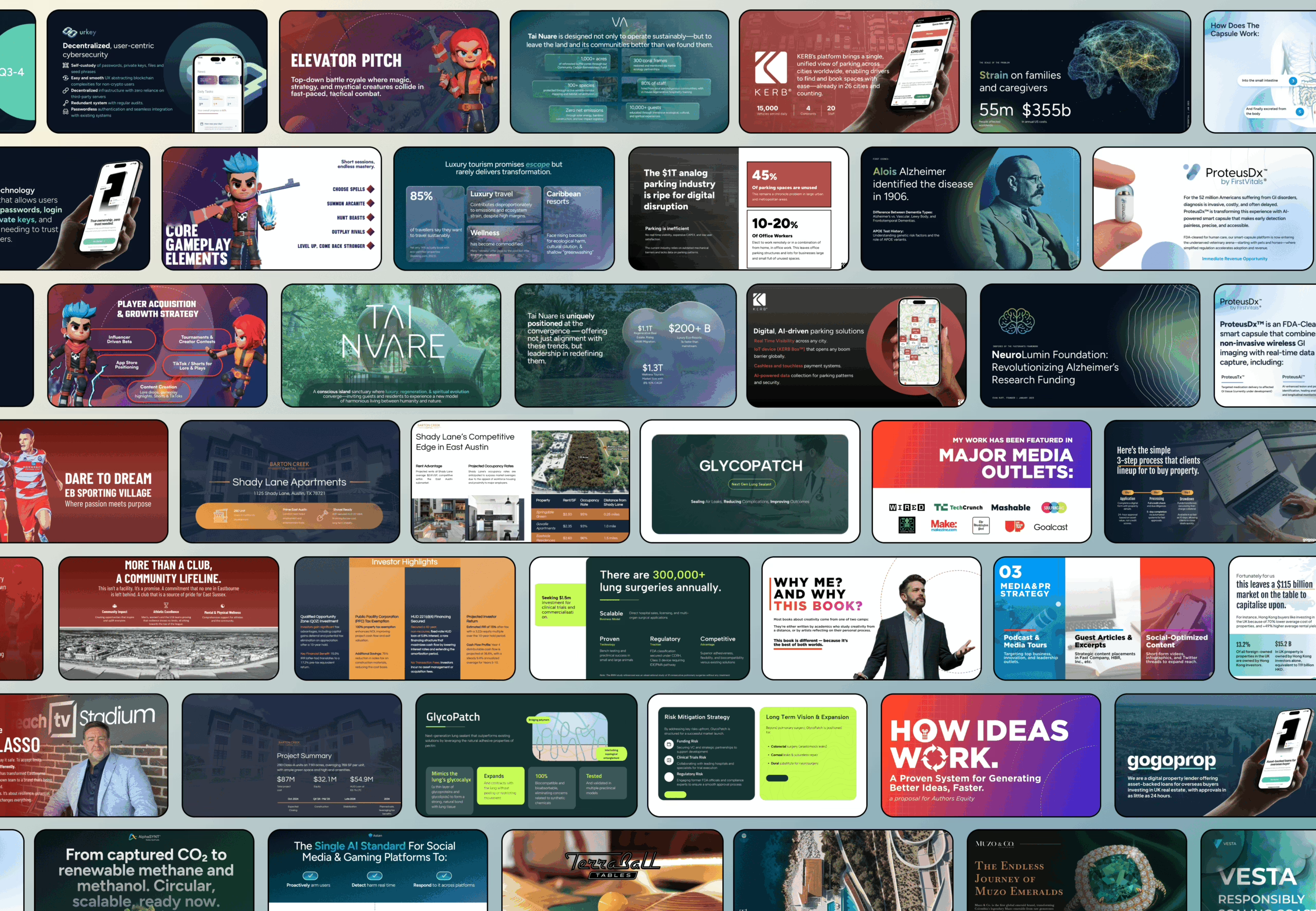
That’s why one-size-fits-all decks fail: they overload the wrong proof, under-explain the right assumptions, and accidentally signal “we don’t know what this room is here to judge.” This dynamic is visible in how a deck’s core structure is typically laid out in how information is structured in a standard pitch deck build.
Purpose of tailoring a pitch deck
Tailoring isn’t about changing the story. It’s about changing what the story is asked to prove. Different audiences apply different decision filters—time horizon, risk tolerance, technical fluency, and what “proof” looks like in their environment.
Why one-size-fits-all decks fail
A single deck trying to satisfy everyone usually shows up as:
- too much context for insiders, not enough clarity for outsiders
- metrics that matter to one audience but read as irrelevant (or suspicious) to another
- a narrative that sounds confident but doesn’t resolve the audience’s specific uncertainty
Overview of key audience types
Most founder environments rotate through five rooms:
- Investors
- Customers & partners
- Internal stakeholders
- Media / public
- Recruiting / talent
Identify and Segment Your Audiences
Investors (angel, seed, VC, strategic)
Investors evaluate risk + return + timing. Angels may accept ambiguity if the logic is coherent. Seed/VC care about repeatability and scaling mechanics. Strategic investors care about adjacency and integration potential. This pattern shows up as different expectations around what “an investor-facing deck” even is, which is structurally expressed in how an investor deck is typically defined.
Customers and partners
Customers evaluate outcomes, switching costs, and operational trust. Partners evaluate mutual benefit, positioning risk, and friction of execution.
Internal stakeholders (executive team, board)
Internal stakeholders evaluate coherence: does the story survive scrutiny when the people judging it can actually open the hood?
Media and public presentations
Public audiences evaluate narrative clarity and relevance. Their patience for assumptions is low; their sensitivity to jargon is high.
Recruiting and talent-focused audiences
Talent evaluates competence signals: pace, craft, leadership clarity, and whether execution feels real rather than aspirational.
Research Audience Needs and Priorities
Business objectives and decision criteria
The same slide reads differently depending on what decision is being made: invest, pilot, partner, approve, join, or cover.
Risk tolerance and time horizon
A VC can tolerate long timelines if scaling logic is clear. A customer often can’t tolerate instability for long because their risk is operational, not portfolio-based.
Industry knowledge and technical fluency
Technical depth is not automatically persuasive. In non-technical rooms, dense detail often reads as uncertainty (“Are they hiding the simple explanation?”). This dynamic reflects how decks are interpreted when technical fluency varies, which is structurally expressed in how decks are typically structured for non-technical investors.
Preferred metrics and proof points
- Investors: growth rate, retention, unit economics, capital efficiency
- Customers: time-to-value, reliability, security/compliance, references
- Partners: distribution leverage, attach rates, shared incentives
- Talent: craft, pace, product ambition, leadership clarity
Define Core Message and Value Proposition
Single-sentence value prop for each audience
Same product, different meaning:
- Investor value proposition: “We compound value by turning X constraint into a scalable system with measurable unit economics.”
- Customer value proposition: “We reduce X cost/risk by delivering Y outcome with predictable reliability.”
- Partner value proposition: “We expand your distribution or margins by attaching to your existing motion.”
- Internal value proposition: “This is what we are building, why it holds together, and what we refuse to be.”
- Talent value proposition: “This is the problem we’re obsessed with—and the caliber of execution we expect.”
Aligning benefits with audience pain points
If the pain point is “uncertainty,” benefits must show up as reduction of unknowns—not hype.
Prioritizing content pillars (traction, market, team, tech)
Different rooms weight pillars differently. The “right” emphasis is the one that matches the room’s evaluation pressure.
Slide-by-Slide Tailoring Guidelines
The deck doesn’t change slide-by-slide because you “want it to.” It changes because each slide is a different kind of proof, and different audiences accept different proofs.
Title / opening — hook variations by audience
Investors respond to crisp category definition and why-now. Customers respond to the outcome and the cost of inaction. Public rooms respond to clarity and relevance.
Problem slide — framing and depth of detail
Investors want the problem framed as a structural market inefficiency. Customers want the problem framed as operational pain.
Solution slide — emphasis on product vs. business model
Some rooms need product clarity; others need operating model clarity. This pattern shows up as recurring errors on the “solution” layer, which is structurally expressed in how solution slides typically behave when they work.
Market slide — TAM vs. served market depending on audience
Investors tolerate abstract market sizing if logic is solid. Customers often care more about whether their segment is understood. This dynamic reflects how sizing language is interpreted, which is structurally expressed in how TAM/SAM/SOM is typically framed in decks.
Traction / validation — metrics and anecdotes to highlight
Investors want compounding signals (retention, growth, margin direction). Customers want outcome proof (before/after, reliability, case evidence).
Business model — revenue unit economics for investors; value exchange for customers
Investors want unit economics and scalability constraints. Customers want the value exchange: what they pay, what changes, what risk is removed.
Go-to-market — channels and partnerships relevant per audience
Investors care about repeatable acquisition logic. Partners care about integration and distribution fit. This pattern shows up as clarity (or confusion) around motion, which is structurally expressed in how GTM is typically structured on its own slide.
Competition — positioning and defensibility
Investors want defensibility logic. Customers want confidence you won’t disappear—and that you’re not a fragile “nice demo.”
Financials — level of detail and forecasts
Investors want assumptions and sensitivity. Customers rarely want a spreadsheet; they want stability cues.
Team — signals each audience cares about
Investors look for execution credibility and domain insight. Customers look for reliability and support competence. Talent looks for leadership quality and standards.
Ask / next steps — calls-to-action tailored to audience
Different rooms require different next steps: meeting → diligence → pilot → partnership → hire conversation.
Visuals, Data and Evidence
Choosing the right charts and data depth
Charts aren’t decoration; they’re compression of proof. The mistake is choosing charts that compress the wrong thing.
Case studies and customer quotes for customers/partners
Customer rooms respond to outcome proof and credibility markers more than abstract strategy.
Due diligence artifacts and appendices for investors
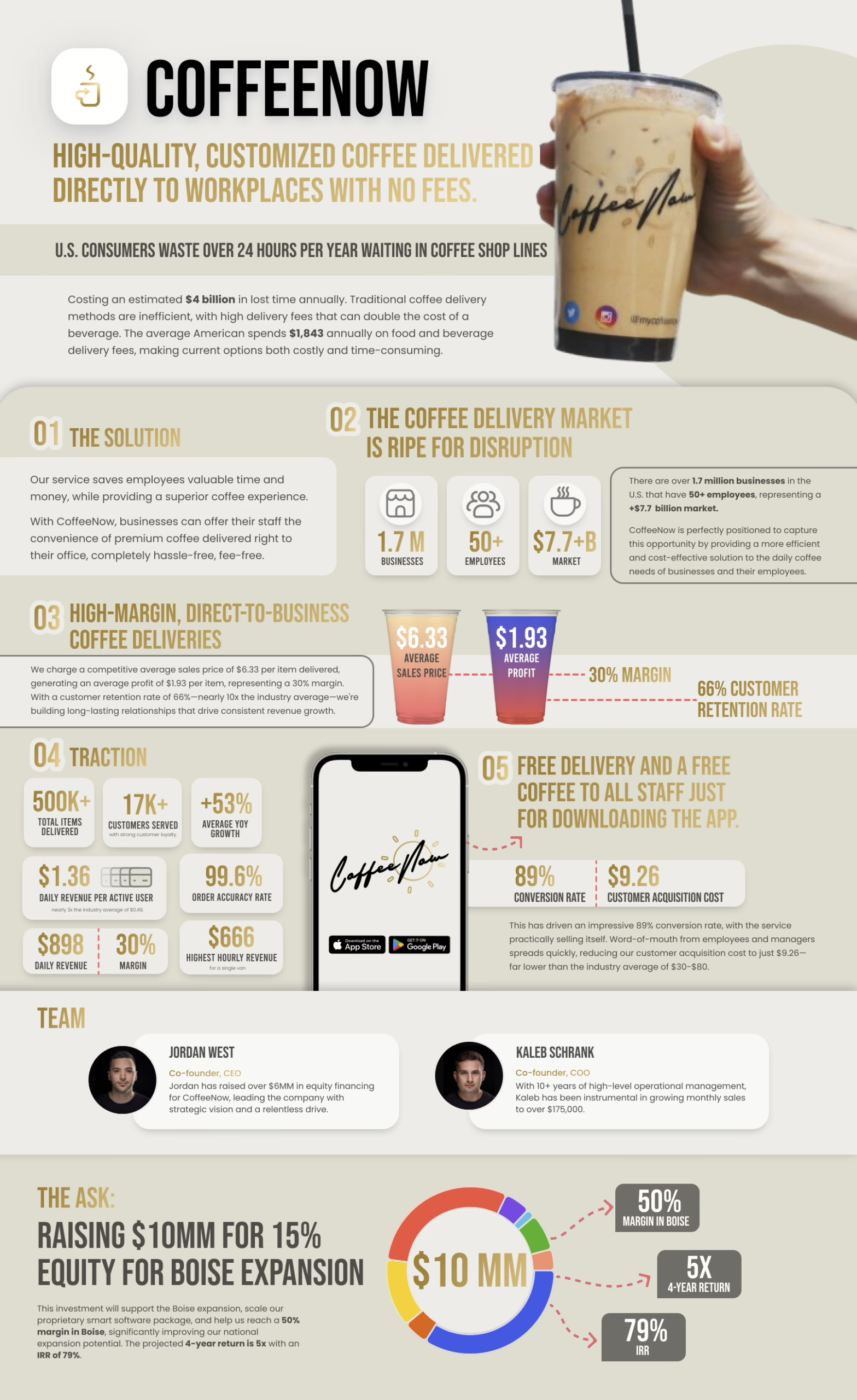
Investor rooms often need extra material to reduce uncertainty. This dynamic reflects why “extra detail” belongs in a controlled format, which is structurally expressed in how financials are typically presented without breaking the deck.
Design consistency and simplicity tips
Consistency reads as competence. Visual noise reads as confusion. (Harsh, but fair.)
Language, Tone and Storytelling
Technical vs. non-technical language
A technical explanation should translate into an operational implication. Otherwise it’s trivia.
Formal vs. conversational tone
Formal isn’t “better.” It’s just a different trust signal. Some rooms interpret informality as confidence; others interpret it as risk.
Narrative structure adjustments by audience
Investors tolerate abstraction earlier if the logic resolves. Customers need clarity earlier because they’re deciding whether to give you access to real operations.
Using metaphors and analogies appropriately
Metaphors reduce cognitive load when they map to the audience’s existing mental model. They backfire when they sound like you’re avoiding specifics.
Delivery and Presentation Strategy
Length and pacing for different settings
A deck read asynchronously behaves differently than a deck delivered live. Live rooms reward clarity and pacing; async rooms reward structure and navigability.
Q&A preparation and anticipated objections
Objections are not “attacks.” They are the audience telling you what category of uncertainty they’re holding.
Supporting materials: one-pagers, demos, financial model
Supporting assets exist to prevent the core deck from collapsing under detail. This pattern shows up as the need for a secondary format that holds proof without bloating the story, which is structurally expressed in how a one-page companion typically functions next to a deck.
FAQ: Tailoring Your Pitch Deck to Different Audiences
1. Why does pitch deck design matter when tailoring your pitch for different audiences?
Pitch deck design determines whether your message is impactful, easy to scan, and instantly credible. When you tailor your pitch deck for various audiences, every element must work harder: layout, hierarchy, and flow must highlight key information, compress complex information, and guide attention using use bullet points, visuals to support, and selective infographics. This ensures your effective pitch deck is both visually appealing and strategically clear.
2. What is the first step in tailoring a pitch deck for different audiences?
The first step in tailoring is to understand your audience. That means identifying their specific needs, specific interests, decision criteria, and risk tolerance. Whether you are pitching to potential investors, customers, partners, or board members, you must define which aspects of your business they care about most. This helps you shape your presentation, focus on the right key areas, and highlight key proof that removes uncertainty.
3. What makes a good pitch that resonates with different audiences?
A good pitch is one that resonates by removing uncertainty. Investors focus on financial projections, market analysis, and viability. Customers care about immediate outcomes, reliability, and usability. Partners look for leverage and operational fit. To resonate with different rooms, your pitch deck to resonate must adapt emphasis—not story—using a tailored approach.
4. How do you create a pitch deck that captivates investors?
To captivate investors, especially potential investors such as angel investors and venture funds, your pitch presentations must clearly show market opportunity, execution logic, and credible financial projections. Strong narrative structure, professional design, and crisp logic help capture their attention, keep the audience engaged, and position your deck as a powerful tool for fundraising and seed funding discussions.
5. How does understanding your audience improve pitch deck results?
When you help you understand the audience’s mental filters, you can customize your message, clarify your problem statement, and shape proof that directly addresses specific needs and interests. This ensures your presentation is polished, focused, and captures attention, turning a generic business idea into a compelling opportunity.
6. How should you structure your story in a pitch deck?
To structure your story, follow a logical decision path:
- clear problem statement
- compelling market analysis
- differentiated product or service
- traction or validation proof
- scalable business logic
- confident call to action
This process of structuring your presentation helps ensure your presentation is coherent, concise, and designed to drive results.
7. When should you use a pitch deck design agency?
A pitch deck design agency is valuable when visual clarity, narrative flow, and brand identity need professional execution. However, design only works if your strategy is clear. Professional design amplifies credibility, but strategy determines persuasion. When done right, it transforms your deck into an impactful presentation that provides valuable insights without clutter.
8. Why are success stories and testimonials powerful in pitch decks?
Success stories and customer success stories build immediate trust. A well-placed testimonial shows proof of outcomes and reinforces viability. For customer-facing decks, these stories often matter more than metrics and help capture their attention faster than any claim.
9. What are practical tips for tailoring your pitch deck?
Some highly effective practical tips include:
- use bullet points to keep slides readable and high-level
- integrate selective infographics to simplify complex information
- keep language concise
- align visuals with narrative to create impactful presentations
- ensure your deck should include only what advances the decision
This approach keeps the deck visually appealing, efficient, and persuasive across different audiences.
10. Why is tailoring your pitch deck a strategic advantage for startups?
For a startup, tailoring is not optional—it’s a competitive edge. A tailored approach turns your deck into it’s a strategic tool, allowing you to need to adapt messaging without rewriting everything. This flexibility helps your story scale across rooms, markets, and funding stages—maximizing impact while protecting clarity.
