


Real estate decks don’t win on inspiration. They win on underwriting logic. That means clarity around deal flow, acquisition, unit economics, and exits—presented in a way that doesn’t make investors squint or guess.
This deck’s visuals show a blue institutional system with orange accents: “Go-to-Market Strategy,” a clear renter → lease → own pathway, investor yield logic, a proof-of-concept timeline, and an “Ask” slide centered around $10M with use-of-funds.
The challenge: explain two value propositions without confusing anyone
Rent-to-own has two customers:
- the renter who wants a path to ownership
- the investor who wants yield + equity upside
Most decks jumble these together. This one separated them cleanly while still showing they support each other.
The story becomes:
- Renters get a structured path.
- Investors get yield while renters build ownership.
- The platform manages acquisition, operations, and conversion.
Structure: from “broken system” to “repeatable machine”
The narrative flow was built to feel inevitable:
- Problem: homeownership is broken (tight lending, down payment barriers, credit constraints).
- Market opening: scalable rent-to-own models are rare; incumbents stalled or misaligned.
- Solution: a structured program and operational platform.
- How it works: simple steps, no hidden complexity.
- Go-to-market: partner channels (agents, builders, national networks).
- Unit economics & scale: CAC, cap rate targets, inventory, pipeline.
- The ask: capital as fuel for the first institutional-scale cohort.
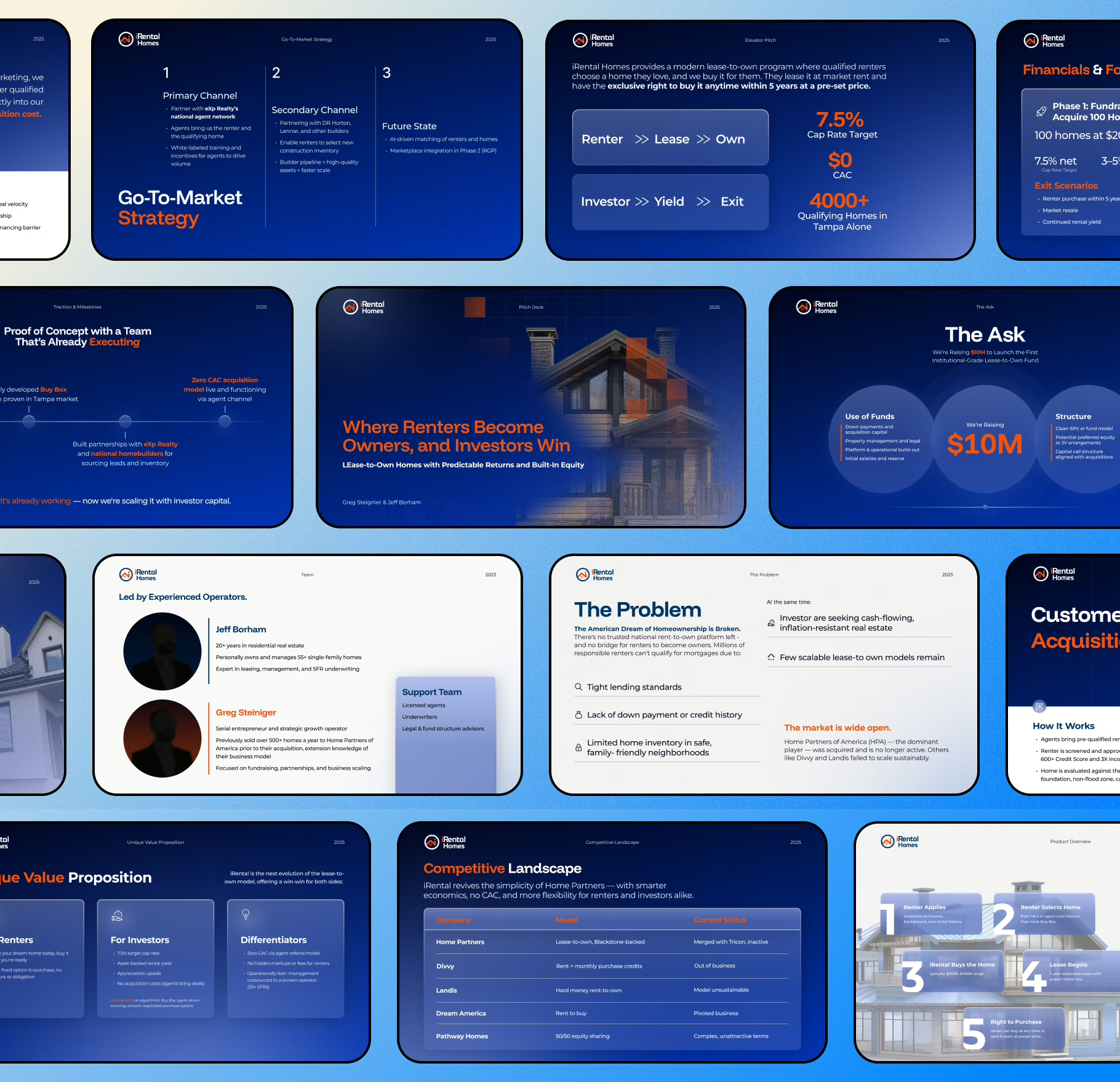
That’s why “Renter → Lease → Own” sits next to “Investor → Yield → Exit.” It’s the deck’s thesis in two lines.
Visual discipline: real estate investors hate noise
This design language is intentionally conservative:
- strong typographic blocks
- simple iconography
- minimal decoration
- clear data callouts
It feels like a fund memo, not a pitch event. That’s the right vibe for capital allocators.
The go-to-market slides aren’t “marketing,” they’re acquisition infrastructure
The Primary / Secondary / Future State channel slide matters because it signals that inventory and deal flow are being treated as a system, not wishful thinking. Real estate scaling fails when sourcing is vague.
“Partner with national agent networks” and “builders” reads like operator logic—distribution, not branding.
The ask slide: make it specific, not dramatic
Instead of “we’re raising to scale,” the ask slide frames capital in terms of:
- what it buys (homes, operations, platform)
- what it unlocks (a repeatable cohort and scaled inventory)
- how investors win (yield + exits)
Real estate investors are allergic to ambiguity. The deck respects that.
What this deck is good for
It works in multiple contexts:
- raising from real estate investors or family offices
- pitching strategic partners (agents, builders)
- internal alignment for scaling operations
A strong real estate deck becomes an operating document. That’s the bar.
