


A fictional fast food restaurant pitch, built slide by slide to show what investors would need to believe.
A smiling sun on a burger box can make someone hungry. It won’t tell an investor whether the kitchen can survive a slow Tuesday.
That’s the problem I wanted to explore with Burger Boys. I created the concept as a plant-based smash burger brand, complete with its identity, restaurant mockups, packaging, food imagery, and interactive website. It was a web and brand design exercise, and I liked how much personality we could put into something as ordinary as ordering lunch.
But if I took the same idea to someone with money, what would I actually say? Would I pitch one Amsterdam location, a delivery-first operation, or a restaurant chain? And how would I move from beautiful mockups to a credible investment conversation?
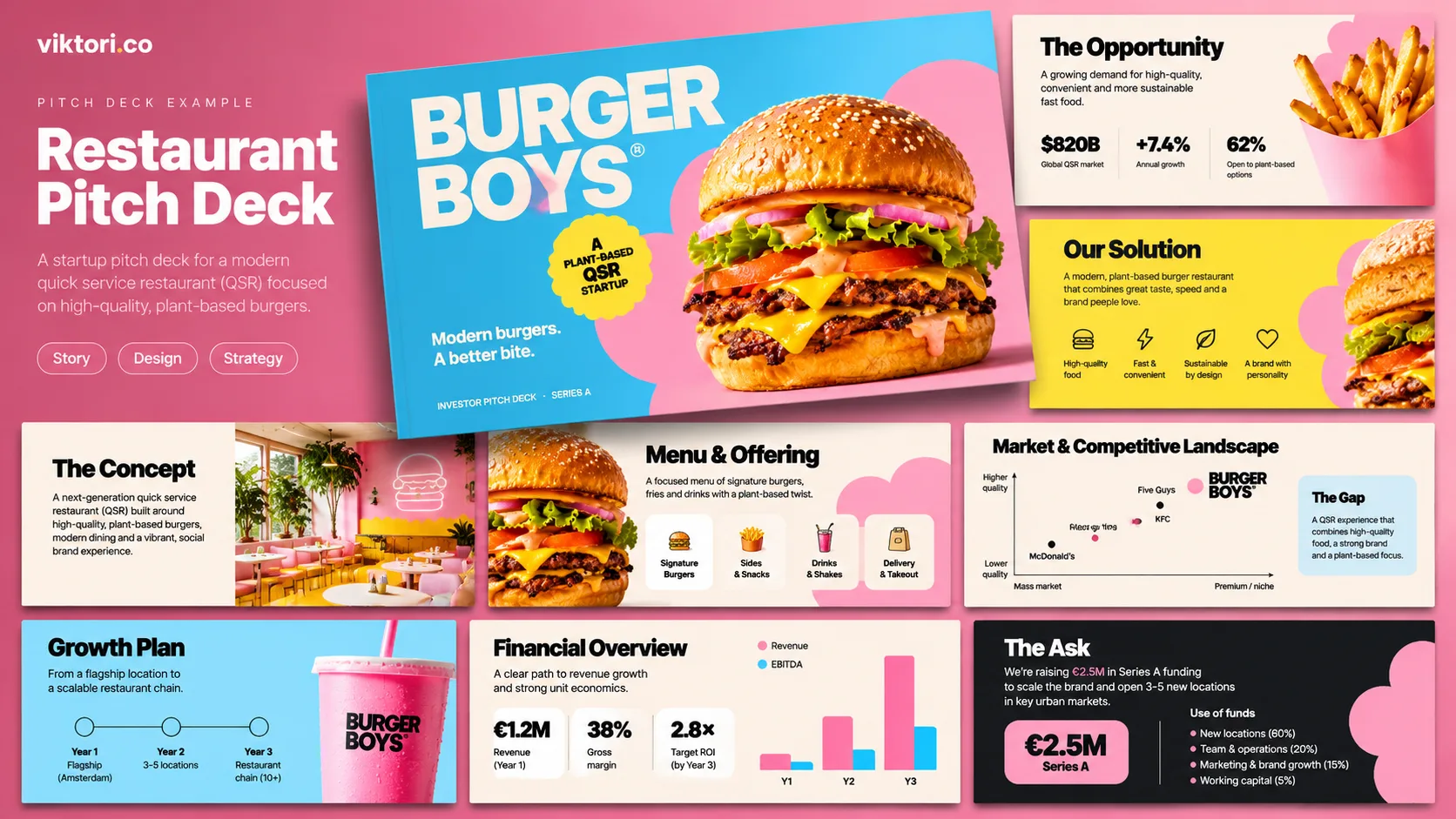
This article is my answer: a restaurant pitch deck example built around Burger Boys, showing the decisions behind each slide and the evidence a real operator would need to supply.
Important: Burger Boys is a fictional, self-initiated concept. It is not an operating restaurant or a startup seeking funding. The locations, capital requirements, forecasts, costs, and investor scenarios below are illustrative assumptions, not real performance data, a valuation, or an investment offering. Use the deck as a learning example, not as financial evidence.
First, decide what the restaurant pitch is actually selling
A restaurant is an unusual business to pitch because the product can be judged in a bite, while the investment needs to be judged over years. Investors might like the burger, the atmosphere, and the whole friendly brand. None of that answers whether the opening site is affordable, how many customers can be served at peak time, or whether the same idea works in another neighborhood.
For this example, I would pitch one fast food restaurant in Amsterdam, with the possibility of a second location only after the first unit proves itself. Not a global food startup from day one. And definitely not a franchise slide with a hundred imaginary dots on a map.
That choice changes the entire startup pitch deck. The core questions become: Is there a local customer? Can this kitchen serve that customer profitably? Is the initial capital enough to reach a useful operating milestone? And what would justify expanding?
If you’re still deciding how to order and design the presentation, I’ve already written a broader restaurant pitch deck execution guide. Here I’m applying that thinking to a single fictional case, including what I would leave out.
The 12-slide Burger Boys restaurant pitch deck
There isn’t a sacred slide count. For this particular investor conversation, twelve is enough to introduce the offering, show the commercial logic, expose the risks, and ask for the next discussion. A lender would need more operational documentation. A prospective franchise partner would want evidence from existing units, which Burger Boys doesn’t have.
| Slide | The question the pitch must answer | What I would show |
|---|---|---|
| 1. Cover | What is this? | A one-line concept and clear fictional status |
| 2. Customer gap | Who wants it, and why? | The lunch/takeout occasion to validate |
| 3. Concept | Why choose Burger Boys? | Product, price positioning, service model |
| 4. Customer and location | Where will demand come from? | Catchment hypotheses and site criteria |
| 5. Menu economics | What gets sold? | Signature burgers, combos and costs |
| 6. Operating model | Can the kitchen deliver consistently? | Order, prep, staff, handoff and delivery flow |
| 7. Unit economics | Does one restaurant work? | Tickets, contribution, fixed costs and break-even |
| 8. Competitive landscape | What are the alternatives? | Real local competitors to research |
| 9. Marketing plan | How do customers find it? | Launch tests, repeat purchases and channel mix |
| 10. Validation | What has actually been proven? | Evidence required before opening |
| 11. Capital and milestones | What does the raise buy? | Fit-out, equipment, working capital and opening plan |
| 12. Team and next step | Who executes, and what happens next? | Named operator credentials when available |
Slide 1: Sell the concept in one line
Possible headline: The smash burger experience, made entirely plant-based.
I’d use a big, high-quality food photo, the Burger Boys identity, and a short subtitle: An illustrative Amsterdam quick-service concept. The brand gives the opening a distinct personality. A deck isn’t a menu board, though. The person reading it needs to understand the business in a few seconds.
Loading Viewer…
Avoid making the first slide a collage of every visual asset. One strong image will do more work than ten small ones. The job of a good opening pitch is to earn the next slide.
Slide 2: Describe the customer gap without pretending it’s proven
The hypothesis is that there are customers who want the familiarity of a classic, indulgent burger and also prefer plant-based food. Young professionals might be one demographic to investigate around office-heavy neighborhoods, but the presentation should never call them the target market until the research supports it.
A useful restaurant pitch here might read:
We want to test whether a familiar smash burger occasion can attract both plant-based customers and people who simply want a good burger.
No invented percentages, no anonymous survey claiming everyone is switching diets, and no line about how a changing global trend automatically guarantees demand on one street in Amsterdam. The gap needs to be established by actual local observation, interviews, footfall counts, competitor research, and food trials.
Slide 3: Show the Burger Boys offering
This is where the visuals earn their place: the colorful storefront, the blue-and-pink packaging, the yellow sun mascot, and burgers that don’t visually announce their ingredient philosophy before their taste.
I’d keep the story to three decisions: a focused menu of signature smash burgers, a quick service model with dine-in and takeout, and branding that people can recognize outside the restaurant. The website’s playful six-layer burger anatomy and combo builder help explain the desired customer experience, but they are concept demonstrations, not proof of completed sales or an operating payment system.
Could a chef develop the menu? Certainly. But an investor would then want actual recipes, yield tests and supplier quotes before assigning value to those beautiful food images.
Slide 4: Make the location and customer story specific
A fast food restaurant lives inside a local map. National food and beverage statistics can help establish context, but they won’t tell you whether the restaurant can pay its rent.
The pitch should identify a candidate catchment area, nearby retail and office activity, accessible transport, lunch and evening footfall, local spending, and the competitive environment. It should distinguish weekday dine-in customers from people ordering delivery at home. If no lease has been agreed, call it a target location profile, not a confirmed site.
A location slide is much better with a real map, photographs of potential streets, and measured observations than with an enormous, unsupported market size circle. A landlord and an investor may ultimately care about different terms, but they both need to believe the location can support the operation.
Slide 5: Show menu decisions, not the entire menu
Four headline burgers, sides, sauces and drinks are enough for the concept. I’d feature a signature burger, a second flavor variation, fries, and a combo that increases the average meal value. A gourmet-looking photo doesn’t tell us the contribution margin; that comes from a recipe card, portion size, purchasing price and waste assumptions.
For a real presentation, give the reader a compact table with each key dish, expected menu price, cost of ingredients and estimated gross contribution. High-quality food is essential to the customer proposition, but food cost needs equal attention. If one signature item is expensive to produce, don’t hide it behind a tempting photo.
Slide 6: Take investors into the kitchen
Here’s the less glamorous part, and probably one of the most useful. What happens between an order appearing and a finished meal reaching the customer?
The operational slide would follow this flow: customer orders → payment is recorded → kitchen receives a standardized ticket → staff prepare the food → quality check → dine-in, takeout or delivery handoff. Then identify where the process might break: peak-hour throughput, staffing levels, ingredient availability, delivery delays and waste.
The POS system, kitchen equipment, employee salary budget and supplier relationships all belong somewhere in the underlying model. Investors funding a quick service restaurant (QSR) need to understand how it functions during a busy hour, not just how it photographs when empty.
Slide 7: Give the investor a model they can challenge
Let’s invent a simple Burger Boys operating scenario to demonstrate the math. Every number in the table below is fictional and has not been validated against an Amsterdam lease, supplier quote or customer test. The average order is expressed net of VAT to keep the example consistent.
| Illustrative assumption | Monthly base case |
|---|---|
| Average order value, excluding VAT | €17 |
| Orders per trading day | 120 |
| Trading days per month | 26 |
| Monthly net revenue | €53,040 |
| Food and ingredients (30%) | €15,912 |
| Packaging and channel/payment costs (8%) | €4,243 |
| Labor, rent, marketing, utilities and other fixed costs | €27,581 |
| Illustrative operating surplus, before interest, depreciation and taxes | €5,304 |
The calculation is straightforward: €17 × 120 orders × 26 days = €53,040 in modeled monthly net revenue. Under these invented assumptions, variable costs are 38% of sales, which leaves €10.54 contribution per order. With about €27,581 in modeled monthly fixed costs, the break-even volume is roughly 101 orders per trading day.
That’s the number I’d put in large type on the slide, alongside the 120-order base case. Then I’d show a downside case of 90 orders per day, where the model moves to an operating loss of roughly €2,917 a month. At 150 orders per day, holding the fixed-cost assumption constant, the operating surplus becomes roughly €13,525. Those are mathematical outcomes from the example, not forecasts of demand or profitability.
A percentage in the cost column is not market evidence. Before the deck goes near an actual investor, replace these figures with tested food costs, labor schedules, rent quotes, tax treatment, channel fees and a full cash-flow model. For the more detailed mechanics, see my guide to the financial projection slide.
Slide 8: Face the competitive landscape
I’d compare three to five real alternatives in the intended catchment rather than claiming the idea has no competitor. Those alternatives might include an established burger chain, a neighborhood takeout business, a plant-based restaurant, and a nearby quick-service format that wins on price or speed.
Compare them on matters the customer can verify: price of a comparable meal, service time, menu range, seating or pickup convenience, delivery availability, and positioning. Then state where Burger Boys might have a gap to exploit. If the research shows there isn’t a meaningful gap, that’s valuable too. Better to discover it before paying for an extraction hood.
Slide 9: Build a marketing plan around repeat behavior
The brand gives us plenty to work with. Colorful packaging, a recognizable sun mascot, short-form burger content, and a playful website could all support digital marketing. But I wouldn’t promise the concept will become viral. A business can’t pay its electricity bill with a trending Reel.
The marketing slide should start with a launch test: local sampling, simple offers, referral codes, Google Business Profile visibility, targeted social content, and a small budget for repeat-order experiments. Monitor acquisition cost by channel, average spend, repeat frequency, and whether delivery orders leave enough margin after fees.
I’d also separate customer entertainment from measurable acquisition. A fun interactive website can encourage browsing, but there’s no conversion claim to make until real users visit and order. If the advertising is run by an external agency, include that cost and clarify who owns the creative, audience and data.
Slide 10: Be explicit about what has and hasn’t been validated
Because Burger Boys is a design concept, this slide cannot claim operating revenue, queue length, retention, or supplier agreements. I’d show a staged validation plan instead:
- Food tests with documented, repeatable recipes and feedback.
- A pop-up or short-term kitchen pilot with real order volume and waste tracking.
- Supplier, staff and equipment quotes.
- A realistic location shortlist and lease discussions.
- A stress-tested cash forecast and operating plan.
A real restaurant startup might already have one or more of these. If so, show the evidence, date it, and explain what it changed. If not, don’t invent traction to make the slide prettier.
Slide 11: Show where the funding would go
As a fictional example only, suppose the project needed €250,000 to prepare one location and retain a buffer for the early months:
| Illustrative use of funds | Amount |
|---|---|
| Fit-out and interior | €70,000 |
| Kitchen equipment | €65,000 |
| Permits, legal and setup | €15,000 |
| Opening inventory, hiring and training | €25,000 |
| Initial marketing | €20,000 |
| Working capital reserve | €40,000 |
| Contingency | €15,000 |
| Total illustrative capital requirement | €250,000 |
These are demonstration amounts, not a genuine raise, budget quote, or investment offer. The actual funding strategy depends on the operator, lease, financing structure and cash needs. I’d show the opening milestones beside the capital plan so the investor can see what each stage buys.
If you want to pitch a scalable restaurant chain rather than a single unit, you’ll need another layer: evidence of unit repeatability, management depth, location selection standards and the cost of opening subsequent outlets. One attractive pilot won’t automatically justify an international expansion vision.
Slide 12: Who operates it, and what happens next?
I can design the experience, but a real investment pitch needs people who can run a kitchen and a business. I’d leave clearly labeled placeholders for the founder, culinary lead, operations manager and finance support until there are real names and credentials to show.
For this fictional case, the final ask isn’t “invest €250,000 now.” It’s “review the operating assumptions and validation plan.” The next step might be a tasting, site walkthrough, or discussion of the model with a potential partner. Clear, modest and appropriate to the stage.
What should a food startup’s pitch deck look like?
Burger Boys has a vibrant visual system, so I would use it. Keep the blue and pink color palette, yellow mascot, strong typography, high-quality product photography and packaging details. They help the idea feel coherent across the restaurant, digital experience and printed materials.
But the investor slides need a different discipline from a restaurant website. On the website, a floating burger and animated ingredient stack are exactly the right sort of fun. In a deck, movement shouldn’t compete with the numbers. The priority is readability: larger financial labels, clear sourcing notes and charts that survive a PDF export.
I’d craft the master in PowerPoint or a comparable editable presentation tool, then export a clean PDF for sharing. The PPTX file is for editing and presenting; the PDF keeps the layout predictable when forwarded. An older PPT format may still appear in searches, but I’d generally use PPTX today. If the deck contains animations, check both versions because static exports won’t preserve them.
This downloadable example is deliberately a fictional teaching deck. You can view online for free by reading the slide breakdown here, then download as a PDF or edit the PowerPoint file using the links above once they are published. None of the hypothetical figures should be reused without replacing the assumptions.
Three things I’d challenge before showing this to an investor
First: who is providing the capital, and why? A local business partner might evaluate the operation, lease and possible distributions. A venture investor may want a much larger opportunity. The same restaurant pitch won’t suit both audiences. If the capital path is unclear, start with fundraising narrative strategy before designing another ten slides.
Second: what are the economics of one unit? The average order, ingredient cost, throughput, rent, staff scheduling and working capital matter more than the number of future pins on a map. A forecast without testable inputs is just a nicely formatted wish.
Third: what would make us walk away? A customer test might fail. The right location might cost too much. Delivery fees might erase the benefit of more orders. Establish the conditions that would invalidate the idea. Investors deserve to see that the founder can distinguish enthusiasm from evidence.
Restaurant pitch deck FAQs
Is a restaurant pitch deck the same as a business plan?
No. The deck is the short presentation that opens a conversation. The business plan and operating model contain the detailed staffing, financial, supplier, location and execution assumptions. In serious diligence, you’ll need both.
Can I use this as a restaurant pitch deck template?
Yes, as a structural example. Replace the fictional Burger Boys brand, scenario, menu, assumptions and placeholders with your own evidence. The slide logic can work for a food startup, but a fine-dining venue, food truck, delivery kitchen and quick service restaurant will require different operating metrics.
Can I download the restaurant pitch deck as a PDF?
Yes. The illustrated example is supplied in PDF format, along with an editable PPTX file. Download links will appear above once both files are added to the site. For your own deck, use File → Export → PDF in PowerPoint or the equivalent export command in your slide editor.
What should investors see on the financial slide?
Revenue drivers, food cost, labor, rent, marketing, channel costs, break-even volume, cash needs and assumptions. If you discuss return on investment, explain how and when cash could actually be returned under the proposed structure. Don’t use a large percentage as a substitute for the underlying model.
Do I need to show a chef, existing sales or a finished location?
Show what is genuinely available. Before opening, credible evidence can include recipe trials, supplier quotes, permitted site options, test sales or management experience. Label planned milestones as plans. A startup concept doesn’t become a real operating business because it has a convincing storefront mockup.
What if I want to pitch a restaurant chain or a franchise?
Prove the first location’s economics and the systems that could make it repeatable. Then explain what a second site would cost, what might change by market, and how the operator manages consistency. Scale belongs in the deck when there’s a basis for believing it.
Closing thought
My favorite thing about the Burger Boys website is that it treats a burger as something worth playing with. You can pull its ingredients apart and put it back together. Building the hypothetical investor deck forced me to do the same thing to the business: take apart each assumption and see whether the idea still holds when all the pieces are separated.
That’s the useful part of the exercise. A restaurant pitch deck should leave someone interested in the food, certainly. More importantly, they should understand the business that has to deliver it.
For a broader investor-readiness discussion, you can explore my startup fundraising consulting, or see how I approach pitch deck design once the story and evidence are in place.
