


Most bakery founders don’t fail because the product isn’t good.
They fail because investors don’t understand the business fast enough.
A bakery pitch deck isn’t a place to showcase passion, recipes, or aesthetic slides. It’s a decision tool. Investors want to see whether the numbers work, whether the operation is realistic, and whether the business can survive real-world constraints like labor costs, ingredient volatility, and location dependency.
I’m Viktor, a pitch deck consultant and brand strategist. For more than a decade, I’ve helped founders across food, retail, and other asset-heavy businesses structure investor pitches that get funded — not by exaggerating potential, but by making the underlying logic clear and defensible.
This guide breaks down why bakery pitch decks so often miss the mark, what investors actually look for when evaluating food businesses, and how to structure a 12-slide bakery pitch deck that reflects how capital is allocated in the real world. You’ll also find a practical AI prompt later on to generate a strong first draft using tools like Pitch, Gamma, or ChatGPT — as a starting point, not a shortcut.
Why Bakery Pitch Decks Fail (Even When the Product Is Great)
Most bakery pitch decks fail for the same reason: they tell the wrong story.
Founders often lead with passion, craftsmanship, and product quality — all important, but not decisive. Investors assume the product is good. What they’re trying to understand is whether the business behind it is investable.
A common mistake is confusing a business plan with a pitch deck. Business plans explain everything. Pitch decks explain only what matters. Bakery decks frequently overload slides with operational detail while leaving the financial logic and risk profile vague.
Another issue is overestimating passion and under-explaining economics. Loving baking does not explain margins. A strong local following does not explain scalability. Investors aren’t dismissing the craft — they’re looking for proof that the numbers hold under pressure.
Bakeries are also harder to pitch than SaaS, and investors know it. There are no exponential margins, no frictionless scale, and no fantasy multiples. Food businesses live in the world of labor, rent, spoilage, and daily execution. A pitch deck that ignores this reality loses credibility immediately.
When a bakery deck fails, it’s rarely because the idea is bad. It’s because the business story isn’t aligned with how investors evaluate food ventures.
What Investors Actually Look for in a Bakery Pitch Deck
A strong bakery pitch deck speaks the investor’s language without pretending to be something it’s not. These are the areas that matter most.
Unit Economics: Margins, Spoilage, and Labor
Investors want to see how money is made per unit, not just per month. That means clear visibility into ingredient costs, labor intensity, waste, and gross margins. Bakeries live or die on operational discipline. If the unit economics aren’t understood, nothing else in the deck matters.
Location Dependency and Foot Traffic Risk
Unlike digital businesses, bakeries are tied to physical reality. Location quality, foot traffic patterns, and neighborhood dynamics are fundamental risk factors. Investors expect you to understand how dependent revenue is on geography — and what happens if assumptions fall short.
CapEx Realities: Equipment, Leases, and Fit-Out
Ovens, mixers, refrigeration, permits, and build-outs require upfront capital. Investors want clarity on where money goes before revenue begins and how long it takes to recover those costs. Underestimating CapEx is one of the fastest ways to lose trust in a bakery pitch.
Scalability: Single Shop, Multi-Location, or Franchise
Not every bakery is meant to scale the same way. A single profitable location is a different investment than a multi-store rollout or franchise model. Investors look for alignment between ambition and operational reality — not vague claims of expansion without a mechanism.
Why “Growth” Means Something Different in Food
In food businesses, growth is slower, heavier, and more constrained. Investors don’t expect hockey sticks — they expect controlled expansion, repeatability, and margin stability. A credible bakery pitch deck defines growth in operational terms, not startup slogans.
This is where strong bakery decks separate themselves from generic templates. They don’t try to look like tech pitches. They respect the economics of food.
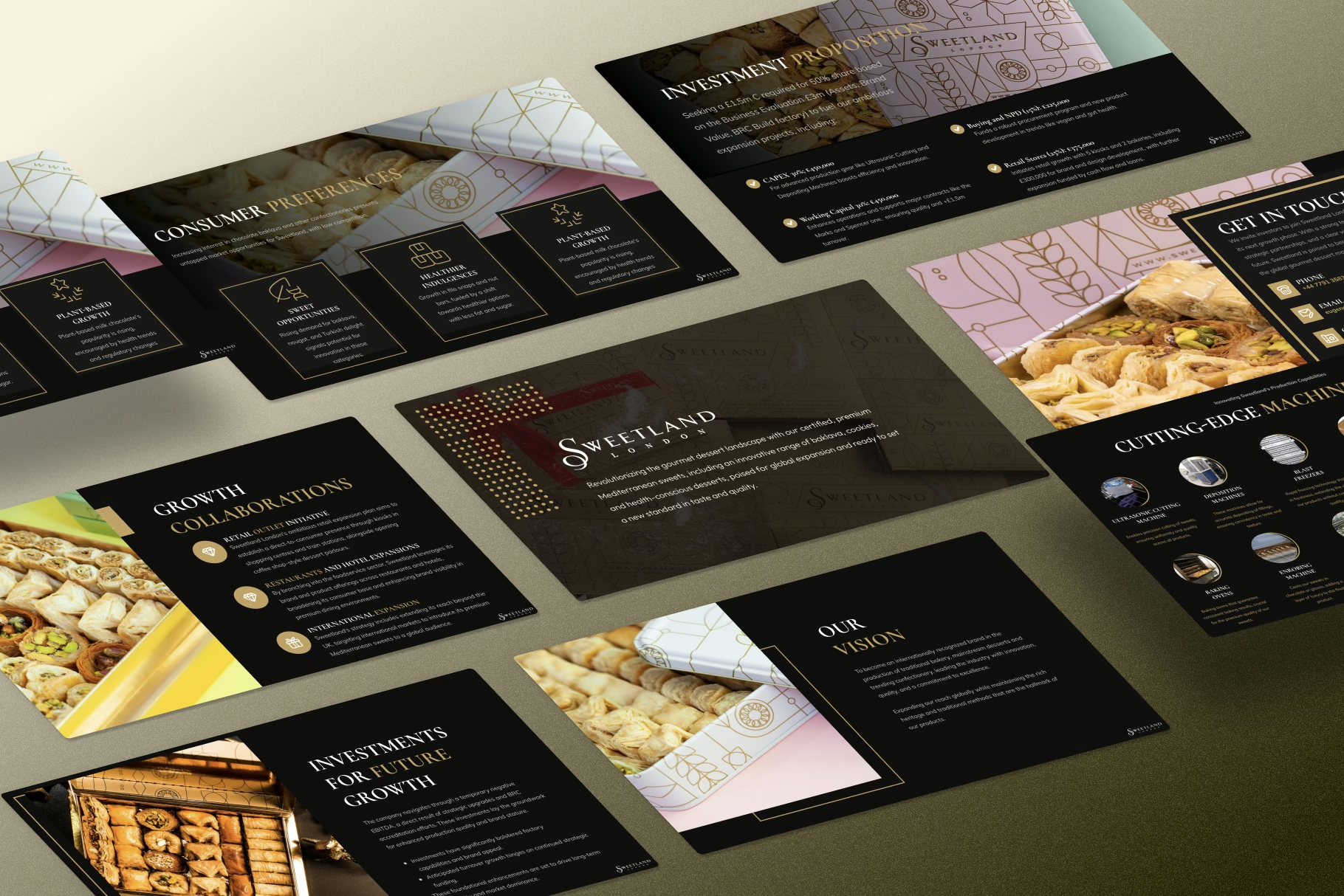
The 12 Slides Every Bakery Investor Pitch Needs
(Template + Practical Example)
A strong bakery pitch deck doesn’t entertain — it answers questions before they’re asked. Each slide below includes what investors expect to see and a realistic example of how a bakery might present it.
1. Cover — Concept, Location, Positioning
Template
- Bakery name and short descriptor
- Primary location (city / neighborhood)
- Clear positioning (artisan, everyday, premium, niche)
Example
Stone & Crumb — Neighborhood sourdough bakery in East London focused on naturally leavened bread and morning foot traffic.
Why it works: investors immediately understand what, where, and for whom.
2. The Problem — What the Local Market Is Missing
Template
- Specific gap in the local bakery market
- Customer frustration or unmet demand
- Evidence from observation or data
Example
Our neighborhood has 5 convenience bakeries, but none offer fresh sourdough or consistent quality before 9am. Morning commuters either buy packaged bread or travel outside the area.
Why it works: the problem is local, concrete, and believable.
3. The Solution — Why Customers Choose You
Template
- Clear value proposition
- Primary reason customers switch
- Differentiation that matters daily
Example
We produce fresh sourdough and laminated pastries on-site daily, priced for repeat weekday purchases rather than occasional treats.
Why it works: focuses on repeat behavior, not branding fluff.
4. Product & Menu Strategy
Template
- Core product categories
- Margin leaders
- Menu discipline rationale
Example
Our menu is limited to 12 SKUs: 4 breads, 5 pastries, and 3 seasonal items. Bread drives margin and volume; pastries drive morning basket size.
Why it works: signals operational discipline.
5. Market & Location Dynamics
Template
- Target customer segments
- Foot traffic assumptions
- Peak hours and seasonality
Example
Primary customers are weekday commuters and nearby office workers. 65% of projected sales occur between 7–11am.
Why it works: grounded in real behavior, not TAM slides.
6. Business Model & Revenue Streams
Template
- Primary revenue channel
- Secondary channels (if any)
- Why this mix makes sense
Example
80% of revenue comes from in-store sales, 15% from local cafés via wholesale bread supply, and 5% from pre-orders.
Why it works: clear priorities, no distractions.
7. Traction or Validation
Template
- Early sales or proof points
- Customer signals
- Momentum indicators
Example
Pop-up weekends generated €4,200 in sales over three weeks with a 38% repeat purchase rate.
Why it works: small numbers, real proof.
8. Competitive Landscape (Local, Not Global)
Template
- Nearby competitors
- Comparison on quality, price, hours
- Strategic position
Example
Nearby bakeries focus on low-cost volume or late-day pastries. We operate earlier, focus on bread quality, and price mid-market.
Why it works: acknowledges reality without arrogance.
9. Operations & Supply Chain
Template
- Staffing model
- Production flow
- Key suppliers
Example
Two bakers cover overnight production; one front-of-house staff handles morning service. Flour sourced from a regional mill under annual contract.
Why it works: shows thought-through execution.
10. Financials & Unit Economics
Template
- Gross margin assumptions
- Fixed vs variable costs
- Break-even logic
Example
Average gross margin is 62%. Monthly break-even at €38,000 in revenue, reached at ~220 transactions per day.
Why it works: investors can pressure-test it.
11. Team & Execution Capability
Template
- Relevant experience
- Role clarity
- Operational credibility
Example
Founder previously ran a 4-location café group; head baker trained at two high-volume artisan bakeries.
Why it works: reduces execution risk.
12. Funding Ask & Use of Funds
Template
- Capital required
- Allocation
- What it unlocks
Example
Seeking €250,000 to fund equipment (€110k), fit-out (€90k), and 3 months of working capital (€50k). Enables launch and first 6 months of operation.
Why it works: disciplined and transparent.
Why this structure works
- It mirrors how investors think
- It avoids startup clichés
- It respects the economics of food
- It makes risk visible — and manageable
This is the difference between a deck that gets polite nods and one that gets follow-up questions
The 12-Slide Bakery Pitch Deck AI Prompt (copy-paste)
If you’re using tools like Pitch, Gamma, Tome, or ChatGPT to draft your deck, this prompt will give you a clean, investor-grade starting point — not generic slide filler.
Copy it, paste it, then refine with real numbers.
If you want to really dive into the world of pitch decks, check out our complete collection of pitch deck templates.
Related F&B Pitch Deck Resources
Check out our massive directory of pitch deck templates, or the following related templates:
16 Slide Fish Frying Business Pitch Deck Template
You’ve got a recipe that could put the local fish joints to shame and a…
14 Slide Ready to Drink Beverage Pitch Deck Template
You’ve concocted the next big thing in the ready-to-drink beverage world—maybe it’s the love child…
14 Slide Health Food Pitch Deck
Alright, so you’ve got a fantastic product—a protein bar or drink that’s set to shake…
15 Slide Frozen Juice Pitch Deck Template
You know those moments when you’re sipping on a glass of frozen lemon juice, and…
Bakery Pitch Deck: How Small Bakeries Pitch Investors (12-Slide Example + AI Prompt)
Most bakery founders don’t fail because the product isn’t good.They fail because investors don’t understand…

12 Slides Food Processing Pitch Deck Template
Author: ViktorPitch Deck Expert. Ex Advertising. Founder of Viktori. $500mill In Funding. Bald Since 2010….
15 Slide Produce Export Pitch Deck Template
So, you’ve got a bumper crop of the finest fruits and veggies from the lush…
12 Slide Food and Beverage Pitch Deck Template
So, you’ve got the next big thing in the food & beverage world. Maybe it’s…
12 Slide Restaurants Pitch Deck Template | Google Slides
Author: ViktorPitch Deck Expert. Ex Advertising. Founder of Viktori. $500mill In Funding. Bald Since 2010….
Looking for a step by step guide to build an F&B pitch deck?
Check out our in-depth pitch deck guide.
Check out some of the essential 101 guides:
Burn Rate and Runway in a Pitch Deck: How to Show Investors Survival Math
Burn rate is where a pitch deck stops being brave and starts being accountable. Up…
Financial Projection Slide: How to Show Investors the Numbers Behind the Story
A financial projection slide shows investors how your business could grow over time. It usually…
Revenue Model Slide: How to Show Investors How You Make Money
A revenue model slide explains how your business makes money. That sounds simple, but this…
Use of Funds Slide: How to Show Investors Where the Money Goes
Use Of Funds Slide Quick Summary A use of funds slide explains how the capital…

Top Pitch Deck Design Agencies for Investor-Ready Presentations
Quick Summary A pitch deck design agency helps startups turn complex business ideas into clear,…

How to Create a High-Impact Investment Highlights Slide For Your Pitch Deck
An investment highlights slide is often the moment in a pitch deck when investors decide…
