


Aviation decks have a specific problem that most founders underestimate: the audience rarely shares your mental model. In a SaaS pitch, people can “get it” fast and then argue about go-to-market. In aviation, people get stuck earlier. They’re trying to reconcile technology, safety, certification, adoption pathways, and mission use cases—often all at once. If your story forces them to do that synthesis themselves, you lose them.
This project was built around an autonomous aviation platform and an AI-piloted interface concept. The visuals show a world map framing adversaries and vulnerabilities, a “dual-use growth path” across categories (eVTOL / UAM / cargo drones), a bold central positioning slide, and then a flow of proof elements: readiness language, timeline, aircraft breakdowns, flight proof, and operational use cases like ISR/support.
The core constraint: credibility before persuasion
In aerospace and defense-adjacent work, persuasion comes second. The deck must first establish that the team understands the institutional frame:
- What exactly is being deployed (and what is not).
- What “ready” means in this context (not “we’re building,” but “we’re deploying”).
- Where the system lives (on-aircraft, in avionics, in software, in ops).
- What adoption path reduces risk (retrofit vs new platform, pilot programs, validation gates).
So the deck architecture prioritized readiness language and deployment logic early, before any big growth narrative.
Narrative rebuild: from “cool tech” to “operational system”
The guiding rewrite was: this is not an AI feature; it’s an operational system that changes how aviation is flown and coordinated.
That changes the storyline. Instead of “here’s our AI,” it becomes:
- Why the current state is unacceptable (vulnerability, human limitations, adversary advantage, operational bottlenecks).
- What the system does in plain language (flies, navigates, communicates like a human—without fatigue/hesitation).
- Where it fits (aircraft types and deployment contexts).
- Why it’s defensible (integration depth, compliance posture, operational data loop, testing footprint).
- How it scales (dual-use expansion path with sensible sequencing).
- Proof (TRL progression, test flights, readiness milestones, partners).
This is why the “UNPILOTED ≠ UNMANNED” slide works: it reframes autonomy as capability and decision support, not simply removing a pilot.
Slide-level design logic
The visual system did a lot of work on behalf of the narrative:
- Dark, cinematic surfaces signaled defense-grade seriousness without going “tactical cosplay.”
- Glowing particle gradients and soft spectral textures were used to suggest sensing, intelligence, and autonomy—without the cliché of robot icons.
- Large typographic hierarchy kept technical density from swallowing the message.
- A “proof cadence” (timeline, TRL, flight proof, aircraft diagram) created momentum: each proof slide reduces perceived risk.
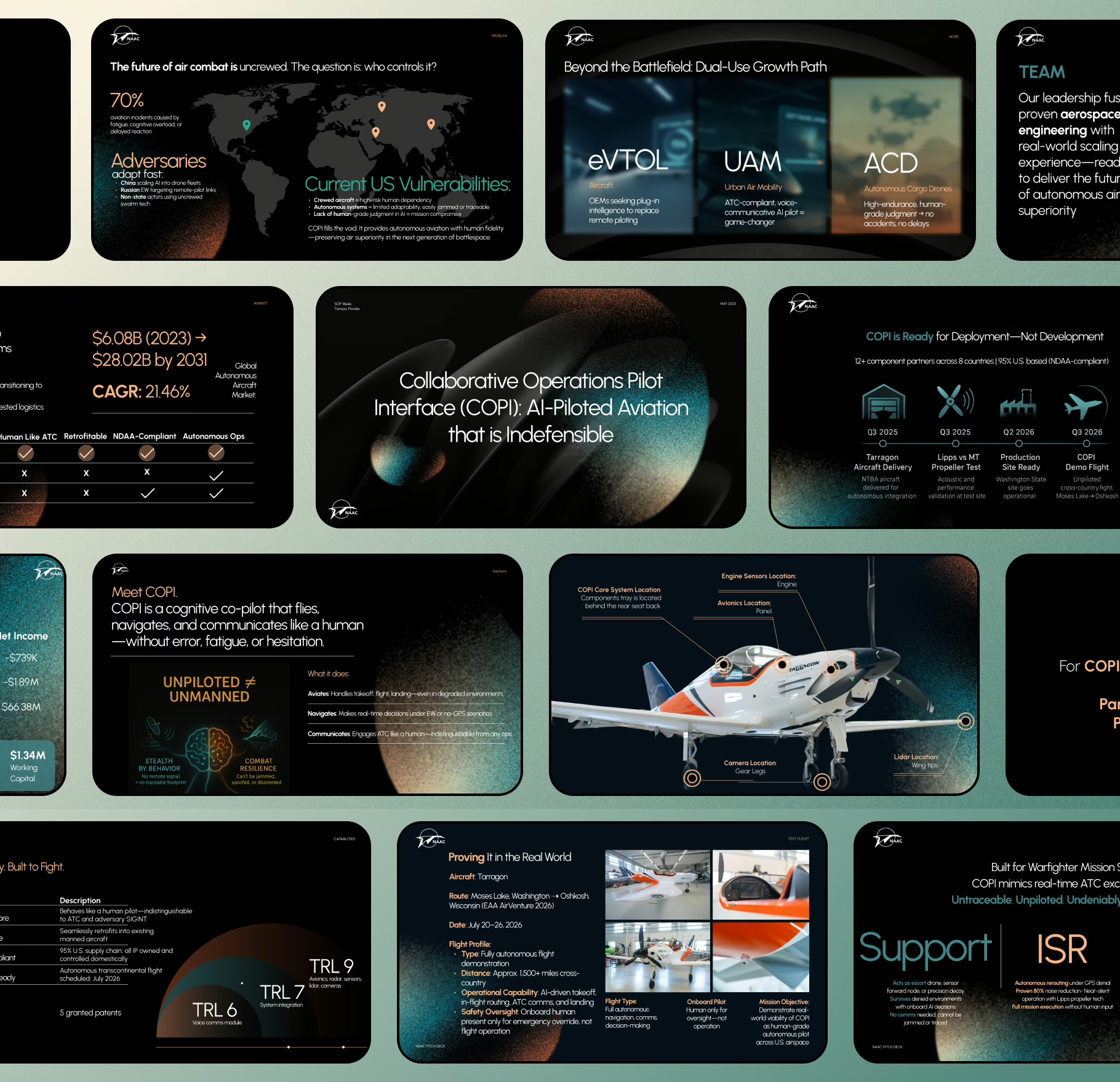
The aircraft diagram slide matters more than it looks. Calling out sensor locations and avionics integration is a credibility move: it tells technical reviewers “we know where this lives,” and it tells non-technical stakeholders “this is real hardware integration, not an app demo.”
Institutional readiness framing
A key move in decks like this is to avoid framing the company as “pre-product” if that’s not accurate. The slide stating “ready for deployment — not development” isn’t bravado; it’s positioning. But it has to be earned by what follows: partners, milestones, flight proof, and clearly stated next steps.
So the deck used gates and milestones rather than vague promises. That’s also why the timeline is expressed in quarters and actions (deployment, programs, production) rather than “someday we’ll scale.”
What the final deliverable enabled
The end product wasn’t just a set of slides. It was a presentation system that could flex for different rooms:
- A version that leads with defense/ISR relevance.
- A version that leads with commercial adoption (cargo, UAM).
- A version that is partner-facing (integration and rollout).
Aviation and autonomy companies rarely win by having “a deck.” They win by having a deck that survives three very different audiences without breaking.
