


You know how it goes—you’ve got the next big idea for a hiring process that’s going to change the game. But when it comes to pitching it to potential investors or partners, you’re hitting a wall. Spoiler alert: it’s not your idea; it’s the way you’re presenting it. The pitch deck isn’t just a bunch of slides; it’s your story, your vision, and if done right, it’s your key to making things happen.
I’m Viktor, a pitch deck designer and a creative business strategist. Over the past 13 years, I’ve helped businesses secure millions of $ in funding thanks to my approach and I’m sharing it here in this pitch deck guide.
I’ve spent the last decade helping founders like you not just get their foot in the door, but kick it wide open. I’ve seen what works, what doesn’t, and most importantly, how to turn a “maybe” into a “yes.” This isn’t about fluff or filler—just straight talk and practical tips to make sure your simulation-driven hiring pitch lands where it should: in the win column
So, let’s cut to the chase and start building a pitch that does your idea justice.
Get My 12 Slide Framework That Got $500mil in Funding For Clients.
What do you think of having 12 dead simple formulas, that will help you craft 12 slides, in about 1 hour? That’s what you’ll get, when you download my 12 slide framework. Save hours crafting your pitch deck copy with my tested approach that includes:
- Elevator pitch one sentence formula
- Problem/ solution slide one sentence formula
- Competitor slide one sentence formula
- 9 other formulas, tips, tricks and advice
The formulas worked for 40+ industries and 500+ companies. Including the one you’re looking at now.
Clicking the link won’t charge you anything.
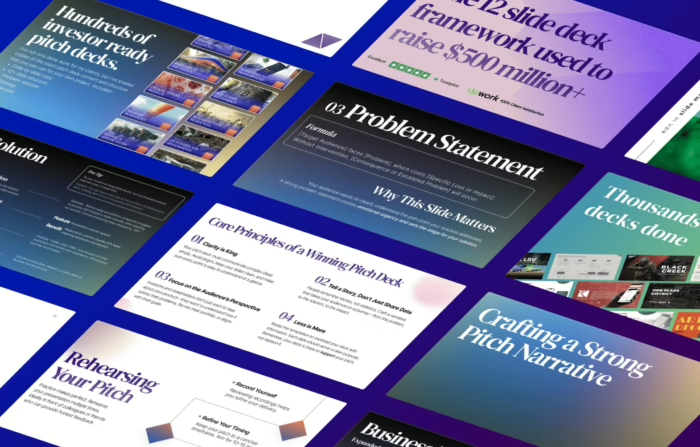
13 Slide Simulation-Driven Hiring Pitch Deck Template In Google Slides
The above is is just a simplified template.
Founders that are serious about getting the funding they need, opt in for a deck has industry specific content, superb narrative and award winning design like these ones below:


I can help you build that deck with my hands-off process in 7 days or less.
Book a free 30 minute call below if you’re serious about getting an investor ready deck, and we’ll discuss your needs in detail. I’ll help you design the deck, write the content, develop the narrative and flesh out the strategy with financials.


Follow us on social for the newest templates:
Slide 1: Elevator Pitch Slide
Headline: “Revolutionizing [Industry]: A Game-Changer for [Target Audience]”
Content:
- Name the Enemy: “Traditional [industry problem] is outdated and inefficient.”
- Create Urgency: “Customers and businesses need an innovative solution now.”
- Agitate the Problem: “Current methods lead to wasted time, money, and resources.”
- Offer the Missing Piece: “Our solution provides [key benefits] directly to [target audience].”
- Spark Intrigue: “Introducing [Your Solution], like Uber but for [specific service].”
Visuals:
- Side-by-side comparison of the current problem and your solution.
- A high-quality image or infographic that highlights the inefficiencies of the current system versus the streamlined process your solution offers.
Slide 2: Investor Memo Slide
Purpose: Provide a concise summary of the opportunity, including key metrics, market potential, and what makes your business a compelling investment.
Content:
- Company Overview: “[Your Company Name] is a [industry] company focused on [primary product/service].”
- Market Opportunity: “The [industry] market is valued at [market size], with a projected growth of [growth rate]% annually.”
- Product/Service Summary: “We offer [product/service], which solves [problem] for [target market].”
- Competitive Advantage: “Our unique approach leverages [key differentiator], setting us apart from competitors.”
- Financial Snapshot: “We’ve achieved [revenue/milestones], with [X]% growth YoY and a strong pipeline for future growth.”
Visuals:
- A simple, clean chart or graph showing market growth, company traction, or other relevant metrics.
- Logos of key customers or partners, if applicable.
Slide 3: Problem Statement
Purpose: Clearly articulate the problem you are solving, making it relatable and urgent.
Content:
- Problem Overview: Describe the specific pain point or issue that your target audience faces. Be as specific as possible. Example: “50% of mid-sized companies struggle to find qualified candidates quickly enough to fill critical roles, leading to significant operational delays.”
- Impact: Explain the consequences of this problem if it remains unsolved. Use data to illustrate the gravity. Example: “These delays can result in up to $X million in lost productivity annually for affected companies.”
- Current Solutions: Briefly mention the existing solutions and why they are inadequate. Example: “Current recruiting tools are either too slow, too expensive, or lack the precision needed to find the right talent quickly.”
Visuals:
- A statistic-driven infographic that highlights the problem’s scope.
- A customer journey map showing where the pain points occur.
Slide 4: Solution Overview
Purpose: Introduce your solution and explain how it directly addresses the problem.
Content:
- Solution Introduction: Provide a high-level overview of your product or service. Example: “[Your Solution] is a simulation-driven hiring platform that accelerates the candidate evaluation process, reducing hiring times by up to 70%.”
- Key Features: List the standout features that make your solution effective. Example: “Our platform offers AI-powered candidate screening, realistic job simulations, and instant performance feedback.”
- Benefits: Explain how these features translate into benefits for the user. Example: “This means companies can hire top talent faster, with greater confidence in their fit and abilities.”
Visuals:
- A product demo video or screenshots of your platform.
- A before-and-after scenario showing the difference your solution makes.
Slide 5: Market Opportunity
Purpose: Show the size, growth potential, and attractiveness of the market you are entering.
Content:
- Market Size: Quantify the total addressable market (TAM) and serviceable obtainable market (SOM). Example: “The global HR tech market is valued at $X billion, with a CAGR of Y%. Our SOM focuses on the $Z billion segment of mid-to-large enterprises.”
- Growth Potential: Highlight the projected growth in your target market. Example: “As the demand for efficient hiring solutions grows, this market segment is expected to expand by [X]% annually over the next [Y] years.”
- Target Audience: Define your primary customers and their needs. Example: “We target mid-sized to large companies in the tech and healthcare sectors, who face acute challenges in recruiting specialized talent.”
Visuals:
- A market map or segmentation diagram.
- A graph showing the projected growth of the market over time.
Slide 6: Business Model
Purpose: Explain how your company plans to generate revenue and achieve profitability.
Content:
- Revenue Streams: Detail the different ways your company makes money. Example: “We operate on a subscription-based model, with tiered pricing based on company size and usage. Additional revenue comes from premium services like advanced analytics and custom simulations.”
- Pricing Strategy: Describe how you’ve priced your solution relative to competitors and market demand. Example: “Our pricing starts at $X per user per month, which is competitive given our advanced features and the savings we offer.”
- Customer Acquisition: Explain how you plan to attract and retain customers. Example: “We acquire customers through a combination of direct sales, partnerships with HR consultants, and targeted digital marketing.”
Visuals:
- A flowchart showing the customer journey from acquisition to revenue.
- A pricing table or comparison with competitors.
Hold on. You might want to check my list on the best presentation and communication books...
These are crucial books that will help you improve the design and structure of your decks and presentations, besides improving your delivery and skyrocketing your confidence when facing investors. Check them out below.

Slide 7: Go-to-Market Strategy
Purpose: Describe how you plan to enter the market, gain traction, and scale.
Content:
- Launch Plan: Outline your initial market entry strategy. Example: “We will focus on the North American tech sector, leveraging existing relationships and industry events to build initial traction.”
- Marketing Channels: Identify the channels you will use to reach your target audience. Example: “Our primary channels include LinkedIn advertising, content marketing focused on HR blogs, and direct outreach through industry webinars.”
- Sales Strategy: Detail your sales approach, including key tactics for converting leads into paying customers. Example: “Our sales team will focus on demo-based selling, emphasizing the time and cost savings our platform offers.”
Visuals:
- A timeline or roadmap of your go-to-market strategy.
- A funnel graphic showing the customer acquisition process.
Slide 8: Traction
Purpose: Highlight any significant progress or milestones that demonstrate your solution’s viability and market acceptance.
Content:
- Key Metrics: Share important metrics that show your growth. Example: “We have acquired [X] paying customers, with a [Y]% retention rate and a [Z]% monthly growth in active users.”
- Partnerships: Mention any strategic partnerships that help validate your business. Example: “We’ve partnered with [well-known industry names] to integrate our solution into their HR tech stacks.”
- Customer Testimonials: Use quotes from satisfied customers to build credibility. Example: “‘[Your Solution] has cut our hiring time in half, and our managers are thrilled with the quality of candidates we’re getting.’ – [Customer Name, Company]”
Visuals:
- A growth chart showing user or revenue metrics.
- Logos of key customers or partners.
Slide 9: Competitive Landscape
Purpose: Show where you stand relative to competitors and why you have a unique advantage.
Content:
- Competitors: Identify your main competitors and their market positioning. Example: “We compete with [Competitor 1, Competitor 2], but we differentiate by offering [unique feature/benefit].”
- Comparison: Provide a comparison of key features or advantages. Example: “Unlike [Competitor], we offer [specific advantage], making our solution [faster, more reliable, cost-effective].”
- Barriers to Entry: Highlight what makes it difficult for others to replicate your success. Example: “Our proprietary AI and exclusive partnerships create significant barriers to entry.”
Visuals:
- A competitor comparison table or matrix.
- A positioning map showing your place in the market.
Slide 10: Financial Projections
Purpose: Present your financial forecasts, showing potential investors the expected return on investment.
Content:
- Revenue Forecast: Provide projections for revenue growth over the next 3-5 years. Example: “We expect to reach $X million in revenue by Year 3, with an annual growth rate of [Y]%.“
- Key Assumptions: Outline the assumptions underlying your projections. Example: “Our projections are based on acquiring [X] new customers per month, with a customer lifetime value (CLTV) of $[Y].”
- Break-even Analysis: Show when you expect to become profitable. Example: “We anticipate reaching break-even by [quarter/year] at [X] customers.”
Visuals:
- A graph of projected revenue, expenses, and profit over time.
- A table summarizing key financial metrics (e.g., revenue, costs, profits).
Slide 11: Team
Purpose: Highlight the experience and skills of your team, showing why they are capable of executing your vision.
Content:
- Team Members: Introduce the key players in your team. Example: “[Name], CEO, has over 15 years of experience in HR tech, with a successful exit in 2018. [Name], CTO, is a former Google engineer with a deep background in AI and machine learning.”
- Advisors: Mention any advisors who bring additional expertise. Example: “We are supported by advisors like [Name], who has led multiple HR tech companies to successful exits.”
- Company Culture: Briefly describe the values or culture driving your team. Example: “Our team is united by a passion for innovation and a commitment to making hiring smarter and more efficient.”
Visuals:
- Photos and brief bios of each key team member.
- Logos or icons representing companies where team members have previously worked.
Slide 12: Ask
Purpose: Clearly state what you are seeking from investors and how the funds will be used.
Content:
- Funding Request: Specify the amount of funding you are seeking. Example: “We are seeking $X million in funding to accelerate our growth and expand our team.”
- Use of Funds: Provide a breakdown of how you plan to use the investment. Example: “Funds will be allocated as follows: [Y]% to product development, [Z]% to marketing and customer acquisition, [A]% to scaling operations.”
- Milestones: Outline the key milestones you aim to achieve with the funding. Example: “This funding will enable us to achieve [specific milestone, e.g., launching in two new markets, doubling our customer base] by [date].”
Visuals:
- A pie chart or bar graph showing the allocation of funds.
- A timeline showing key milestones and expected dates.
Slide 13: Closing
Purpose: Leave the audience with a memorable closing statement that reinforces your vision and invites further discussion.
Content:
- Vision Statement: Reiterate your long-term vision. Example: “Our vision is to revolutionize the hiring process, making it faster, fairer, and more efficient for companies of all sizes.”
- Thank You: Express gratitude for the audience’s time and attention. Example: “Thank you for your time and consideration. We look forward to the opportunity to work together.”
- Next Steps: Encourage follow-up and next steps. Example: “We’d love to discuss how we can bring this vision to life together. Let’s set up a time to dive deeper into the details.”
Visuals:
- A powerful, emotionally resonant image that encapsulates your vision.
- Contact information with a call to action (e.g., “Contact us at [email address] to learn more”).
Pick a specific pitch deck design from the award winning Envato.
1000’s of ready made Powerpoint, Google Slides, and Keynote presentations that are easy to edit, format and tailor to your idea.
Conclusion
By now, you’ve got the tools and the template to take your pitch from “interesting” to “let’s talk more.” But remember, the deck is just the beginning. The real magic happens when you tell your story, connect with your audience, and make them see what you see. It’s not just about getting through the slides; it’s about making them feel why your simulation-driven hiring process is the future.
Keep it real, keep it focused, and don’t be afraid to show a little of yourself in the process. After all, people invest in people, not just ideas. So go out there and pitch like you mean it—I’m rooting for you. You got this!
If you want to really dive into the world of pitch decks, check out our complete collection of pitch deck templates.
Check out some of the essential 101 guides:

Burn Rate and Runway in a Pitch Deck: How to Show Investors Survival Math
Burn rate is where a pitch deck stops being brave and starts being accountable. Up…
Financial Projection Slide: How to Show Investors the Numbers Behind the Story
A financial projection slide shows investors how your business could grow over time. It usually…
Revenue Model Slide: How to Show Investors How You Make Money
A revenue model slide explains how your business makes money. That sounds simple, but this…

Use of Funds Slide: How to Show Investors Where the Money Goes
Use Of Funds Slide Quick Summary A use of funds slide explains how the capital…

Top Pitch Deck Design Agencies for Investor-Ready Presentations
Quick Summary A pitch deck design agency helps startups turn complex business ideas into clear,…

How to Create a High-Impact Investment Highlights Slide For Your Pitch Deck
An investment highlights slide is often the moment in a pitch deck when investors decide…
