
Leo AI Raises $9.7 million - What’s Working (and the Pitch Pattern Behind It)

Author: Viktor
Pitch Deck & Fundraising Consultant. Ex Advertising. Founder of Viktori. $500mill In Funding. Bald Since 2010.
This is a pitch-deck breakdown: what likely created investor conviction, and how to replicate the structure (not the company)
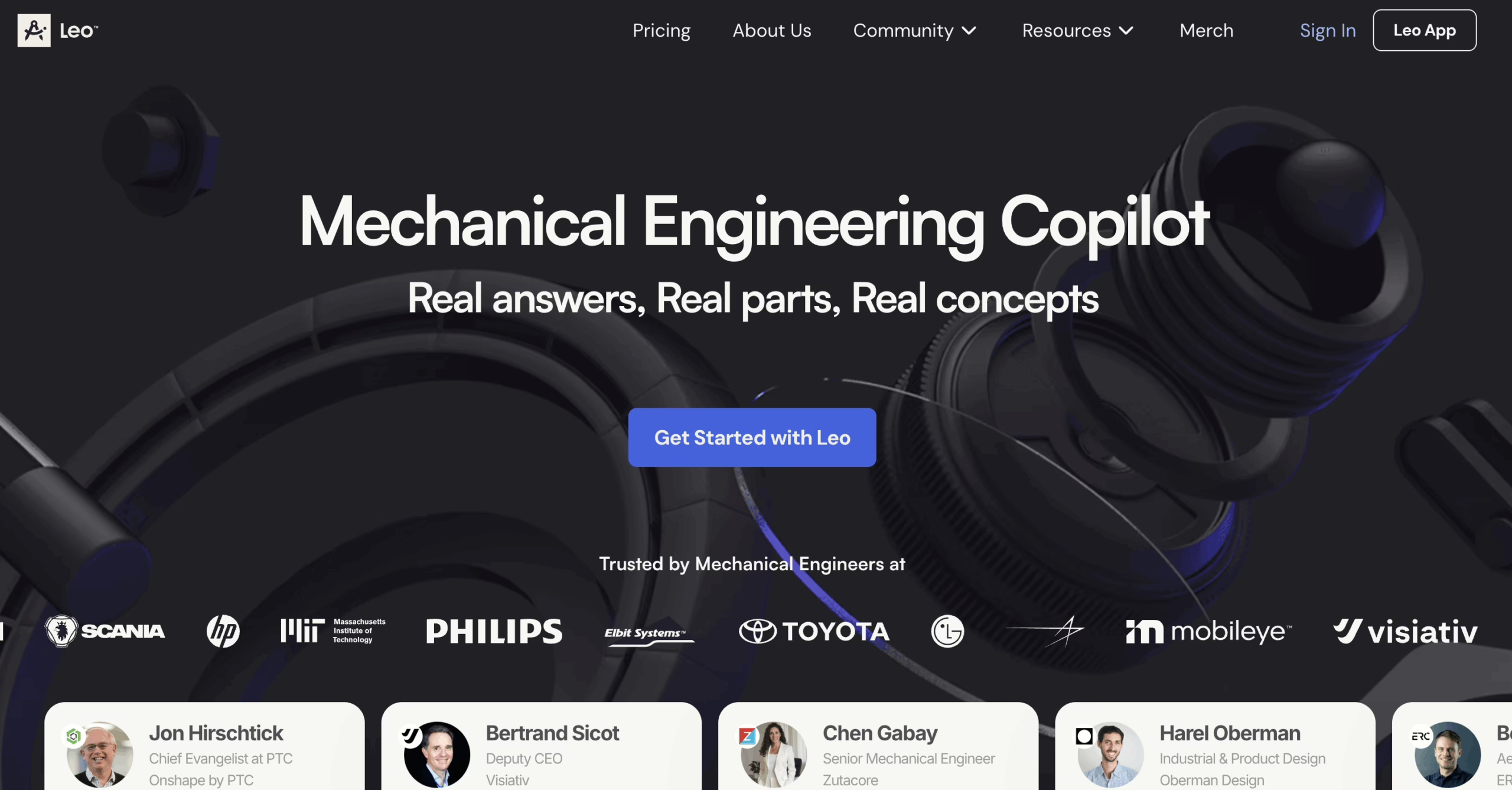
Who & What: Leo AI is a Cambridge-based startup founded in 2023 by mechanical engineers Dr. Maor Farid and Moti Moravia.
Core Product: A Large Mechanical Model (LMM) trained on CAD files, technical drawings, standards, and peer-reviewed research (not just text/image data) to turn sketches/prompts into ready-to-use 3D designs.
Early Outcomes: Reported positioning: up to 70% reduction in repetitive design work. Reported first-month monetization: ~$100,000 in revenue without paid marketing. Reported usage signals include teams at Scania, HP, Siemens, and Mobileye.
Why This Pitch Hit $9.7M
Precise domain focus: Mechanical engineering is a huge industry with deeply entrenched, inefficient tools. Leo identifies a very real pain (tedious part hunts, manual drafting, legacy CAD workflows) and shows how they solved it.
Technical credibility & domain pedigree: The founders are mechanical engineers; they’ve experienced the pain themselves. That gives trust. Investors typically reward domain founders who understand both engineering + AI.
Early traction + product benchmarks: Cut design time, strong accuracy numbers (≈95–96%), large usage (many designs created). That shows the product works, not just promises.
Investor alignment & strategic backers: Flint Capital led, others like a16z scout, TechAviv, and strategic investors from engineering/software backgrounds (former SolidWorks CEO, Google VP) add both capital + validation.
My Take: What Leo AI Teaches Founders
It’s not always about a visually stunning deck nor a perfect story arc. Sometimes it’s being the right person, in the right domain, catching the right wave.
Deep domain + lived experience count. In decks like this, the move is making the founders’ firsthand frustration the origin story—because it reads as earned insight, not marketing.
Accuracy and trust win in technical fields. This is typically the deciding factor: in mechanical engineering, errors are expensive, so reported 95–96% accuracy (on relevant tests/data) can matter more than slick visuals.
Moats beyond features. The move is showing why replication is hard: CAD files + technical standards + PDM data as training fuel creates a data/workflow moat, not a feature moat.
Traction matters early. The pattern: even one month of monetization with revenue + usage + credible logos is a strong investor signal—because investors buy momentum with proof, not “potential with vibes.”
Suggested Pitch Deck Blueprint (What Leo AI Might Have Used / Could Use)
Here’s how I’d map out a 10-slide (or so) pitch deck for Leo AI, based on what we know, with “My 2 Cents” commentary:
Slide 1: Elevator Pitch / Vision
Hypothetical Content:
Headline: “The AI Copilot for Mechanical Engineers.”
Subline: From sketch to 3D design in minutes — not weeks.
Visual: Prompt → CAD output example.
Investor Lens:
Clear category positioning: an “AI Copilot” for a massive technical field.
Communicates ambition while staying focused.
My 2 Cents:
In decks like this, the move is to open with ruthless clarity. Engineers and investors both need to get it in one line. This opener lands because it instantly frames the product: “GitHub Copilot for mechanical engineers.” That’s a sticky mental model — fast comprehension, zero cognitive friction, high recall.
Slide 2: The Problem
Hypothetical Content:
Engineers waste 40–60% of time on repetitive tasks (design variations, part searches).
Legacy CAD + PLM tools are powerful but inefficient for early-stage exploration.
Errors in design cost billions annually in wasted parts, rework, and compliance failures.
Investor Lens:
This is a time = money argument, easy to quantify.
High pain, high cost = high willingness to pay.
My 2 Cents:
This slide would work best with a day-in-the-life example: an engineer spending 2 hours searching for a part when AI could surface it instantly. The goal: make investors feel the pain, not just read stats.
Slide 3: Market Opportunity
Hypothetical Content:
Global CAD/CAE/PLM software market: $70B+ TAM, growing 8–10% CAGR.
Serviceable segment: mechanical + manufacturing design = $25B+.
Initial obtainable slice: early adopters in automotive, aerospace, medical devices.
Investor Lens:
Big market + expanding = growth potential.
Anchors Leo AI as not just a “tool” but a company that can ride the next wave of industrial AI.
My 2 Cents:
This is where most founders just throw a TAM slide. Leo’s edge? Show why now. AI is hitting engineering at the exact moment of a labor shortage + cost pressure + global competition. It’s the timing that makes this irresistible.
Slide 4: The Product / Solution
Hypothetical Content:
Large Mechanical Model (LMM): trained on CAD files, technical drawings, peer-reviewed standards.
Translates sketches/prompts into validated 3D models.
Cuts repetitive design work by up to 70%.
Already producing designs for Siemens, HP, Scania, Mobileye teams.
Investor Lens:
Not just “AI” — it’s domain-specific AI.
Demonstrates both technical credibility and practical usability.
My 2 Cents:
I’d imagine this slide packed with before/after visuals: traditional CAD workflow vs. Leo AI output in minutes. That visual contrast is worth more than a thousand words. Investors don’t need to be engineers — they just need to see the time savings.
Slide 5: How It Works / Tech Stack
Hypothetical Content:
Engineer inputs sketch/prompt.
Leo’s LMM generates CAD-ready model.
Validates against engineering standards + libraries.
Outputs into existing CAD workflows (SolidWorks, Siemens NX).
Investor Lens:
Builds technical defensibility: data + workflow integration = moat.
Makes it clear this is augmentation, not replacement.
My 2 Cents:
This is where I’d emphasize: “We’re not replacing engineers. We’re supercharging them.” That reframing matters. It turns Leo AI into a partner, not a threat, which wins trust from both customers and investors.
Slide 6: Traction & Metrics
Hypothetical Content:
Reported ~$100,000 in first month of monetization (zero paid marketing).
Logos: Siemens, HP, Scania, Mobileye.
Reported benchmark accuracy: 95–96% against peer-reviewed engineering standards.
Engineers report 70% reduction in time spent on repetitive design tasks.
Investor Lens:
Early revenue + enterprise logos = strong validation.
High accuracy stats prove product readiness.
De-risks the “science project” fear.
My 2 Cents:
This is the credibility slide. Nothing speaks louder than early paying customers — especially blue-chip brands. If I were them, I’d hammer this home visually with logos + quotes from engineers who say, “Leo AI saved me hours every day.” That hits harder than charts.
Slide 7: Business Model
Hypothetical Content:
SaaS subscription model.
Pricing tiers: $500–$2,000 per seat / month depending on features (enterprise contracts scale higher).
Enterprise licensing for large engineering firms.
Potential for integrations with CAD platforms (SolidWorks, Siemens NX).
Gross margins projected: 70–80%.
Investor Lens:
Recurring revenue, high margins = classic SaaS economics.
Enterprise contracts = big ACVs, predictable growth.
My 2 Cents:
This is where they show investors the money. I’d keep it simple: “engineers already spend $X billion on software; we’re capturing a slice of it with a stickier, smarter solution.” The focus should be on predictability — investors love clear SaaS multiples.
Slide 8: Go-To-Market Strategy
Hypothetical Content:
Beachhead: Automotive & manufacturing (complex designs, global pressure to cut costs).
Expansion: Aerospace, robotics, medical devices.
Sales Motion: Direct sales to enterprise, starting with design teams already using CAD.
Growth Engine: Land-and-expand (start with one department, scale across company).
Partnerships: Integrations with CAD/PLM vendors to accelerate adoption.
Investor Lens:
Clear wedge: start small, expand big.
Strategic partnerships = accelerant.
Focused verticals reduce risk of spreading too thin.
My 2 Cents:
The best GTM story here is “engineers sell to engineers.” If I were them, I’d highlight referrals, word-of-mouth, and the fact that every success inside Siemens or HP opens 10 more doors. Bottom-up adoption in a top-down industry is gold.
Slide 9: Competitive Landscape / Moat
Hypothetical Content:
Legacy CAD Vendors (Autodesk, Dassault, Siemens): Powerful tools, but outdated workflows; not AI-native.
Generic AI tools (ChatGPT, Midjourney, etc.): Broad, but not domain-trained; lack accuracy + compliance.
Leo AI: Purpose-built for mechanical engineering, trained on CAD + standards, integrated into enterprise workflows.
Investor Lens:
Investors want to know: “Why you, not Autodesk or OpenAI?”
Leo’s moat = domain-specific data + standards + integrations.
Harder to replicate than a generic model.
My 2 Cents:
This slide is where you hit the table and say: “We’re not building general AI. We’re building engineering-grade AI.” That’s the moat — data, accuracy, and trust. This is how you win an industry, not just hype a trend.
Slide 10: Team
Hypothetical Content:
Dr. Maor Farid (CEO): PhD in Mechanical Engineering (MIT), published researcher, deep AI + engineering expertise.
Moti Moravia (CTO): Mechanical engineer, veteran in CAD systems + enterprise workflows.
Advisors: Ex-SolidWorks CEO, Google VP, senior leaders in engineering software.
Investor Lens:
Founders = domain insiders, not outsiders.
Advisors = credibility + connections in industry.
Execution risk reduced — they know the workflows from the inside.
My 2 Cents:
This is typically the most important slide. Investors aren’t just buying the tech — they’re buying the fact that these founders lived the problem. And the advisors? That’s the kind of credibility that makes enterprise buyers take meetings.
Slide 11: Ask & Use of Funds
Hypothetical Content:
Raise: $9.7M Seed/Series A.
Use of Funds:
40% product development (improving LMM, integrations).
30% sales & GTM.
20% talent (engineers, researchers).
10% compliance & infrastructure.
Milestones:
Grow to $5M ARR within 18–24 months.
Expand integrations with CAD vendors.
Launch into aerospace + medical verticals.
Investor Lens:
Clear use of funds, tied to growth levers.
Ambitious but credible milestones (ARR + integrations).
Investors like to see that $1 = $X ARR path.
My 2 Cents:
I’d spin this slide as confidence, not desperation. “We know exactly where this money goes and exactly what it unlocks.” Investors don’t want guesswork; they want a roadmap. That’s how you close rounds.
Deck Pattern Summary:
Positioning: Vertical AI copilot that turns a messy, high-stakes workflow into a fast, repeatable system (human-in-the-loop, not “magic AI”).
Proof: Concrete benchmarks + specific customer traction signals (usage, outcomes, and early revenue) instead of vague “interest.”
Moat: Domain-specific data + workflow integration (the product becomes the default operating layer, not a replaceable feature).
Pitching Guides and Resources



Viktori. Pitching your way to your next funding.
Locations
Office 1: 633 North Wells Street Chicago, IL, United States, 60654
HQ: Boulevard P.O. 10000 Skopje, North Macedonia
Pitch Deck Resources
Case Studies
Client Reviews
Presentation Resources
Pitch Deck Services
Industry Specific Pitch Deck Services:
Additional Services
About Viktori