


Let’s be honest for a second.
Most drone pitch decks don’t fail because the technology is weak. They fail because founders explain how drones work instead of why this specific business is fundable.
Investors don’t care that your drone can fly.
They care whether:
- it can scale;
- survive regulation;
- and make money without burning cash like a jet engine.
Below are two drone pitch deck examples, broken down the way investors actually read them — not as pretty slides, but as decision-making tools.
I’ll show you:
- what each deck needed to prove;
- which slides mattered (and which didn’t);
- and how drone startups should frame risk, regulation, and revenue in 2026.
I’m Viktor — pitch deck consultant and strategist. Over the past 13+ years, I’ve helped founders across aerospace, defense, logistics, and industrial tech raise real capital by fixing the one thing most decks get wrong: the story investors are silently grading you on.
Let’s get into the examples.
Example 1 — AgroSight
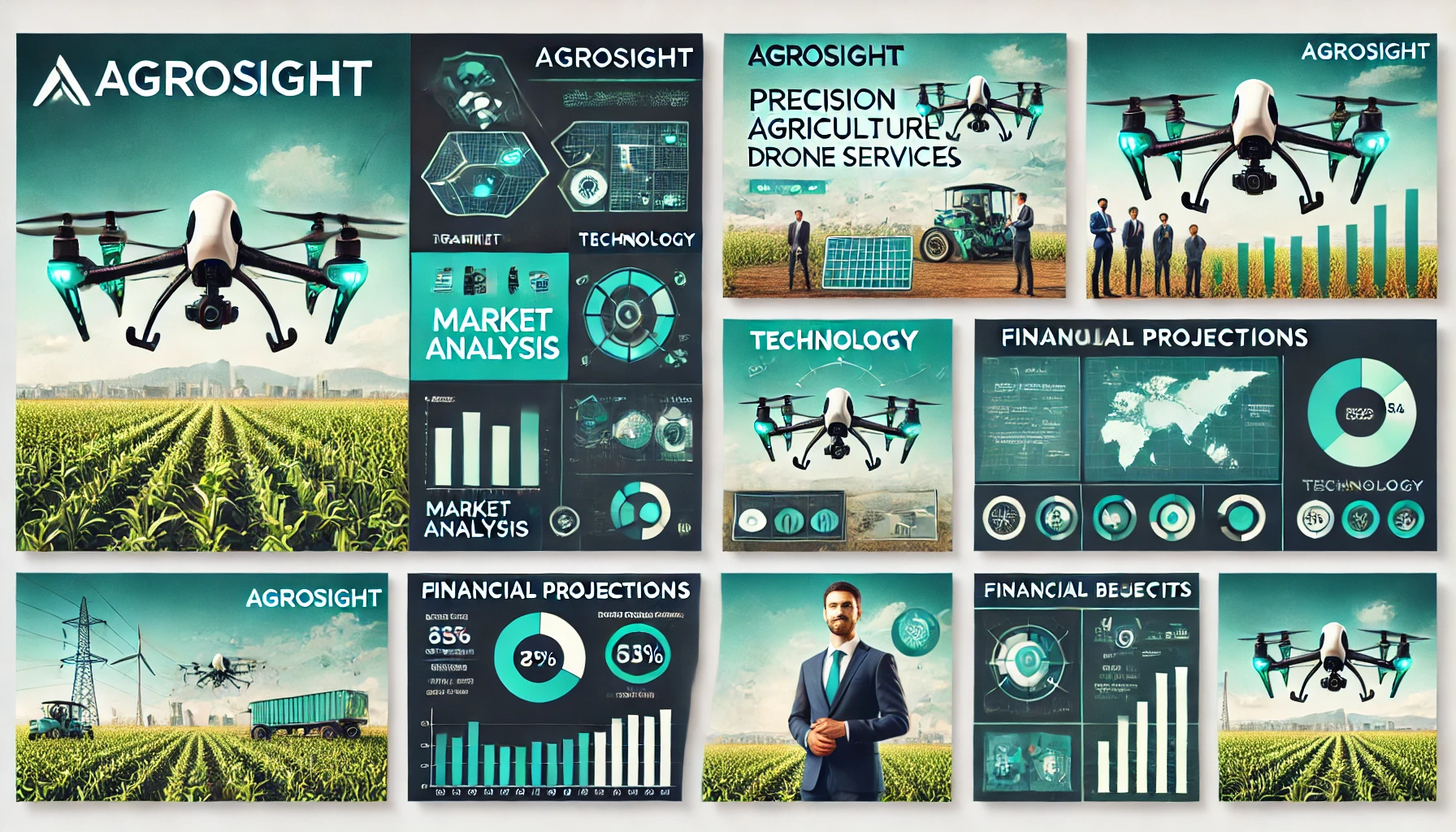
Precision Agriculture Drone Services (Investor-Focused Breakdown)
What this startup is pitching:
A drone-as-a-service platform for precision agriculture — crop monitoring, yield forecasting, irrigation optimization.
Who this deck is for:
- Agritech investors
- Strategic partners
- Government or subsidy-backed programs
What this deck gets right
- Clear buyer: farmers and agri-institutions, not “everyone with land”
- Operational logic: recurring surveys → recurring revenue
- Outcome framing: yield optimization, not “cool aerial data”
What investors would immediately test
- Can this scale without custom deployments per farm?
- Are margins driven by software or flight hours?
- Is this a services company pretending to be tech?
Slides that matter most in this deck
- Problem — framed around cost leakage, not tech gaps
- Solution — drones as infrastructure, not gadgets
- Business Model — subscription logic per hectare
- Go-to-Market — partnerships > direct sales
- Regulation & Ops — often ignored, but critical here
This is where most agritech drone decks collapse: they pitch vision but avoid unit economics.
Here are mockup slides for AgroSight, illustrating how a precision-agriculture drone business can be presented with clear value, scalable logic, and investor-ready structure.
Example 2 — SkyGuard
Drone-Based Security & Surveillance Platform
What this startup is pitching:
Aerial security, surveillance, and rapid-response drones for commercial and public-sector use.
Who this deck is for:
- Enterprise security buyers
- Government & infrastructure investors
- Defense-adjacent VCs
What this deck gets right
- Use-case clarity: surveillance, incident response, perimeter control
- Buyer logic: contracts, not one-off sales
- Risk framing: safety, compliance, redundancy
Where investors zoom in
- Procurement cycles (longer ≠ worse, but must be acknowledged)
- Regulatory clearance and flight permissions
- Integration with existing security systems
Slides investors scrutinize hardest
- Market Opportunity — segmented by buyer type
- Competitive Landscape — drones vs guards vs cameras
- Revenue Model — contracts, retainers, SLAs
- Technology — reliability > novelty
Security drone decks fail when they oversell autonomy and undersell operations.
Here are mockup slides for SkyGuard, showing how the narrative, visuals, and structure come together in an investor-ready drone security pitch deck.

The 5 Things Investors Expect in Drone Pitch Decks (2026)
This is the part founders usually skip — and pay for later.
1. Regulation isn’t a footnote
If you don’t show awareness of FAA / EASA constraints, investors assume you don’t understand your own risk.
2. Hardware is not the hero
Margins must come from:
- software,
- data,
- or contracts — not airframes.
3. “Scalable” must be proven, not claimed
Investors want to see:
- repeatable deployments
- standardized ops
- predictable CAC
4. Buyers ≠ users
Farmers, security teams, municipalities — all buy differently. Your deck must show this.
5. Operations are part of the product
If your drone needs humans, logistics, insurance, and permits — that’s the business, not a problem to hide.
Want a Drone Pitch Deck That Investors Take Seriously?
The examples above are simplified for clarity.
Founders who raise capital don’t use generic templates — they use:
- industry-specific narratives
- investor-grade structure
- and design that communicates credibility, not excitement
If you want a hands-off, investor-ready drone pitch deck — strategy, narrative, copy, and design — I can build it with you in under 7 days.
Common Mistakes Drone Founders Still Make
Let’s save you a few painful investor meetings.
1. Pitching the drone instead of the business
Investors don’t fund flying objects. They fund cash-flowing systems.
If your deck spends more time on specs than on revenue mechanics, you’re already losing the room.
2. Ignoring regulation until the Q&A
If compliance only appears when someone asks, investors assume:
- delays,
- legal risk,
- and unexpected costs.
Show awareness early. It builds trust fast.
3. Claiming “scalability” without operational proof
Saying “this scales globally” isn’t a strategy.
Showing standardized deployment, repeatable contracts, and predictable costs is.
4. Treating hardware margins as the business
Hardware is expensive, slow to iterate, and margin-thin.
Serious drone companies anchor value in:
- software,
- data,
- subscriptions,
- or long-term contracts.
5. Forgetting who actually signs the check
Users, buyers, regulators, and payers are often different people.
If your deck mixes them up, investors assume go-to-market chaos
When a Template Is Enough (And When It’s Not)
Templates get a bad reputation — unfairly.
A template is enough when:
- you’re validating an idea,
- pitching early-stage angels,
- applying to accelerators,
- or need internal clarity.
At this stage, speed beats polish.
A template is not enough when:
- you’re pitching institutional investors,
- dealing with regulated airspace,
- selling to governments or enterprises,
- or asking for serious capital.
That’s when:
- narrative precision,
- industry context,
- and investor psychology matter more than slide count.
Templates are tools.
They’re not strategies.
How to Build an Investor-Ready Drone Pitch Deck
This is the framework investors expect — even if they never say it out loud.
1. Frame the problem in dollars, not frustration
Show:
- cost leakage,
- inefficiencies,
- or missed revenue — not “pain points.”
2. Position drones as infrastructure, not novelty
Your drone isn’t the product.
The system around it is.
3. Make regulation visible (but calm)
Confidence beats avoidance.
Show you understand the rules and can operate within them.
4. Prove repeatability
Investors look for:
- standardized deployments,
- predictable pricing,
- and scalable ops.
One great pilot means nothing without replication.
5. End with a clear investment logic
Why now?
Why you?
Why this market structure makes sense today?
If those aren’t obvious by the last slide, the deck didn’t do its job.
Final Words
At the end of the day, drone startups don’t win funding because their technology flies higher — they win because their story lands better.
Whether you’re building precision tools for agriculture or security systems that watch over critical infrastructure, the fundamentals are the same: clarity, credibility, and a business model investors can believe in without mental gymnastics.
Use the examples above as reference points, not shortcuts. A solid template can get you started, but real funding happens when your deck reflects how investors think, how buyers buy, and how your company actually scales.
If you’re serious about raising capital, don’t just show what your drone can do.
Show why this business deserves to exist — and grow.
That’s when conversations change.
FAQ — Drone Pitch Decks
Related Drone Pitch Deck Templates

The 12 Slide Drone Pitch Deck Template
This 9 Slide Drone Delivery Startup Pitch Deck Template Will Have Investors Swarming | Google Slides
Drones, huh? They’re not just for influencers filming themselves holding hands on a beach anymore….
10 Slide Election Drone Pitch Deck Template
Ever felt like the electoral process is stuck in the Stone Age? You’re not alone….
13 Slide Drone Manufacturing Pitch Deck Template
Ever watched a drone zip by and thought, “Hey, I could build something cooler than…
12 Slide Drone Pitch Deck Template
Author: ViktorPitch Deck Expert. Ex Advertising. Founder of Viktori. $500mill In Funding. Bald Since 2010….
Looking for a step by step guide to build a drone pitch deck?
Check out our in-depth drone pitch deck guide.
Check out some of the essential 101 guides:

Burn Rate and Runway in a Pitch Deck: How to Show Investors Survival Math
Burn rate is where a pitch deck stops being brave and starts being accountable. Up…
Financial Projection Slide: How to Show Investors the Numbers Behind the Story
A financial projection slide shows investors how your business could grow over time. It usually…
Revenue Model Slide: How to Show Investors How You Make Money
A revenue model slide explains how your business makes money. That sounds simple, but this…

Use of Funds Slide: How to Show Investors Where the Money Goes
Use Of Funds Slide Quick Summary A use of funds slide explains how the capital…

Top Pitch Deck Design Agencies for Investor-Ready Presentations
Quick Summary A pitch deck design agency helps startups turn complex business ideas into clear,…

How to Create a High-Impact Investment Highlights Slide For Your Pitch Deck
An investment highlights slide is often the moment in a pitch deck when investors decide…
