


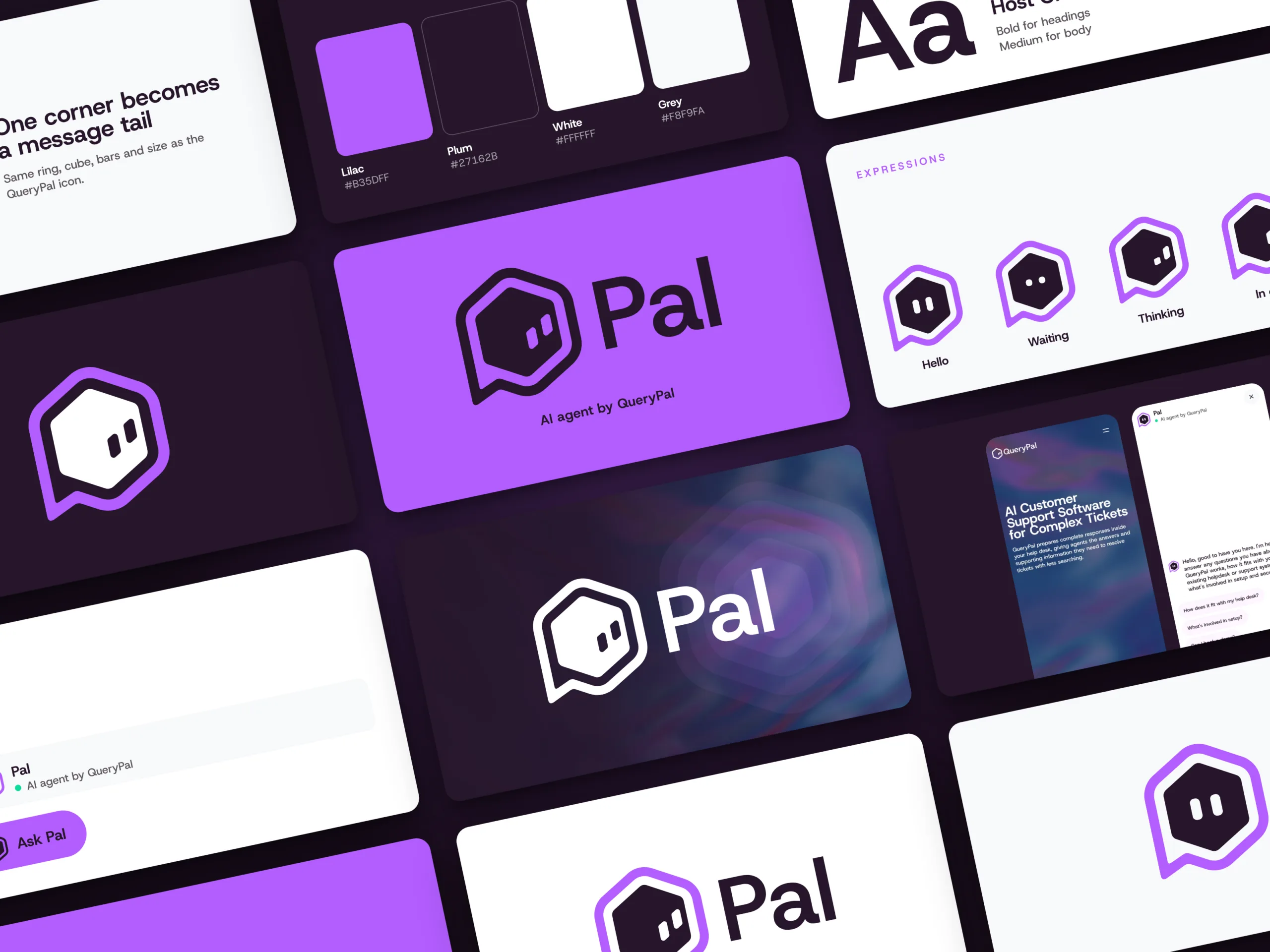
I recently named and designed the identity for QueryPal’s AI sales agent. We called it Pal. The name was already there. We just stopped saying the first part.
It sounds almost too simple when you write it down, which is probably why I like it. There is a useful product messaging lesson in that little decision: the audience should not have to repeat your entire thinking process to understand the result.
This is a real branding project, rather than a pitch deck case study. But the communication problem is familiar to anyone trying to explain a product in a deck, on a website or during a sales conversation. What does the other person need to understand first, and how much can you remove before the explanation stops being useful?
What product messaging needs to do
Product messaging is how you explain what a product does, who it is for and why someone should care. It includes the words people encounter across the website, demo, sales materials and product itself.
A useful message gives the reader enough context to decide whether to keep going. That means your target audience, their problem, the relevant benefit and the evidence behind your claims all matter. The order matters too. A visitor opening a website chat has a different question from an investor evaluating the business model.
In Pal’s case, the immediate introduction has a compact structure: a name, a description and an action. Pal. AI agent by QueryPal. Ask Pal.
Those words do different jobs. The name makes the agent easy to refer to. The description identifies it and its parent company. The action tells the visitor what to do next. Together, they are an entry point into a more detailed conversation.
Product positioning starts with the target audience
When somebody is deciding whether to interact with an unfamiliar product, they are trying to place it. Is this relevant to me? What can I do here? What happens when I click?
The application mockup for Pal introduces questions about how QueryPal works, how it fits with an existing help desk or support system, and what is involved in setup. Those are concrete subjects a prospective buyer can recognise. They give the conversation somewhere to begin.
Compare that with an invented line such as “Your intelligent partner for the next era of enterprise transformation.” You can read it three times and still not know what to ask.
For your own product, write down the questions people ask before a useful sales conversation begins. Use the actual phrasing from calls or enquiries where you have it. Those questions reveal customer pain points and are better raw material for a product messaging strategy than a list of adjectives about your company. A buyer persona should help you recognise a real decision and the person making it, rather than fill a page with fictional demographics.
Give each part of the message one job
A product name does not need to explain the business model, technical architecture and commercial proposition. But something nearby needs to supply the missing context.
Pal is a friendly name. “AI agent by QueryPal” is a factual descriptor. “Ask Pal” is a call to action. You can see how each piece earns its space.
I use the same thinking when structuring a pitch. A headline can state the main point. A diagram can explain the mechanism. A short piece of evidence can support the claim. A founder can then go deeper when the audience has a reason to care.
If every element tries to communicate everything, you get repetition and clutter. If every element is vague, you get a beautifully designed mystery. Assigning a job to each part makes the whole explanation easier to build.
A simple product messaging framework and template
For an early messaging draft, I would work through five questions. Who is the specific audience? What are they trying to do? What does the product help them do differently? What supports that claim? What should they do next?
Here is a hypothetical example, separate from the QueryPal project. Imagine software that helps maintenance teams prepare repair reports from approved inspection notes. “AI-powered operational excellence” tells you very little. “Turn approved inspection notes into a repair report your supervisor can review” explains a task, an input, an output and a review step.
That still needs evidence. You would want to show an example report, explain what the software can and cannot infer, and be honest about the review required. Clear product messaging makes those questions easier to investigate. It does not make them disappear.
A working messaging template can be as plain as: “For [specific audience] dealing with [problem], [product] helps [useful outcome] through [credible mechanism]. Here is [proof], and here is [next step].” Fill the gaps with facts, then rewrite it as natural language.
Your value proposition belongs in that structure. So do the proof points: a demonstration, relevant case studies or a customer testimonial you have permission to use. These are the messaging pillars the marketing team and sales reps should agree on before they adapt the story for different channels.
Once the basic explanation works, adapt it to each audience. An operator may care about the reporting workflow. A manager may care about consistency. An investor will also need to understand who pays, the market, margins and the route to growth.
Visual identity should reinforce the message
Pal’s icon keeps the recognisable QueryPal geometry and turns one corner into a speech tail. The two internal bars become the expressive elements. That gives the visual a direct relationship to the conversational role.
We explored three directions and also tried a mouth. The simpler treatment kept the connection to the original brand more clearly. It gave the identity enough character without requiring a new mascot story.
This is where design can help product communication: the visual gives the words support. The name suggests approachability, the descriptor identifies the AI agent, and the speech corner suggests an interaction. You do not need to explain all of that to every visitor for the system to be useful.
Keep the claims proportional to the evidence
It would be easy to turn this into a story about higher conversion, stronger trust or faster sales. I do not have measurements from this identity project that establish those outcomes.
What I can show is the work: a name, icon, expression system and interface applications built around a coherent introduction. That is a defensible result. Performance is a separate question to test with actual visitors.
The same distinction matters in fundraising narrative strategy. A clear explanation helps someone evaluate the business. It should make the available proof easier to examine and leave uncertainty visible where it exists.
Test your product message with customer feedback
Before polishing the wording, put the message in front of someone who resembles your intended reader. Ask what they think the product does, who it helps and what they would do next. Avoid explaining the answer before they respond.
If the feedback is confused, identify the missing piece. It could be the audience, the category, the benefit or the next step. Adding more text indiscriminately can make the problem worse. Change the part that is failing, then try again.
In B2B SaaS, this review also helps align messaging across a landing page, demo and sales deck. A product marketing team can keep the main explanation stable while changing the examples and level of detail for each use case.
For a pitch deck, that may mean giving the product slide a plain explanation before introducing the architecture. For a website, it may mean replacing an abstract headline with a recognisable task. For an AI agent, it may be as small as a clear descriptor beside a familiar name.
Pal reminded me how satisfying that can be. Sometimes the useful answer is already sitting inside what you have. You need to recognise it, give it a clear role and resist making it cleverer than necessary.
If your product takes too long to explain, I can help with the narrative and the pitch deck design that carries it.
