


Travel pitch decks used to be easy.
Pretty destinations. Big market slides. A sprinkle of “experiences” and a sustainability buzzword or two. Investors nodded politely. Then 2020 happened. Then regulation. Then margin compression. Then AI ate the itinerary.
Travel pitch deck examples are only useful when they stay honest. They show what a travel startup looked like after it had enough coherence to survive real-world review. Not theory. Not templates. Just the artifact — the pitch deck that existed when capital, partners, or the market had to treat the company as real.
I’m Viktor — a pitch deck expert and brand strategist who’s been building decks for 13+ years across travel, hospitality, marketplaces, and asset-heavy industries. I’m not interested in romanticizing travel. I’m interested in what survives: how travel businesses hold up under scale, seasonality, regulation, and distribution dependency — and how those realities show up inside a startup pitch deck presentation once it’s being taken seriously.
For the upstream sector framing — how consumer brands and travel platforms are evaluated at a category level — see Consumer Brand Capital Evaluation.
Travel Pitch Deck Example 1. Marketplace Travel Platform Pitch Deck
Archetype: Experience Aggregator / Travel Marketplace
Primary Real-World Anchor: GetYourGuide
Real-World Anchors
These companies define how investors already understand this model:
- GetYourGuide — $1B+ raised (SoftBank Vision Fund, KKR, others)
Proof that experience aggregation can scale globally with strong unit economics and demand-side power. - Tiqets — ~$250M+ raised
Verticalized ticketing marketplace proving that focus (attractions, museums, timed entry) sharpens margins. - Musement (TUI Group) — Acquired by TUI
Example of marketplace + curation becoming a strategic acquisition, not just a VC outcome. - Headout — ~$100M+ raised
Real-time and last-minute booking model demonstrating liquidity, speed, and operational leverage as a moat.
Example Overview
GetYourGuide is one of the clearest examples of how a travel marketplace can absorb large amounts of capital and turn fragmented supply into a scalable platform.
- GetYourGuide — $1B+ raised (SoftBank Vision Fund, KKR, others)
Built a global tours-and-activities marketplace by solving supplier fragmentation, standardizing inventory, and concentrating demand at scale.
Unlike traditional tour operators, GetYourGuide positioned itself as distribution infrastructure, not a travel brand — a framing that consistently resonated with late-stage and growth investors.
Observable Framing in the Pitch Deck
GetYourGuide didn’t win by convincing people to travel.
It won by convincing investors that travel experiences could be treated like inventory.
Its early pitch focused on:
- Thousands of disconnected local operators
- Zero unified distribution
- High-intent traveler demand already searching
That framing turned tourism chaos into a platform opportunity — and it still works in 2026.
What the Pitch Deck Emphasizes
Across available versions and summaries, the GetYourGuide pitch deck emphasizes:
- Highly fragmented global supplier bases
- Absence of unified discovery and booking infrastructure
- Existing high-intent traveler demand
- Centralized booking, payment, and inventory normalization
Tourism is presented less as inspiration and more as inventory under management.
Structural Patterns Visible in the Deck
Common structural elements observed in GetYourGuide-style decks include:
- Problem framing centered on supplier fragmentation
- Solution framing as a unified distribution and booking layer
- Market framing around bookable experiences rather than destinations
- Traction framed through liquidity, repeat usage, and conversion
- Platform defensibility framed through demand aggregation and data effects
These patterns recur across comparable marketplace travel pitch decks.
Capital Outcome Context
Marketplace travel platforms following this structure show several recurring post-review outcomes:
- Ability to scale without owning physical assets
- Capacity to absorb large capital allocations
- Greater resilience to seasonality compared to destination-centric brands
- Multiple downstream exit paths, including IPOs and strategic acquisitions
As a result, these companies are frequently categorized alongside platform businesses rather than traditional travel operators.
Reference Context: Below is GetYourGuide’s early pitch deck, created when tours and activities were still considered too fragmented to scale.
Travel Pitch Deck Example 2. Experience-Led Travel Pitch Deck
Archetype: Experience Layer on Top of a Travel Platform
Primary Real-World Anchor: Airbnb (Experiences)
Real-World Anchors
The following cases establish how experience-led layers have appeared inside platform-scale travel businesses:
- Airbnb (Experiences) — product layer inside Airbnb (Airbnb raised ~$6B+ pre-IPO; later became a public company)
- Booking.com (Attractions & Experiences) — product layer inside Booking Holdings (public company)
- Tripadvisor (Experiences) + Viator — experiences monetization layer inside Tripadvisor’s ecosystem (Viator acquired by Tripadvisor; Tripadvisor is public)
- Google Things to do — experience discovery/booking surface inside Google Travel (platform layer, not a marketplace startup outcome)
These examples define how investors and acquirers have already encountered the model in practice.
Example Overview
Airbnb Experiences represents a distinct category within travel pitch deck examples: experiences positioned as a layer, not a marketplace in isolation.
Public materials and product rollouts show that the experience layer is framed as a way to increase engagement, retention, and basket size within an existing travel platform. The experience product does not carry the full burden of demand creation; it inherits traffic, trust, and distribution from the core platform.
Observable Framing in the Pitch Materials
Across product announcements and platform narratives, Airbnb’s experience layer emphasizes:
- Host-led, locally curated activities
- Integration with existing booking and account infrastructure
- Trust mechanisms inherited from the core marketplace
- Experiences positioned as context, not inventory volume
The experience offering is presented as complementary, not foundational.
Structural Patterns Visible in Experience-Led Deck
Pitch materials and summaries associated with this archetype commonly exhibit:
- Experiences framed as an engagement or retention lever
- Market framing tied to existing user bases rather than total travel spend
- Limited emphasis on standalone supply liquidity
- Platform leverage emphasized over marketplace mechanics
Experiences appear as a value amplifier, not a primary platform engine.
Capital Outcome Context
Experience-led travel layers tend to appear in capital outcomes as:
- Internal platform expansions rather than venture-scale spin-outs
- Strategic features supporting lifetime value and differentiation
- Components that strengthen ecosystem defensibility
- Products justified through platform metrics rather than independent unit economics
As a result, this model is most often funded implicitly—inside larger platform valuations—rather than as a separate venture category.
Reference Context: Below is Airbnb’s first pitch deck — created back when it was still explaining why strangers would sleep in each other’s homes.
Patterns That Show Up in Funded Travel Pitch Deck Examples
Across the travel pitch deck examples above, the decks that reached funding or durable market legitimacy share a simple trait: they remove uncertainty without overselling the destination.
Four patterns show up repeatedly in how these travel pitch decks frame the business:
The system, not the story.
Travel is presented as distribution, operations, or infrastructure—not a lifestyle narrative.
How money moves.
The business model becomes legible early: who pays, when cash arrives, and where margins can plausibly live.
Where risk lives.
Seasonality, platform dependency, regulation, and operational complexity are acknowledged directly, not bypassed with brand language.
Why scale doesn’t break it.
Growth is described in terms of repeatable mechanics—how expansion behaves operationally—rather than pure ambition.
Sustainability, when present, tends to show up as resilience (cost control, supply stability, repeat behavior), not as marketing. And precedent is quietly respected: the model is recognizable fast, because it resembles patterns already seen in funded travel and consumer platforms.
Final Word
Travel pitch decks don’t usually fail because travel is seasonal, regulated, or competitive. That’s the industry. It’s been the industry.
They fail because the deck starts selling romance when the business runs on machinery.
By 2026, nobody needs convincing that people want to travel. What still needs to be made legible is whether a travel startup can:
- scale without collapsing under operations
- survive platform dependency and distribution shocks
- protect margins when demand shifts
- stay defensible when experiences turn into a commodity
The strongest travel pitch deck examples above aren’t memorable because they’re clever. They’re memorable because they’re clear about constraints—and confident about the system that survives them.
That’s what makes a travel deck feel real: clarity, not postcards.
FAQ
Related Travel Pitch Deck Templates
Check out our massive directory of pitch deck templates, or the following related templates:

13 Slide AI-Powered Travel Deck Template | Google Slides
You’ve planned the ultimate vacation in your mind—beaches, mountain views, perfect sunsets. But planning the…
13 Slide Pitch Deck Template for Youth-Focused Ventures | Google Slides
You know the feeling: you’re halfway across the world, shoes worn down from exploring, and…
14 Slide Sustainable Luggage Pitch Deck Template
So, you’ve decided to disrupt the luggage game. Maybe you’re tired of seeing the same…
12 Slide Tour Gaiden Pitch Deck Template
So, you’ve planned the perfect trip. You’ve got your flights, your hotel, and your Instagram…
10 Slide Tourist Destination Pitch Deck Template
Are you looking to showcase the best features of your tourist destination in a concise…
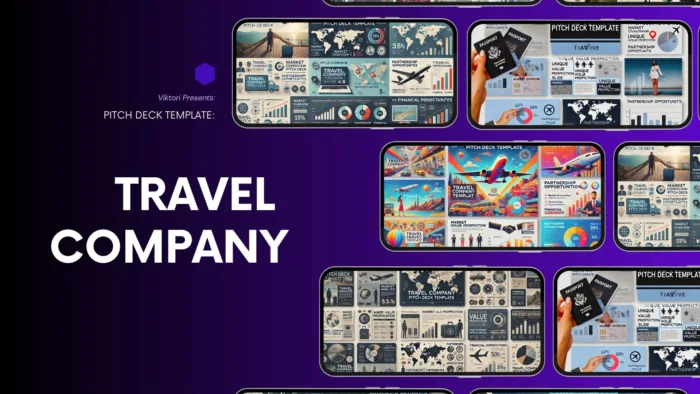
12 Slide Travel Company Pitch Deck Template
So, you’ve got this travel company, and it’s about to be the next Airbnb, but…
