


You can have a genius eCommerce idea—Gymshark meets Tesla, but for whatever niche you’re obsessing over this week. And still get polite silence. Not because the idea is bad, but because your story is hard to review fast.
This is a Hub 4 execution guide: how to structure an ecom pitch deck so someone can scan it in minutes and validate the big things (market, traction, model, team, and the ask) without going on a treasure hunt through your brain.
If you want the sector-level expectations this guide is built around, start here: consumer-brand diligence checklist.
Now, back to mechanics—because decks don’t win on vibes. They win on clarity.
What is an Ecom Pitch Deck?
An ecom pitch deck is a short, high-signal presentation that makes it easy for investors, retail partners, or strategic collaborators to understand your business and verify the key claims quickly. Think Shark Tank, but in a PDF—without Kevin O’Leary interrupting you for breathing too confidently.
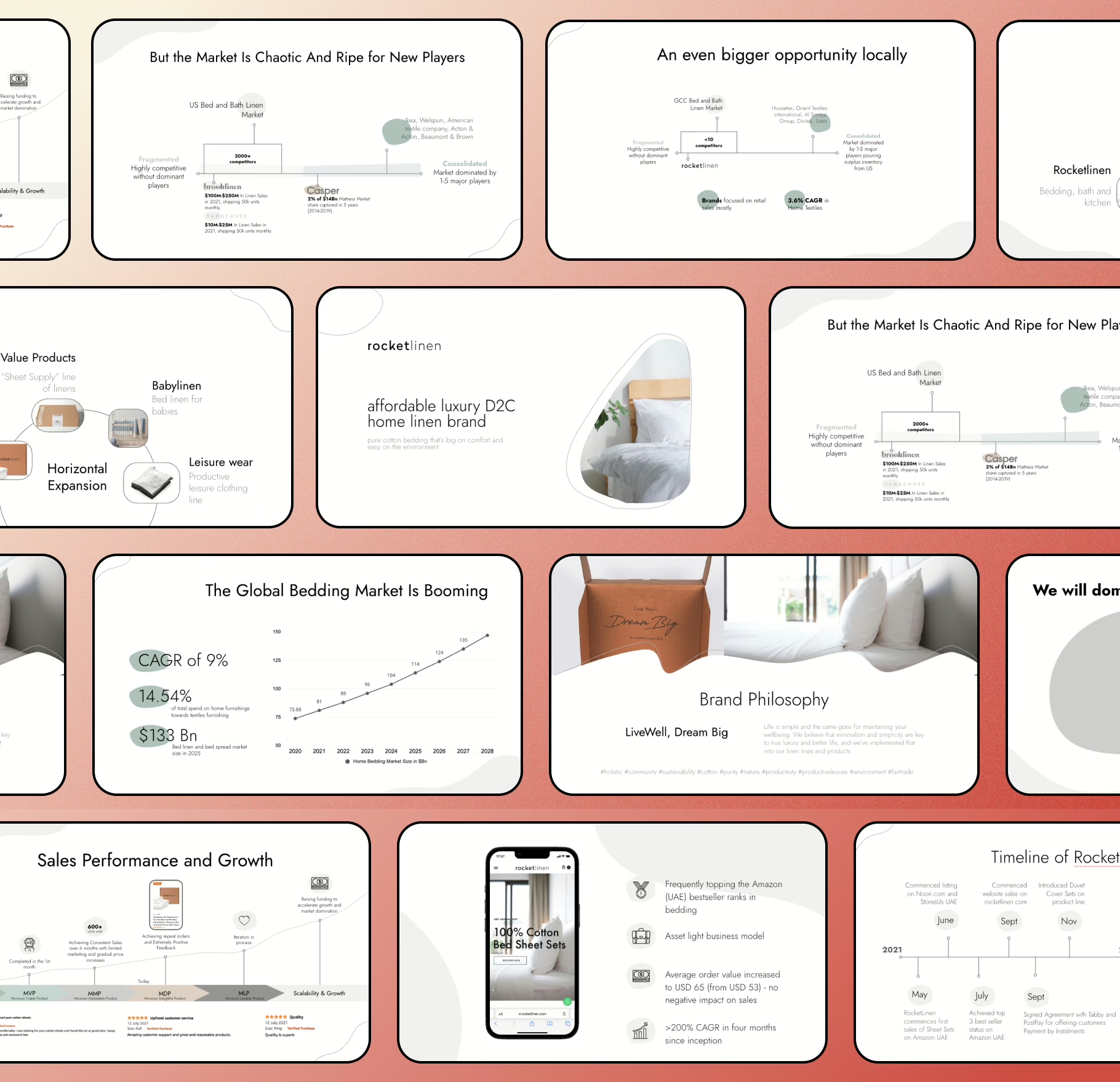
A strong eCommerce pitch deck typically helps a reviewer confirm, fast:
- What you sell and who it’s for (positioning + audience)
- What problem you’re solving (and why it’s expensive/annoying enough to matter)
- Why your solution wins (product, brand, distribution edge, or operational advantage)
- How big the opportunity is (market framing, not wishful thinking)
- Proof you can execute (traction, retention, partnerships, velocity)
- How you make money (margins, unit economics, repeat purchase, CAC/LTV logic)
- What you’re asking for (amount + what it unlocks + milestones)
That’s it: a deck is not a novel, and it’s not a motivational speech. It’s a structured way to make your business easy to evaluate.
Step By Step Guide To Build an E-commerce Pitch Deck
Follow these 12 steps to build a deck that withstands review and scrutiny.
1) Decide what this deck is for (pick one primary use)
Most decks fail because they’re trying to do 3 jobs at once: raise money, land retail, and impress your cousin who “does marketing.” Pick one primary objective, then build for it.
Choose your “deck mode”:
- Send-ahead deck (asynchronous): needs more context per slide, clearer labels, fewer “trust me” leaps.
- Live deck (you present): less text, stronger visuals, tighter pacing, more room for story.
Lock the audience + decision type:
- Investors → scalability + return logic + risk reduction
- Retail/wholesale partners → velocity + margins + readiness + marketing support
- Strategic partners → overlap + distribution advantage + why it benefits them
Output you should have before Step 2:
- Objective: “This deck exists to ________.”
- Audience: “Reviewed by ________.”
- Decision: “They need to decide ________.”
Quick guardrails so you don’t overbuild: use this as your slide-count sanity check → ideal slide count for a pitch deck.
And if you’re about to “decorate” instead of clarify, read this first → pitch deck mistakes that kill deals.
2) Write the one sentence that keeps the whole deck from drifting
If your deck doesn’t have a single clean sentence at the center, every slide becomes a different story. This is the line that should still make sense out of context (forwarded, screenshot, skimmed).
Use a 4-part structure (simple, brutal, works):
- Target (who pays / who benefits)
- Pain (expensive + frequent + urgent)
- Fix (what you do, not how clever you are)
- Outcome (money saved, time saved, conversion lift, repeat rate, margin, etc.)
Example (generic, plug-and-play):
“We help [customer] stop [pain] by [solution], so they can [measurable outcome].”
If you want the exact breakdown + variants, steal from here → one-sentence pitch formula.
Output you should have before Step 3:
- One sentence
- One supporting proof line (traction/stat/insight)
- One “why now” trigger (trend, behavior shift, cost spike, regulation, etc.)
3) Build the first slide like a bouncer: only clarity gets in
Slide 1 isn’t “about your brand.” It’s a compression test. If Slide 1 doesn’t land, the rest is cardio.
What Slide 1 needs (and nothing else):
- Headline: “What we do” (not “revolutionizing…” unless you enjoy being ignored)
- Your one-sentence pitch (from Step 2)
- One proof point (traction, result, or sharp market stat)
- One visual (product, customer context, or outcome visual)
Fast rule: if it can’t be understood in 5 seconds, it’s not a first slide—it’s a punishment.
Use this to structure it properly → elevator pitch slide template + examples.
Output you should have before Step 4:
- Slide 1 drafted (headline + sentence + proof + visual)
- Slide 2 drafted (what you want them to believe next: traction highlights or problem framing)
4) Make the problem undeniable (not “relatable”)
Investors don’t fund “relatable.” They fund expensive. Your problem slide must read like:
“This hurts, it’s measurable, and it’s getting worse.”
Write the problem like an auditor:
- Who experiences it? (specific segment)
- Where does it show up? (checkout, retention, returns, CAC, supply chain, etc.)
- How often does it happen? (frequency)
- What does it cost? (money/time/risk)
- Why now? (what changed recently)
Most common ecom mistake: describing your frustration instead of the buyer’s pain.
For clean structure and punch, use this → make your problem/solution slides memorable.
Output you should have before Step 5:
- 1 headline problem sentence
- 2–3 bullets max (facts, not feelings)
- 1 stat or proof (even internal data is fine if labelled honestly)
- Optional: “before” snapshot (what broken looks like)
5) Present the solution as a system (not a feature dump)
Your solution slide should answer: “So what changes?” not “Look at our features, please clap.”
Use the transformation format:
- Before: what the customer does today (painful workflow)
- After: what happens with you (simplified workflow + measurable win)
Keep it to three layers:
- What it is (one sentence)
- How it works (3 steps max)
- Why it’s better (1–2 proofs: conversion lift, repeat rate, reduced returns, better margins, etc.)
If you’re early and don’t have metrics: show mechanism + proof of demand (waitlist, LOIs, pilots, early revenue, strong retention cohort—even small).
Want the cleanest way to connect problem → solution without sounding like a brochure? Reuse the structure here → problem/solution slide tips (yes, it’s that useful).
Output you should have before Step 6:
- One sentence: “We solve X by doing Y”
- A simple 3-step diagram or screenshot
- One credibility hook (traction, customer quote, benchmark, etc.)
6) Size the market in a way that survives questions
Market sizing isn’t “big number theater.” It’s: who pays, how many of them exist, and what they pay for.
Do it in a ladder:
- TAM: the full category (big picture)
- SAM: the portion you can actually serve (geo, segment, channel, price point)
- SOM: what you can realistically win (based on GTM capacity + time + conversion assumptions)
Best practice (especially for ecom):
- Anchor SOM in real constraints: CAC, distribution, fulfillment capacity, conversion rate, AOV, repeat purchase.
- If you only do top-down, it looks like you downloaded your math from LinkedIn.
Use this guide to structure it properly → market sizing ladder (TAM/SAM/SOM) for decks.
Output you should have after Step 6:
- TAM/SAM/SOM numbers with one-line assumptions each
- A simple visual (ladder or segmented bar)
- One “why now” market tailwind (trend with credible source)Step 7: Build a Go-To-Market Plan That Doesn’t Depend on “Going Viral”
7) Show a timeplan and distribution
This is where you prove you can actually sell (not just “build and pray”).
What to include
- Your first wedge: the exact customer segment you’ll win first (niche > “everyone with internet”).
- Channel math: 2–3 acquisition channels you can realistically execute (paid, SEO, affiliates, marketplaces, retail, partnerships).
- Funnel basics (for ecom): traffic → conversion → AOV → repeat rate → CAC payback.
- Distribution advantage: why you can get attention cheaper or convert better than incumbents.
Show it like this
- A simple 3-phase rollout (0–3 / 3–9 / 9–18 months) with milestones.
- “Channel → tactic → expected KPI → cost” bullets (keep it grounded, not fantasy RPG stats).
Common mistake
- Listing 12 channels and mastering none. Investors read that as “we’re lost.”
Helpful internal reads to weave in:
- If you want to tailor this slide based on who’s reading it, use adjust the deck for each investor type.
- For making the plan feel inevitable (not hopeful), lean on the persuasion mechanics investors actually respond to.
Step 8: Show Your Competitive Position Without Doing the “We Have No Competitors” Thing
If you claim no competitors, you’re either lying… or the market doesn’t exist.
What to include
- Direct competitors (same customer, same solution).
- Indirect competitors (same outcome, different solution).
- The customer’s current workaround (the real enemy in ecom is inertia).
How to win this slide
- Pick 3 battlefields you genuinely win on (e.g., speed, margin structure, brand trust, retention, supply chain).
- Use a clean comparison (matrix or 2×2). Don’t create a 17-row spreadsheet that belongs in the appendix.
What investors want to see
- Your moat: proprietary supply chain, unique distribution, data flywheel, community, retention loop, or pricing leverage.
Design note (because this slide gets messy fast):
- Use the right density for the format: when to go visual vs. more detailed text.
Step 9: Prove Momentum (Even If You’re Early)
Traction is just evidence that reality likes your idea.
What “traction” can be (for ecom)
- Revenue growth (obviously)
- Repeat purchase rate / subscription attachment
- Conversion rate improvements
- Email/SMS list growth with engagement
- Preorders / waitlist quality
- Wholesale LOIs / retail pilots
- Creator/influencer performance benchmarks
- Supply chain readiness (lead times, margins locked, MOQ advantages)
How to present it
- 3–5 metrics max, with trend (MoM, QoQ, cohort).
- A milestone timeline: what you’ve done, what’s next, what this round unlocks.
If you’ve got numbers:
If you’re early / pre-traction:
Step 10: Financials That Don’t Trigger Investor Eye-Roll
Financial projections are less about being “right” and more about being credible.
What to include
- 3-year topline forecast (simple)
- Gross margin + contribution margin logic
- CAC assumptions + payback period
- Key drivers: traffic, conversion, AOV, repeat rate, churn/returns, ad spend efficiency
What makes it believable
- A bottom-up build (units/orders → revenue), not “we get 1% of a $40B market.”
- A base case + conservative case (shows you’re not drunk on your own pitch).
Two internal pieces that help you avoid the classic finance slide sins:
- make the projections slide look (and be) real
- how to build forecasts that don’t feel like science fiction
Step 11: The Team Slide That Actually Builds Confidence
In ecom, investors want to know: can you build brand, acquire customers, and run ops without setting money on fire?
What to include
- 2–4 key people max (founders + critical leads)
- 1-line credibility per person: relevant wins (growth, supply chain, brand, retail, paid media, product)
- Any unfair advantage: previous category expertise, relationships, prior exit, manufacturing leverage, retail access
What not to do
- “Team of passionate hustlers.” That tells them nothing (except you own hoodies).
Pro tip
- If someone on the team is the secret weapon, say it plainly. “X ran performance at Y and scaled Z from A to B.” Clean. Concrete.
Step 12: The Ask (and Close Like You Mean It)
This slide is not a polite suggestion. It’s the transaction.
What to include
- Raising: $X
- Instrument: (if relevant) SAFE / equity / priced round
- Use of funds: 3 buckets only (e.g., inventory + ops, growth, team)
- Milestones this round buys: “This gets us to ____ by ____.”
How to make it feel investable
- Tie the raise to value inflection points: margin improvement, repeat rate target, retail expansion, CAC payback, new SKU launches, geographic scale.
If you want this slide to match how VCs evaluate the whole deal:
Closing line (keep it punchy)
- One sentence: vision + inevitability. Then contact details. Then shut up.
Now, let’s go into some executional layers of the step by step.
Deck Type Selector (Send Deck vs Live Deck vs Retail Deck)
Most founders build “one deck to rule them all.” That’s how you end up with a deck that confuses everyone equally.
Quick selector (pick the primary job of the deck)
A) Send Deck (PDF you email)
- Use when: cold outreach, warm intros, investors reviewing async, “forwarded internally” situations
- Goal: be understandable without you in the room (because you won’t be)
- Format rules: fewer words than your ego wants, bigger font than you think, strong slide titles that can stand alone
- Must include: clear one-liner, traction snapshot, simple model, obvious ask, credibility cues
- Helpful reference: read it through their filter: the way investors actually read your deck
- And don’t sabotage yourself with layout chaos: the layout traps that quietly kill clarity
B) Live Deck (you present on a call / stage)
- Use when: demo day, partner pitch, investor meeting, any “talk track” situation
- Goal: control attention + create conversation
- Format rules: fewer slides can work, less detail per slide, more visuals, more pacing
- Must include: clean story arc, high-contrast visuals, “pause points” for questions
- Story fuel: how to make the room feel something (without being cringe)
- Confidence tip (because we all overthink): the spotlight effect in pitching
C) Retail / Buyer Deck (Target/Walmart/distributors/wholesale buyers)
- Use when: you’re selling into shelves, marketplaces, distributors, retail partnerships
- Goal: prove velocity + margin + operational readiness (buyers don’t “believe,” they “reorder”)
- Format rules: fewer “vision” slides, more proof: sell-through, margin ladder, supply chain, returns, promo plan
- Must include: wholesale pricing, unit economics, supply chain/lead times, marketing support, retailer win story
- Structure reference: a retail supply-chain deck outline you can copy
If you’re still torn: a simple tie-breaker
If the deck will be forwarded, build a Send Deck. If the deck will be performed, build a Live Deck. If the deck must get you stocked, build a Retail Deck.
Slide-by-Slide Copy Blocks (Fill-in-the-Blank Snippets)
Use these as “copy bricks.” Build the wall. Don’t freestyle with wet cement.
Slide 1 — One-Line Hook
Copy block:
“We help [TARGET CUSTOMER] buy [CATEGORY/PRODUCT] by [UNIQUE MECHANISM], so they get [CORE OUTCOME].”
Support line: “We’re winning because [PROOF: traction / unfair edge].”
Slide 2 — The “Why Care” Snapshot (Highlights)
Copy block:
“In the last [X months], we hit [$ revenue / # orders], grew [MoM%], and maintained [gross margin %].”
Mini-proof: “Repeat purchase is [X%] and AOV is [$X].”
Slide 3 — The Customer Pain (Real World)
Copy block:
“Today, [TARGET] struggles with [PAIN], which causes [COST / frustration / waste].”
Punch line: “They’re forced to choose between [bad option A] and [bad option B].”
Slide 4 — The “Why Now” Moment
Copy block:
“This works now because [market shift] + [tech shift] + [behavior shift] changed the rules.”
Close: “The brands that move first win [distribution / retention / cost advantage].”
Slide 5 — The Solution (What You Built)
Copy block:
“[BRAND/PRODUCT] is a [type: DTC brand / marketplace / tool] that delivers [primary benefit] via [mechanism].”
Before / After: “Before: [pain]. After: [result].”
Slide 6 — Product Proof (How It Works)
Copy block:
“In [3 steps], customers go from [starting state] to [desired outcome].”
Add one hard claim: “This improves [conversion/AOV/return rate] by [X%] (from [source: your data/pilot]).”
If you’re tempted to add a paragraph… don’t. Re-read this: how to simplify without dumbing down
Slide 7 — Business Model (How Money Happens)
Copy block:
“We make money through [DTC margins / subscription / take-rate / wholesale].”
Pricing line: “Our average order is [$AOV] with [GM%] gross margin.”
Scaling line: “As volume increases, [COGS/fulfillment] improves due to [levers].”
Slide 8 — Go-To-Market (How You’ll Scale)
Copy block:
“We grow through [channel 1], [channel 2], and [channel 3].”
Efficiency line: “We can profitably acquire customers because [hook / wedge / advantage].”
Retention line: “We keep them through [product habit / replenishment / community / loyalty].”
Slide 9 — Moat (Why You Don’t Get Copied)
Copy block:
“Competitors can copy the product. They can’t copy [brand trust / distribution access / data / ops advantage / community].”
Proof line: “We’ve earned defensibility through [proof: repeat rate, creator network, retailer relationship, IP, exclusive supplier].”
Avoid the “template vibe”: how decks accidentally look copy-paste
Slide 10 — Traction (What’s Working Already)
Copy block:
“We’ve validated demand with [proof points]: [sales], [repeat], [conversion], [retailer interest].”
Momentum line: “The strongest signal is [one metric you’re proud of].”
Slide 11 — Financial Plan (The Adult Slide)
Copy block:
“We’ll reach [$X] revenue by [date] by improving [traffic], [conversion], and [repeat].”
Assumption honesty: “This forecast assumes [2–3 key assumptions].”
Also: sloppy decks get punished. Quietly. Immediately. design mistakes investors interpret as ‘unserious’
Slide 12 — The Ask (Make It Concrete)
Copy block:
“We’re raising [$X] to achieve [milestone 1], [milestone 2], [milestone 3] within [timeframe].”
Use-of-funds: “Spend: [product %] / [marketing %] / [ops %] / [team %].”
Close: “If this fits, the next step is [meeting / diligence / pilot].”
And once you hit “send,” the game changes. what happens after investors receive your deck
Common Objections + Where to Answer Them in the Deck
These are the objections people think silently, then ghost you politely.
Investor-ish objections (and the slide that kills them)
- “This is just another DTC brand.”
Answer on: Slide 9 (Moat) + Slide 8 (GTM)
Line to use: “The product is easy to copy. The [distribution + retention system] isn’t.” - “Paid ads are expensive. CAC will eat you alive.”
Answer on: Slide 7 (Model) + Slide 8 (GTM)
Line to use: “CAC is manageable because [channel mix] + [repeat/replenishment] + [margin] creates payback.” - “Returns will destroy margins.”
Answer on: Slide 6 (Product proof) + Slide 7 (Model)
Line to use: “We reduce returns with [fit guidance/quality/UGC/specs], and we’ve already seen [return-rate metric].” - “Inventory risk = dead capital.”
Answer on: Slide 7 (Model) + (optional appendix)
Line to use: “We manage inventory via [lead times / preorder / batch production / demand forecasting] and target [inventory turns].” - “What if Amazon copies you?”
Answer on: Slide 9 (Moat)
Line to use: “Amazon wins on convenience. We win on [identity, community, content ecosystem, specialty trust].” - “This feels early / messy.”
Answer on: Slide 2 (Highlights) + Slide 10 (Traction) + Slide 11 (Plan)
Line to use: “Here’s what’s already working, what we learned, and what we’ll do next—cleanly.”
If you want a checklist of what makes investors uneasy fast, park a link near this section: investor red flags founders don’t notice
And if you want a deeper “how their brain works,” this fits perfectly too: how investors think when they judge your deck
Retail/buyer objections (and where to answer)
- “Will it sell in my stores?” → Slide 10 (traction), with sell-through style proof
- “Can you fulfill reliably?” → Slide 7 (ops economics) + supply chain appendix
- “Where’s my margin?” → Slide 7 (margin ladder, wholesale pricing)
- “Are you funding promo?” → Slide 8 (retail GTM plan, launch calendar)
Pitch Deck Glossary (Ecom Edition)
AOV (Average Order Value): average $ per order.
Attach rate: how often a customer adds extra items (bundles/upsells).
Blended CAC: average acquisition cost across all channels.
Contribution margin: profit after variable costs (COGS + shipping + payment fees + returns handling).
COGS: cost to produce/buy the product.
Cart abandonment: % who start checkout and bail.
Chargeback rate: payment disputes as a % of transactions (too high = processor risk).
Churn (subscription): % who cancel within a period.
CM1 / CM2: contribution margin at different cost layers (teams define these differently—just be consistent).
Conversion rate (CVR): % of visitors who buy.
Gross margin: (Revenue – COGS) / Revenue.
Inventory turns: how many times inventory sells through per year.
LTV (Lifetime Value): total gross profit from a customer over their relationship.
LTV:CAC: sanity check ratio; shows if acquisition is worth it.
MoM growth: month-over-month growth.
Payback period: time to earn back CAC from gross profit.
Repeat purchase rate: % of customers who buy again.
Return rate: % of orders returned. (Say it out loud. Investors will ask anyway.)
Sell-through: % of units sold out of units delivered (retail obsession metric).
SKU: stock keeping unit (a product variant).
Take rate: % fee taken from transactions (marketplaces).
Top-of-funnel: traffic generation stage (ads, influencers, SEO, partnerships).
Unit economics: the per-order math that decides if you live or die.
Wholesale margin: margin the retailer keeps; your margin must still work after that.
FAQ: eCommerce Pitch Deck (Slides, Metrics, Examples)
1) What is an e-commerce pitch deck (and how is it different from a normal pitch deck)?
An e-commerce pitch deck is a pitch deck built around the realities of the e-commerce industry: margins, customer acquisition costs, repeat purchase, returns, fulfillment, and distribution. A “normal” startup deck can be vague. An ecommerce pitch deck can’t—because ops and unit economics are the story.
2) How many slides should an ecommerce pitch deck be—10 slides or 12 slides?
Both work. If you’re pre-seed or pitching angel investors, 10 slides can be enough for a clean investor pitch deck. If you’re showing more proof (traction, cohorts, wholesale readiness), 12 slides gives you room without turning it into a novel. The rule: every slide earns its seat.
3) What should be included in your deck to convince investors quickly?
To convince investors, your deck needs: a sharp value proposition, a credible market opportunity, proof (traction or demand), a clear product offering, defensibility (your competitive landscape), and realistic financial forecasts. Investors aren’t buying your idea—they’re buying your ability to execute in a competitive market.
4) What are the key metrics investors to make a decision care about in an ecommerce startup?
The key metrics most potential investors look for: conversion rate, AOV, gross margin, return rate, repeat purchase rate, LTV, CAC, payback period, and total revenue trends. If you’re a marketplace, add take rate and liquidity metrics (buyers/sellers, number of users, retention).
5) What should the market slide describe in an ecommerce pitch deck?
Your market slide should describe: who pays, what they pay for, and how big that customer set is right now—plus why your segment is expanding (behavior shifts, payment options, channels, latest trends, CAGR). Don’t just throw a number—show assumptions like an adult.
6) How do I pitch an ecommerce platform vs an ecommerce store?
An ecommerce store pitch emphasizes brand, product differentiation, margins, repeat purchase, and ops (inventory, fulfillment). An ecommerce platform pitch emphasizes network effects, integrations, distribution leverage, retention, and generate revenue mechanics (subscription, take rate, SaaS pricing). Same pitch deck skeleton, different proof.
7) Does Shopify matter in the pitch deck?
Shopify matters only if it changes the risk profile: faster launch, reliable checkout, better conversion tooling, smoother analytics, or easier scaling. Don’t say “we’re built on Shopify” like it’s a moat. It’s plumbing. Good plumbing is still nice.
8) What’s the best way to present the competitive landscape without looking naive?
Show the competitive landscape using buyer decision factors (price, convenience, selection, trust, speed, margins, retention). Then prove where you win with evidence. Avoid “we have no competitors.” Every business has competitors—even if the competitor is “doing nothing.”
9) How do B2B, B2C, and C2C change the ecommerce pitch deck?
- B2C: conversion, AOV, repeat rate, brand trust, CAC payback.
- B2B: sales cycle, pricing, retention/contract value, procurement friction, integrations.
- C2C / online marketplace: liquidity, trust/safety, supply-demand balance, take rate, retention loops.
Same pitch deck, different “what moves the needle.”
10) Should I build the deck in PowerPoint, or does it not matter?
It matters if your PowerPoint deck is hard to scan. Investors review fast, so clarity wins. Use strong slide titles, clean hierarchy, and charts that don’t require decoding. “Design and development” isn’t decoration—it’s comprehension.
11) What’s the last slide supposed to do?
The last slide should make the next step frictionless: your ask, what it unlocks, timeline, and contact. A great pitch ends with a clear decision path—not a motivational quote and vibes.
12) Where do pitch deck examples fit—and how do I use pitch deck examples without copying?
Use pitch deck examples to learn structure, pacing, and proof density—not to steal wording. The best e-commerce pitch deck examples show how each slide answers a single investor question. If your deck starts sounding like everyone else’s, you’re renting credibility instead of earning it.
13) What can we learn from famous pitch decks like Magic Leap or Theranos (even if they’re not e-commerce)?
They’re useful as cautionary contrast: flashy storytelling can create attention, but long-term credibility comes from verifiable proof. For e-commerce businesses, proof usually lives in metrics (repeat rate, margins, CAC payback), not futuristic claims.
14) What are the key questions investors will ask after reading an ecommerce pitch deck?
Expect: “What’s your CAC and payback?”, “What’s your gross margin after returns and shipping?”, “How defensible is this?”, “What’s the market wedge?”, “How do you scale without burning cash?”, “What’s the funding round for and what milestones does it buy?”

Thanks Viktori!
I veni’d and I vidi’d…
Thanks for having ‘best of the lot’ content.
Now I must vici!
I shall return. And when I do, all future pitches are yours.
Cheers
Happy to help Scott! Feel free to book a call with me whenever you’re ready to develop the pitch deck.