


This page explains how institutional capital evaluates Enterprise and B2B software companies through a sector-specific risk lens. It applies the universal capital decision logic already established at the institutional level, and shows how that logic manifests when reviewing B2B SaaS and enterprise software businesses. This is not execution guidance. It does not explain how to pitch, build decks, optimize metrics, or pursue venture capital. Pitch materials, models, and data rooms are referenced only as evaluation artifacts used by investment committees, credit committees, and allocators during review. Authority for capital logic itself resides upstream; this page focuses solely on how that logic is expressed in this sector.
Sector Evaluation Context: Why Enterprise Software Is Treated Differently
Enterprise and B2B software appears scalable on the surface, but institutional capital treats it as structurally fragile until proven otherwise. Valuation, multiples, and benchmarks are not read as upside indicators; they are stress signals.
Unlike asset-heavy sectors, software companies concentrate risk in customer concentration, revenue quality, retention durability, and go-to-market dependency. Small shifts in churn, pricing power, or customer acquisition efficiency can non-linearly collapse value.
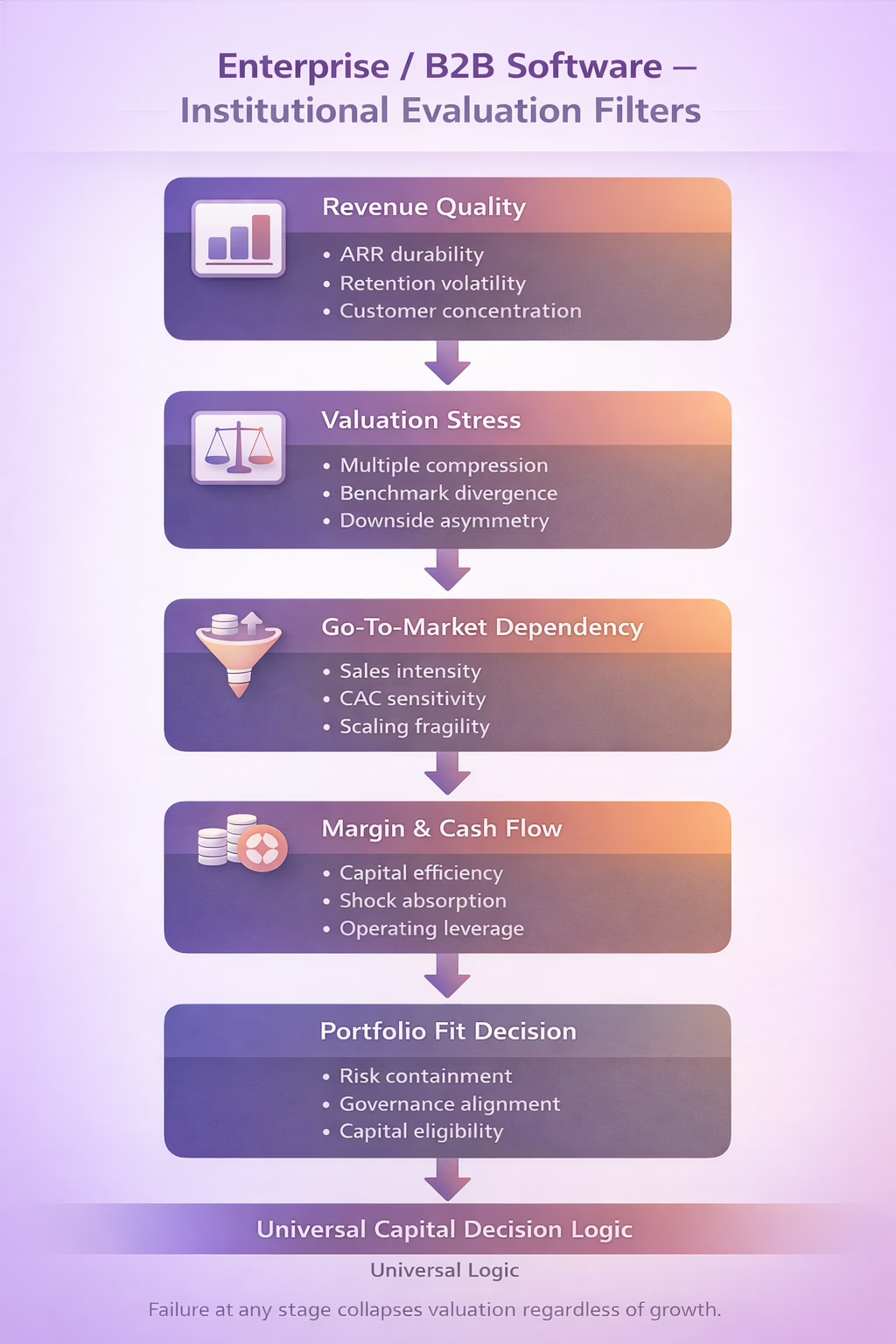
As a result, venture capital firms, private equity funds, and late-stage allocators evaluate enterprise SaaS less as a “growth story” and more as a long-duration cash-flow instrument whose reliability must survive cycle compression, multiple contraction, and liquidity constraints.
Valuation Integrity and Multiple Compression Risk
Institutional reviewers do not ask whether a valuation is “competitive.” They ask whether it is survivable.
Enterprise software valuations are evaluated against benchmarks, public company comparables, and median versus top-quartile performance — not to justify price, but to test downside exposure. High multiples are treated as leverage.
Failure commonly occurs when valuation is dependent on forward growth assumptions without corresponding evidence of durable revenue, margin stability, and customer retention. When valuation requires perpetual acceleration to hold, capital views it as structurally unstable.
Revenue Quality, Recurrence, and Retention Filters
Recurring revenue is not assumed to be durable. Reviewers dissect ARR or MRR to determine how much is truly recurring versus behaviorally optional.
B2B SaaS companies fail this filter when retention is propped up by discounting, professional services dependency, or narrow customer bases. Net revenue retention, churn volatility, ACV concentration, and customer success maturity are examined as indicators of revenue reliability — not growth potential.
Revenue that scales but does not persist is treated as transient, regardless of top-line size.
Go-To-Market Dependency and Scalability Risk
Enterprise software is constrained by how it sells. Institutional capital evaluates go-to-market strategies as risk vectors, not growth engines.
Heavy reliance on founder-led sales, bespoke enterprise deals, long procurement cycles, or high customer acquisition cost relative to lifetime value raises questions about scalability under capital discipline.
Common failure modes include growth that collapses when sales intensity is reduced, or unit economics that only function at sub-scale. Scaling that requires proportional effort is not considered scalable.
Margin Structure, Cash Flow, and Capital Efficiency
Margins are read as shock absorbers. Reviewers assess whether gross margin, contribution margin, and operating leverage can withstand slower revenue growth or pricing pressure.
SaaS businesses fail this filter when margin narratives rely on future efficiency rather than demonstrated cash-flow discipline. Capital efficiency matters more than absolute growth rate once scale is reached.
Strong cash flow and controlled burn are interpreted as governance signals, not merely financial outcomes.
Integration, Lock-In, and Product Dependency
Enterprise adoption is evaluated through integration depth, switching costs, and operational embedment. Products that sit “on top” of workflows are treated as optional; products that sit inside workflows are treated as durable.
Risk increases when value is dependent on external platforms, unstable APIs, or non-proprietary technology. Reviewers look for structural lock-in, not feature differentiation.
Software companies that cannot demonstrate defensible integration positions are discounted regardless of growth metrics.
Sector-Specific Failure Modes in Enterprise Software
Common structural rejection reasons include:
- Valuations unsupported by durable revenue quality
- Churn volatility masked by new customer acquisition
- High multiples dependent on continuous venture capital support
- Go-to-market models that do not scale under cost pressure
- Margin structures that collapse outside growth phases
- Customer concentration that introduces binary downside risk
These are not fixable within the evaluation frame; they are disqualifying conditions.
Role of Artifacts in Enterprise Software Evaluation
Pitch decks, financial models, and supporting documents function as validation tools, not persuasion instruments.
They are used to verify consistency between stated valuation, observed metrics, and benchmarked performance. Artifacts can confirm governance maturity, reporting discipline, and internal coherence.
They cannot compensate for weak revenue durability, unstable retention, or misaligned valuation logic. No artifact changes the underlying risk profile once identified.
Connection to Universal Capital Logic
Enterprise and B2B software evaluation is a sector-specific expression of universal capital decision logic: downside containment, durability of cash flows, governance credibility, and portfolio fit.
While metrics, multiples, and benchmarks differ in form, the underlying allocator logic remains unchanged. This sector simply concentrates risk into fewer variables with faster failure modes.
Enterprise and B2B software does not alter how institutional capital decides — it simply compresses risk into fewer variables, making the underlying universal institutional capital allocation logic visible faster and enforced more aggressively.
